
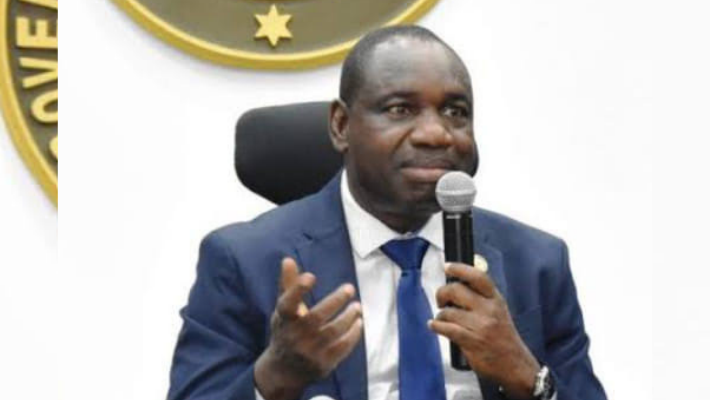
The Lagos State government says it has generated about N1.7 trillion in internally generated revenue (IGR) to finance critical infrastructure and social services across the state.
The Commissioner for Information and Strategy, Gbenga Omotoso, disclosed this on Friday during a media parley in Alausa, Ikeja.
Mr Omotoso said the administration of Governor Babajide Sanwo-Olu remained committed to delivering development projects and improving residents’ living standards despite approaching the end of its tenure.
He cited investments in transportation, healthcare, road infrastructure and security as evidence of the administration’s commitment to sustainable development.
The commissioner identified the ongoing construction of the New Massey Street Children’s Hospital as one of the major investments aimed at expanding access to healthcare.
He said the original facility, established in 1914 as a general hospital, had become inadequate to meet the healthcare needs of the growing population.
According to him, the new hospital would strengthen the state’s capacity to provide specialised healthcare services for children.
Mr Omotoso said the administration had also improved the business environment through the harmonisation of taxes and levies to address multiple taxation.
He said Lagos had moved to first position in the ease-of-doing-business ranking, attributing the improvement to deliberate government reforms.
The commissioner said the government was working with the Lagos State House of Assembly to further streamline taxation and eliminate arbitrary collections.
On transportation, Mr Omotoso disclosed that the Blue Rail Line had recorded about nine million passenger journeys and 70,000 trips since commencing operations.
He said commuters now travelled between Mile 2 and Marina within 13 to 15 minutes, compared with the previous two-and-a-half to three hours.
He added that the Red Rail Line had reduced travel time between Agbado and Oyingbo to approximately 30 minutes.
“These are some of the things that have changed the way people move around Lagos. What used to take hours can now be achieved within minutes,” he said.
Mr Omotoso said the state’s waterways transportation fleet had increased from about seven boats at the inception of the administration to at least 32 vessels.
He said the European Union-supported Omi Eko Project would further expand water transportation across the state.
The commissioner said 500 last-mile buses, additional high-capacity buses and 24 newly arrived Red Line coaches would further strengthen public transportation.
He acknowledged the contributions of private transport operators in meeting the needs of the state’s estimated population of between 25 million and 30 million.
Mr Omotoso, however, said the government would sustain enforcement against unroadworthy vehicles to protect commuters.
“We cannot allow rickety vehicles to continue operating on our roads.
“The Vehicle Inspection Officers are already removing such vehicles because the safety of residents is important,” he said.
The commissioner also cited the recent inauguration of the Ijegun-Ijagemo Road in Alimosho as evidence of the administration’s sustained infrastructure development drive.
He said investments in infrastructure and security had strengthened Lagos’ position as a major financial, entertainment and technology hub in Africa.
On recurring fire incidents, Mr Omotoso attributed many outbreaks to negligence and the improper handling and storage of combustible materials, including petrol.
He said the Lagos State Fire and Rescue Service had intensified public enlightenment campaigns, particularly ahead of the dry season.
The commissioner urged residents and traders to comply with safety regulations and exercise caution when handling combustible materials.
On flooding, Mr Omotoso identified indiscriminate refuse disposal, construction on drainage channels and encroachment on waterways as major contributing factors.
He said successive administrations had continued to expand and maintain the state’s drainage infrastructure.
“Government cannot do everything alone. Residents must also play their part by ensuring that they do not dump refuse in drainage channels or build on waterways,” he said.
Mr Omotoso cited the removal of obstructions along a waterway in Ogombo as part of efforts to improve water flow and mitigate flooding.