
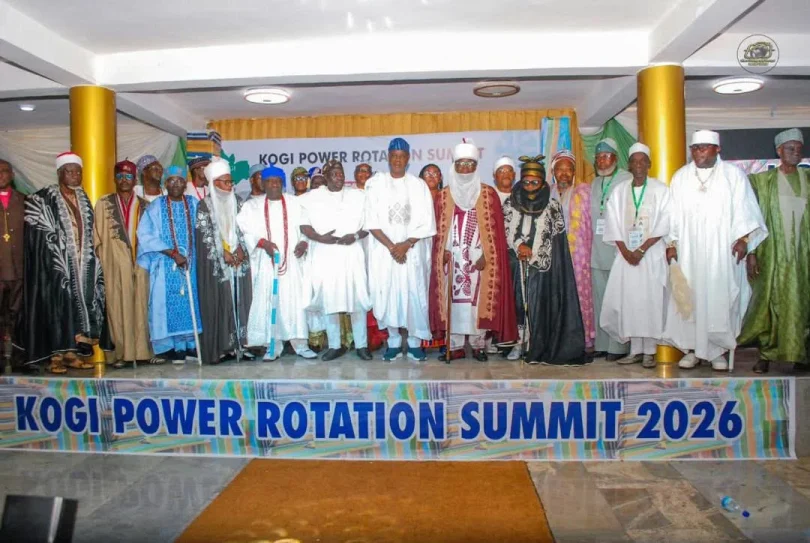
Stakeholders from Kogi State’s three senatorial districts have endorsed political power rotation as a mechanism for promoting equity and inclusion, with the majority of delegates at a two-day summit favouring Governor Ahmed Usman Ododo completing two terms before rotation begins in 2032.
The position was contained in the communiqué issued at the end of the maiden Kogi State Power Rotation Summit held from September 30 to October 1, 2026, at the Kay Galaxy Event Centre, Lokoja.
The summit, organised by the Kogi Unity Accord under the theme, “Retooling Kogi for Unity, Equity and Shared Prosperity,” brought together traditional rulers, religious leaders, politicians, community and socio-cultural organisations, professionals, organised labour, youths, students and civil society groups.
According to the communiqué, the majority of delegates supported an eight-year rotational arrangement, with 2032 proposed as the commencement date.
ALSO READ: Nigeria@66: Sokoto PDP guber candidate urges unity, peaceful coexistence
The delegates said beginning the arrangement in 2032 would allow sufficient time for legislation, wider consultations and the development of an appropriate legal framework, while also allowing the incumbent governor to complete his constitutionally guaranteed second term, if re-elected.
The summit, however, acknowledged that the proposal would require further consultations, consensus-building and compliance with constitutional, electoral and democratic processes.
It noted that the 1999 Constitution, as amended, does not expressly provide for the rotation of governorship among senatorial districts, stressing that any eventual arrangement must operate within lawful political and institutional processes.
The summit also emphasised that power rotation should not override considerations of competence, integrity, capacity, accountability and leadership ability.
“The Summit recognised that power rotation could serve as a mechanism for promoting fairness, unity, peaceful coexistence and a stronger sense of belonging among the people of Kogi State,” the communiqué stated.
However, the proposed 2032 commencement date was not universally supported. Some delegates and organisations called for power to move to Kogi West immediately after the expiration of the incumbent governor’s tenure.
President of the Okun Development Association, Ambassador Rotimi Akenson, argued that Kogi West had not produced a governor since the creation of the state and should therefore be considered in the next succession arrangement.
The Christian Association of Nigeria representative at the summit similarly advocated an equitable rotational arrangement that would see power move to Kogi West after the incumbent’s tenure.
The representative also expressed a preference for a Christian governor, citing ethnic and religious considerations.
The divergent positions highlighted the continuing debate over both the timing and structure of power rotation in the state.
A major development at the summit came from the Kogi State House of Assembly, whose Speaker, Rt. Hon. Aliyu Umar Yusuf, said the legislature was prepared to consider legislation providing a framework for power rotation.
Yusuf said the matter would require careful consideration, adding that the views of stakeholders would be taken into account in the legislative process.
If enacted, such legislation could provide an institutional framework for a debate that has largely remained within the realm of political advocacy and convention.
Governor Ododo, represented at the summit by Commodore Jerry Omodara (Rtd.), urged stakeholders to sustain political dialogue without compromising peace and stability in the state.
Ododo said Kogi’s diversity should be viewed as a strength and called for greater trust, inclusive dialogue and peaceful political engagement ahead of future elections.
He also urged youths to reject political violence and encouraged political actors to resolve differences through dialogue.
Chairman of the summit, Vice Admiral Joseph Ajayi (Rtd.), described the gathering as an important step in addressing questions of political inclusion and succession in the state.
He called for a structured framework that would promote inclusion and reduce political tensions and ethnic rivalry.
Also speaking at the summit, former Deputy Comptroller-General of the Nigeria Customs Service, Sir Kehinde Ejibunu, urged stakeholders to take the aspirations of minority groups into account in any power-sharing arrangement.
“We want the state to be together; we don’t want it to be set ablaze,” he said. The summit recommended the development of a Kogi Charter of Equity and Inclusion to guide political participation, representation and peaceful engagement across the state.
It also proposed a follow-up mechanism, expansion of the Kogi Unity Accord, establishment of zonal structures and continued consultations across Kogi East, Kogi Central and Kogi West.
Traditional rulers, religious leaders, women, youths, professional associations, political actors and community organisations were urged to remain engaged in the process.
The summit further called for the protection of minority tribes and communities against political marginalisation, while urging that elective offices and political appointments reflect equitable representation and the spirit of federal character.
The communiqué stressed that the resolutions should be regarded as the beginning of a sustained dialogue rather than the conclusion of the power-rotation debate.
With the majority of delegates backing an eight-year rotation beginning in 2032, while some stakeholders are advocating an earlier transfer of power to Kogi West, political succession and the structure of power-sharing are set to remain major issues in Kogi’s political discourse.