
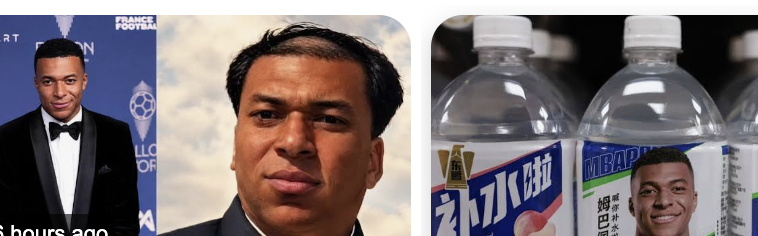
JUST IN: As Expected, Kylian Mbappé Apologises Over Mao Remark After Backlash In China
Kylian Mbappé has apologised for what he described as “ill-judged” comments about former Chinese leader Mao Zedong after several Chinese brands reportedly ended their partnerships with the Real Madrid forward.
The French striker faced criticism in China after comments he made during an appearance on French talk show The Bridge, where he discussed an internet meme showing his face superimposed on an image resembling Mao.
The meme forms part of an online joke referring to Mbappé as a “dictator” because of his influence in football.
“My comment was ill-judged, and I now understand that it hurt many people in China and in Chinese communities around the world,” Mbappé said in a statement.
“I apologise to everyone my words have upset.”
Spain’s La Liga also apologised over the controversy, saying it “deeply regrets the offence that Kylian Mbappé’s recent comments have caused among Chinese fans”.
The controversy gained momentum on Monday night after Chinese football forum Dongqiudi drew attention to the comments, describing them as “inappropriate” and saying they “hurt the feelings of Chinese people”.
Screenshots of the video and meme subsequently circulated on Chinese social media, with some users calling for a boycott of Mbappé and his club, Real Madrid.
Dongqiudi said it was “unable to translate” his comments because they were “offensive to China and the Chinese people”.
The original video is no longer available on the programme’s YouTube channel, and it remains unclear when the interview, hosted by Real Madrid midfielder Aurélien Tchouaméni, was first broadcast.
In clips circulating online, Mbappé does not mention Mao by name but says he “uses [the meme] with friends all the time”.
Some Chinese social media users have questioned the footballer’s comments, accusing him of benefiting from the Chinese market while making remarks that offend the public.
“International public figures, in particular, should show greater respect and sensitivity, as national sentiment must never be taken lightly,” one comment on Weibo read.
Several Chinese companies subsequently announced positions distancing themselves from conduct considered offensive to the country, although their statements did not explicitly mention the video.
Mengniu, China’s largest dairy producer, said it “firmly opposes and has a zero-tolerance policy towards any words or actions that hurt the feelings of the Chinese people”.
Drinks company Dongpeng issued a similar statement, saying, “Our company firmly opposes and has a zero-tolerance policy towards any behaviour that offends national sentiments.”
According to state-owned newspaper The Global Times, China’s state broadcaster CCTV will no longer feature content related to Mbappé on its news applications. Chinese media also reported that CCTV would stop broadcasting La Liga matches.
China’s Foreign Ministry also reacted to the controversy, with spokesperson Lin Jian saying the government had noted reports about the incident.
“We have noted the relevant reports. Words and deeds that hurt the feelings of the Chinese people will naturally be met with opposition from all sectors of Chinese society,” Jian said.
By 14:00 local time on Tuesday, five of the 10 most discussed topics on Weibo centred on Mbappé, with the hashtag “multiple brands terminate partnerships with Mbappé” topping the list.
One of the popular comments on the platform read, “Don’t ever come to China.”
Mao, who founded the People’s Republic of China in 1949, remains a sensitive figure in the country because of his rule and the mass suffering associated with policies introduced during his leadership.
His Great Leap Forward campaign contributed to a devastating famine that killed tens of millions of people, while the Cultural Revolution led to widespread persecution and violence.
Despite the human cost of his rule, Mao remains a national icon in the official historical narrative promoted by China’s Communist Party.
The controversy comes as China remains an important market for international sports personalities, with local companies signing multimillion-dollar endorsement deals with athletes, including Mbappé, Norwegian striker Erling Haaland and NBA player Stephen Curry.
Mbappé has previously acknowledged concerns about memes comparing him to authoritarian leaders.
In an interview with France Football in September, he said some of the jokes revealed “a lack of political and human awareness among people”.
“There’s a side that’s a bit less funny, because we know the damage people like that have caused throughout history,” he said.
“Being compared to people who murder others, or who have made millions upon millions of people miserable… I don’t think I’ve done that in my life.”