
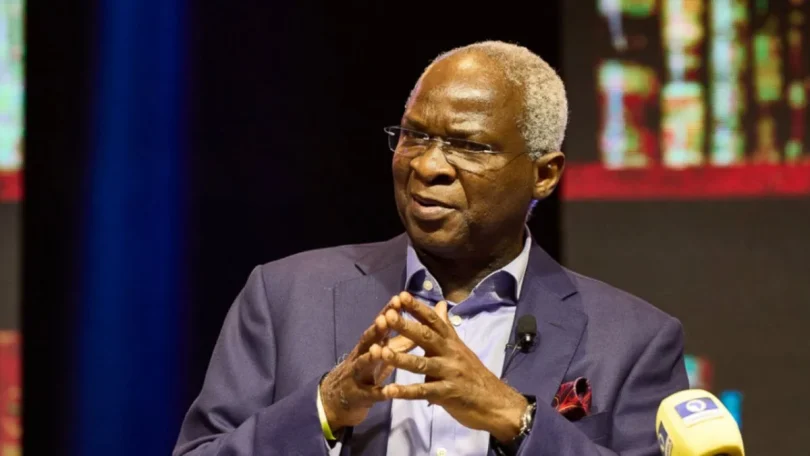
Former minister of Works and Housing, Babatunde Fashola, has described the presidential candidate of the African Democratic Congress (ADC), Atiku Abubakar’s proposal to restore fuel subsidy if elected in 2027 as unrealistic.
Fashola questioned the availability of crude oil to sustain Atiku’s proposed subsidy regime, arguing that the country’s existing challenges with oil production, pipeline vandalism and insecurity could undermine its implementation.
The former Lagos state governor spoke on Tuesday during an appearance on Channels Television’s Politics Today, where he challenged Atiku to explain how he intended to secure enough crude oil to support domestic refineries and maintain the subsidy policy.
“If we have refineries working, what is our current oil quota? Are we optimising it yet? No, because they are legacy issues, challenges with security people, vandalism. So where is this magic crude oil going to come from? People are entitled to ask,” he said.
Fashola insisted that Atiku must provide details of how he intends to implement the proposal, stressing that Nigerians should be able to assess its feasibility before deciding whether to support it.
“If he can explain, good, let the people choose. But without proof, it is like abracadabra. Because the reality that will come then is that he will say that, ‘I didn’t know that there was not enough crude oil.’ That was what happened,” he added.
Asked whether he considered Atiku’s proposal feasible, Fashola replied: “The proposal is not realistic. I am looking at the proposal, not the personality.”
He also questioned Atiku’s credibility, recalling that the former vice president had supported the removal of fuel subsidy ahead of the 2023 presidential election.
“In this environment, it is very easy to throw promises at people. When the rubber hits the road, reality sets in. First question is, in 2023, didn’t he see through this when he was making the promise to remove the subsidy? And that goes to a question of credibility. Those who believe at face value that promise, he will come back and tell you that, ‘Oh, I changed my mind. I didn’t think through it,’” he said.
Fashola further argued that restoring the subsidy would require legislative action rather than a presidential declaration, noting that lawmakers would have to amend existing legislation to make the policy lawful.
“Subsidy is not just about, ‘I said it.’ It will come down to the real economy, and legislators will have to repeal a law to say subsidy is now lawful. How many legislators are ready to stake their election on going back to subsidy? Those are the real issues,” he said.
He maintained that Atiku needed to explain what had changed since the 2023 election to justify his renewed support for the policy, particularly given the financial implications.
“Is it because people are impacted? It’s true. But what are you going to do differently? Where are you going to find the money to sustain what you are offering? It’s not sustainable,” he said.
The former minister, who served under former President Muhammadu Buhari, also recalled the financial difficulties state governments experienced when the federal government was paying fuel subsidy. He warned that restoring the arrangement could leave states with reduced allocations and force some governments to borrow to pay salaries.
“I was in a government that was paying subsidy, and the states were not getting money. So are we going to go back to partial, near-zero returns, states borrowing money to pay salaries? Is that where you want us to go?” he asked.
In August 2026, Atiku pledged to restore fuel subsidy if elected president in 2027. However, he proposed a time-bound and audited arrangement tied to locally refined petroleum products rather than a return to the former import-dependent system.
He argued that the policy would reduce petrol, transportation and food costs while easing the economic hardship faced by Nigerians.
President Bola Tinubu announced the removal of fuel subsidy during his inauguration on May 29, 2023, citing its rising cost to government finances. The decision, alongside the unification of the foreign exchange market, contributed to increased petrol prices and living costs.
Atiku has repeatedly criticised the administration over the economic consequences of the reforms, while Tinubu and the ruling All Progressives Congress (APC) have opposed his proposal, warning that a return to subsidy could reverse the government’s fiscal gains.
Meanwhile, Fashola dismissed concerns about Tinubu’s physical and mental fitness to govern, insisting that he had seen nothing to suggest that the president was incapable of performing his duties.
He said Tinubu remained mentally alert and actively involved in government affairs despite his age, pointing to the president’s continued engagement with official documents and administrative responsibilities.
“Nothing suggests to me that he’s not fit for it. Yes, he’s older. That doesn’t mean his mental capacity is gone. He’s still giving directives. And when I see him, he’s working. He’s still reading, authorising, minuting on things,” Fashola said.
Fashola, who worked closely with Tinubu during his eight-year administration as Lagos State governor between 2007 and 2015, also described the president as more experienced and mature than he was when they first worked together.
Asked to compare the Tinubu he knew in the early 2000s with the president he knows today, Fashola said:
“Well, a much more mature one, certainly, without doubt. I am not the chief of staff he employed in 2002. That’s 39 years. I was 39 then. I’m 63 now. So we must give him that credit for the experience he has gained,” he said.
The former governor acknowledged that Tinubu might no longer maintain the same work routine he had in previous years, particularly regarding late-night activities, but maintained that the president remained capable of handling demanding responsibilities.
“Maybe not keeping late nights that he used to do. I’m not sure. He can still run the engine,” he added.