
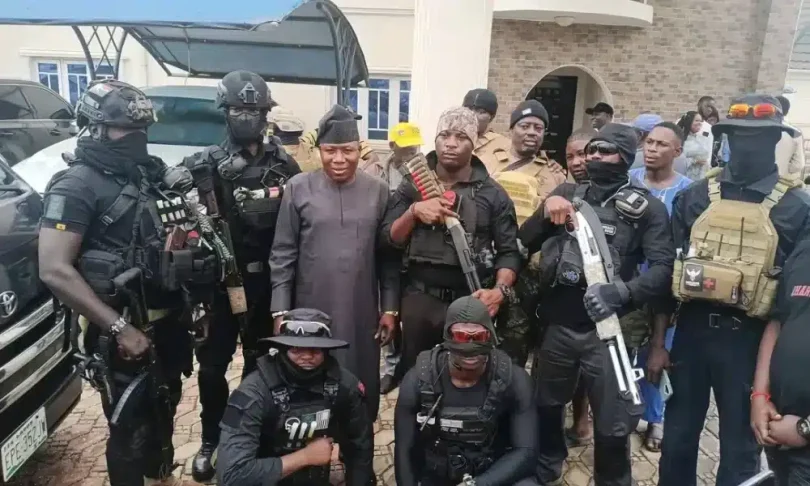
There was a time when the mere mention of Sunday Igboho divided Nigeria into two camps.
To some, he was a fearless defender of the Yoruba people, a man who dared to confront insecurity when many believed government had failed.
To others, he was the face of separatist agitation, a symbol of the growing calls for the break-up of Nigeria through the Yoruba Nation movement.
For years, that image hardly changed.
His speeches centred on self-determination.
His rallies attracted thousands.
His clashes with security agencies became national headlines.
His name was mentioned alongside conversations about restructuring, regional autonomy and the future of the Nigerian federation.
But in recent months, something appears to have shifted.
Not necessarily his passion. Not necessarily his grievances.
But perhaps the direction of his fight.
The launch of the Iru Ekun Security Network has raised a question many Nigerians may never have imagined asking:
Has Sunday Igboho quietly moved from fighting for Yoruba Nation to fighting for Nigeria?
Or is this simply the same struggle wearing a different uniform?
The answer depends on who you ask.
The Man Who Became A Symbol
Sunday Adeyemo, popularly known as Sunday Igboho, did not become nationally known because he wanted political office.
He became famous because of insecurity.
Around 2020 and 2021, violent attacks, kidnappings and killings across parts of the South-West pushed many communities to breaking point.
Farmers abandoned their lands.
Travellers avoided highways.
Entire villages lived in fear.
While many politicians issued statements, Igboho did something different.
He went to communities.
He addressed crowds.
He publicly accused some criminal elements of terrorising Yoruba communities and demanded that they leave.
Those actions transformed him overnight.
To admirers, he represented courage.
To critics, he represented vigilantism and ethnic profiling.
To the Federal Government, he became a man under intense scrutiny.
His residence in Ibadan was later raided by operatives of the Department of State Services (DSS) in July 2021. Two of his associates were killed during the operation, several others were arrested, and Igboho fled Nigeria before he was eventually arrested in neighbouring Benin Republic.
That period cemented his image as one of the most controversial figures in Nigeria’s modern political history.
From Secession To Security?
For years after those events, conversations around Sunday Igboho were almost always about Yoruba Nation.
Could the South-West become independent?
Would the agitation grow stronger?
Would the movement survive?
But the emergence of the Iru Ekun Security Network introduces a different conversation.
Instead of talking about borders…
The discussion has shifted to bandits.
Instead of independence…
The conversation is increasingly about community policing.
Instead of political separation…
The focus appears to be protecting lives.
That distinction matters.
Whether intentional or not, the conversation surrounding Igboho has changed.
Why Security Has Changed Everything
Nigeria today is not the Nigeria of 2021.
Insecurity has spread beyond traditional flashpoints.
Kidnappings are no longer confined to one region.
Communities across the North, South-West, South-East, North-Central and South-South have all experienced varying forms of violent attacks.
The fear that once pushed Igboho into the national spotlight is no longer viewed as a uniquely Yoruba concern.
It has become a Nigerian concern.
Perhaps that explains why a security outfit such as Iru Ekun resonates beyond regional politics.
Security is one issue almost every Nigerian understands.
Everyone knows someone afraid to travel.
Everyone knows communities that have changed because of violence.
Everyone has watched the country debate whether existing security agencies have enough personnel to secure more than 220 million people.
Against that backdrop, conversations about community-based security have become increasingly common across different parts of Nigeria.
Then Came The Ooni
The turning point may have come when the Ooni of Ife, Oba Adeyeye Enitan Ogunwusi, publicly embraced the initiative.
The respected monarch did more than offer prayers.
He donated ₦100 million and a brand-new Toyota Hilux vehicle to the Iru Ekun Security Network.
More importantly, he publicly described the initiative as a necessary complement to existing security efforts.
His message was equally significant.
He called on traditional rulers, business leaders, professionals and other Yoruba stakeholders to support the project.
That endorsement changed the optics.
This was no longer simply Sunday Igboho’s project.
It had received backing from one of Yorubaland’s most influential traditional institutions.
A Different Kind Of Language
Perhaps the biggest difference lies in the language now being used.
There was a time when discussions surrounding Igboho focused heavily on political identity.
Now the vocabulary sounds different.
Community policing.
Intelligence gathering.
Crime prevention.
Protection of lives.
Cooperation with security agencies.
These are not the usual phrases associated with separatist movements.
Igboho himself has repeatedly stated that the Iru Ekun Security Network would operate within the law and work alongside relevant authorities.
Whether critics believe that assurance is another matter entirely.
Has The Mission Really Changed?
This is where opinions begin to diverge.
Supporters argue that nothing has changed except the strategy.
They insist that protecting Yoruba communities has always been the objective.
Whether that protection happens inside Nigeria or under an independent Yoruba Nation, they argue, is secondary.
Others disagree.
They believe the launch of a structured security outfit represents a subtle but significant shift away from separatist politics toward practical governance.
Instead of debating constitutional questions that may take decades to resolve, the emphasis appears to be solving today’s problems.
That distinction is important.
One approach seeks political change.
The other seeks immediate security.
Whether those two goals can coexist remains an open question.
Nigeria’s Bigger Problem
Perhaps this story isn’t really about Sunday Igboho at all.
Perhaps it is about Nigeria.
When citizens begin creating parallel security initiatives, what does that say about confidence in existing institutions?
When traditional rulers openly support community security structures, what message does that send?
When communities begin looking inward for protection, is that innovation…
Or is it evidence of something much deeper?
These questions extend far beyond Yorubaland.
Across Nigeria, several states already operate different forms of community or regional security outfits.
The South-West has Amotekun.
The South-East has local vigilante structures.
The North has various community protection groups.
The common thread is unmistakable.
Communities increasingly believe security requires local participation.
The Image That Nobody Expected
Just a few years ago, many Nigerians associated Sunday Igboho with one phrase: Yoruba Nation.
Today, another phrase is beginning to emerge: Community security.
Also Read: 2027: Accord party presidential candidate steps down, endorses Tinubu
Whether history ultimately remembers him as a separatist, a regional activist, a security advocate or all three may depend on what happens next.
The success or failure of the Iru Ekun Security Network will likely shape that legacy.
The Reality
Titles often simplify people.
Reality rarely does.
Sunday Igboho remains one of Nigeria’s most polarising figures.
Some still view him through the lens of separatist politics.
Others see a man responding to security failures many communities continue to experience.
Both perspectives exist.
Both have supporters.
Which brings us back to the question in the headline.
Has Sunday Igboho gone from fighting for Yoruba Nation to fighting for Nigeria?
Or has he simply found another way to fight for the same people he has always claimed to represent?
The answer may depend less on what he says…
And more on what the Iru Ekun Security Network eventually becomes.