
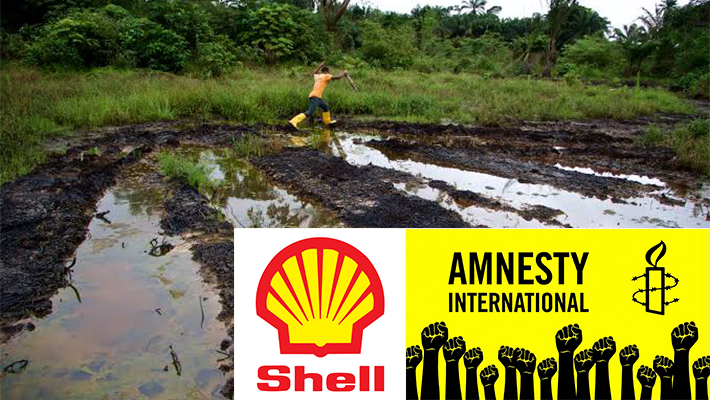
Shell Petroleum Development Company of Nigeria Limited (SPDC) was allegedly complicit in oil theft and environmental damage across communities in the Niger Delta through failures in pipeline management, including a lack of real-time pipeline monitoring and weak spill management that allowed it to continue oil production, internal company documents showed.
The documents, dated between 2008 and 2014, included emails, presentations, and confidential reviews disclosed in ongoing legal proceedings against the oil giant in the United Kingdom. They were analysed in a report by Amnesty International and a coalition of rights and environmental organisations.
The organisations said the documents uncovered “a wider human rights scandal than previously reported”. However, Shell has repeatedly insisted that devastating oil spills in the communities were primarily caused by oil bunkering.
Amnesty International published the report alongside The Corner House, Hawkmoth, HEDA Resource Centre, Kebetkache Women Development & Resource Centre, Miideekor Environmental Development Initiative (MEDI), Recommon, and Social Action.
The report’s details were highlighted in a statement by Amnesty International on Wednesday.
The organisations alleged that, despite presenting its operations as meeting global standards, Shell continued to operate in oil-rich communities with deteriorating infrastructure, exempted its Nigerian subsidiary from its global health, safety, and environment standards, neglected known pipeline integrity risks, and relied on weak leak-detection systems.
A top management official at Shell wrote in 2013 that the Nigerian Army accused the company of complicity in oil theft “because we are not removing the bunkering points”. The report also cited a presentation that year asking whether Shell was “comfortable to continue producing, knowing that further environmental damage will occur”.
According to the report, another email revealed that suspected workers and contractors were involved in oil theft, allowing illegal taps to remain on pipelines, with an email warning that “we have to work on the assumption that the bunkerers get good access to SPDC planning data”.
Internal audits also indicated a major maintenance backlog, weak oversight systems, and poor records on pipeline clamps that Shell had allowed to become permanent repairs on leaking pipelines, with more than 1,600 clamps registered, including older clamps whose locations were unknown.
The report also alleged that Shell failed to replace flowlines every 15 years as required and instead relied on “breakdown maintenance”.
A 2014 internal report showed that its then-CEO said “hundreds” of the firm’s onshore wells, as the company struggled to keep records, prompting a “well hunt campaign” that uncovered 750 overdue maintenance tasks, contributing to an “unsatisfactory” audit rating.
The report stated that key findings corroborated decades-long concerns about Shell’s operations following damage to homes, health, and fishing livelihoods in Niger Delta communities since 1958.
“Shell knew the risks from ageing and leaking infrastructure, including an old pipeline internally described as ‘a basket’, yet kept oil flowing,” the report explained. “It later decided to divest its onshore business rather than face the enormous cost of clean-up and decommissioning, including an internal US$10.9 billion decommissioning estimate.”
The report pointed out that the oil giant, despite replacing the Nembe Creek Trunk Line in 2010, failed to decommission the old one, with a 2014 internal email stating that it left 80km of the old pipeline filled with stagnant crude because of budget constraints, with the pipeline described as “a basket” in the email, which warned of more spills if urgent action was not taken.
The then-CEO estimated that decommissioning all Shell’s assets could cost $10.9 billion, excluding clean-up costs, and take decades. Another internal presentation showed that 375km² of mangrove forest had been damaged by pollution. Shell later sold SPDC to Renaissance Africa Energy in 2025, despite concerns about the buyer’s financial capability.
Amnesty International said it contacted Shell about its findings on July 3, but the company said the “characterisation and portrayal of Shell in your letter is not one we recognise”.
Shell expressed its commitment to honesty, integrity and respect for people and to conducting business ethically and transparently, and added that the findings failed to reflect the “challenging operating environment in the Niger Delta at the time”.
Peoples Gazette could not immediately reach SPDC spokesperson Gladys Afam-Anadu for comments.
Isa Sanusi, the director of Amnesty International Nigeria, maintained that even though Shell blamed oil theft for environmental damage, its internal documents raised “grave questions about what Shell knew, what it allowed to continue, and whether it then sought to walk away from the costs of its toxic legacy”.
Olanrewaju Suraju, chairman of the HEDA Resource Centre, pointed out that Shell “cannot be allowed to take the oil, take the profits and leave the pollution behind”.
“Communities in the Niger Delta deserve truth, justice, clean-up and full remedy,” stated Mr Suraju.
In 2015, the Bille and Ogale communities in Rivers State filed separate lawsuits against Shell in UK courts over oil pollution. The cases are ongoing.