
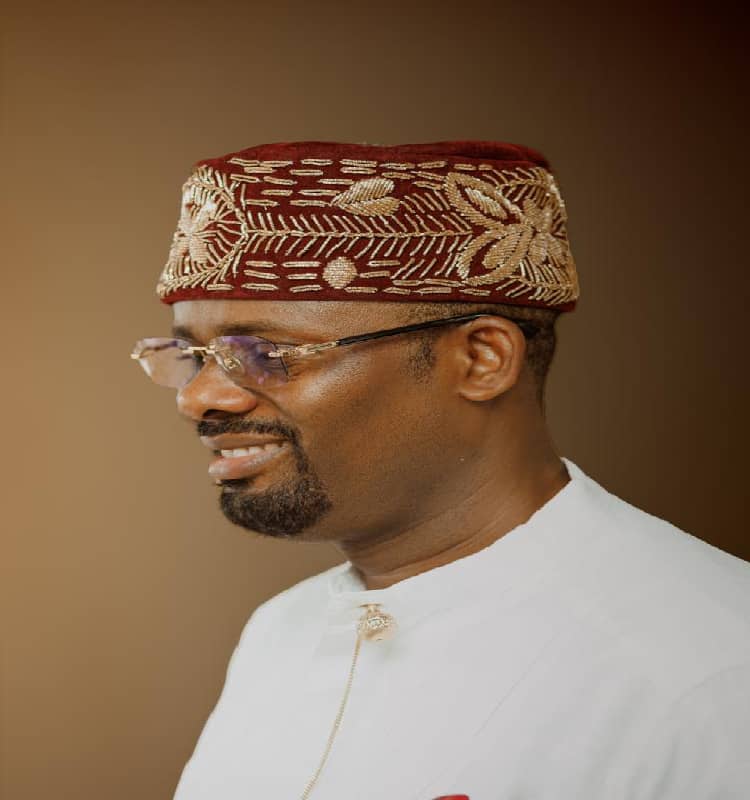
Michael Olomu, public policy professional, has described his journey into national relevance as one shaped deliberately by education, activism and lived experience.
He holds a doctorate in criminology and security studies from Federal University, Otuoke, awarded in 2025, alongside a master’s degree in sociology and anthropology from the University of Port Harcourt and a bachelor’s degree in sociology from Niger Delta University.
Olomu’s earliest academic preparation also included a certificate in accounting education from Waziru Umaru Polytechnic, Kebbi state.
His first encounter with national politics occurred unexpectedly on October 30, 2005, during the funeral of Stella Obasanjo, former first lady, in Abeokuta, Ogun state.
At the time a student activist, Olomu travelled to the burial as part of a National Association of Nigerian Students (NANS) delegation officially invited in recognition of his organising work.
The invitation exposed him to senior political actors because Stella Obasanjo served as a matron of the student body.
Akinjo Kolade Vakama, presidential aide on student matters, introduced him to Timipre Sylva, former Bayelsa governor, during the event.
During their brief exchange, Olomu asked Sylva, then a governorship aspirant, “If you win, what role would I play?”
Sylva responded immediately by promising to appoint him as special assistant on student affairs.
Following the burial, Sylva returned to Bayelsa to pursue his campaign, while Olomu resumed his studies and later commenced national service in Bauchi state.
HIS POLITICAL JOURNEY
Despite the distance, Olomu travelled repeatedly between Bauchi and Yenagoa to mobilise youth and student networks for Sylva’s campaign under the Peoples Democratic Party (PDP).
His activism was shaped by a strong anti-cultism stance, which he said informed his rejection of violence and secret confraternities on campuses.
Olomu’s advocacy relied on dialogue and negotiation, qualities he later said defined his approach to governance.
His fluency in English, Izon, Igbo, Hausa and Yoruba allowed him to build alliances across ethnic and regional lines.
After Sylva’s election as governor, Olomu’s transition from activism to governance was cemented by an unplanned incident at the Government House in Yenagoa.
Emmanuel Iwuanyanwu, elder statesman, contacted Olomu while trying unsuccessfully to reach the governor.
Security personnel granted Olomu access to the governor’s office, where Sylva declared, “The person I will appoint as my Senior Special Assistant on Student Affairs had just walked in.”
Before this appointment, Olomu had served as personal assistant on the students’ desk under Princewill Igbagara, special adviser on higher education, during Goodluck Jonathan’s administration as Bayelsa governor.
The role prepared him for responsibilities including bursary coordination, scholarship administration and student-government liaison.
As senior special assistant, Olomu persuaded the government to reinstate student bursaries through phased implementation despite financial constraints.
He expanded the scheme to cover Bayelsa students studying across Nigeria and abroad, personally visiting some institutions to assess welfare and academic progress.
The Bayelsa State Students’ Union Council later honoured him for his contributions to youth development.
His tenure faced controversy when a journalist, Olumo, published an article critical of the governor.
Security officials mistakenly believed Olumo was related to Olomu and asked him to arrange a meeting.
Unaware of the plan to arrest the journalist, Olomu facilitated the meeting at Igbagara’s residence, where Olumo was detained.
Olomu later testified in court, declaring the journalist innocent and explaining how he had been misled.
The court eventually acquitted Olumo, reinforcing Olomu’s belief that public service must not compromise truth.
Sylva later stated that he expected his aide to speak honestly despite political pressure.
After leaving office in 2012, Olomu returned to private life while continuing community engagement and mentoring young leaders.
He joined Omega Fire Ministry’s multimedia department and worked closely with Johnson Suleman, general overseer.
His media work earned him the ministry’s Excellence in Multimedia Communication Award.
Through Suleman, Olomu was introduced to Rotimi Amaechi, former minister of transportation, who connected him to Nsima Ekere, former managing director of the Niger Delta Development Commission (NDDC).
Between 2016 and 2018, Olomu served as senior special assistant on special duties at the NDDC.
He raised concerns over what he described as inequitable project allocation away from Bayelsa despite its oil-producing status.
When confronted over leaked remarks, Olomu defended his position as advocacy rather than insubordination.
Civil society groups later recognised him with a leadership award for equity and accountability.
Under subsequent NDDC leaderships, Olomu held multiple roles, including special assistant on student affairs, projects, FCT affairs and national assembly matters.
During funding delays and legislative disputes, he engaged political and religious leaders to restore institutional stability.
His refusal to confirm the delivery of a bribe he said he never received led to mounting pressure and eventual resignation on July 20, 2020.
Although media reports framed his exit within corruption investigations, associates described it as a principled withdrawal.
After a period of reflection, Olomu returned to public service following encouragement from Effiong Akwa, former NDDC managing director, and Olubunmi Tunji-Ojo, minister of interior.
He accepted the role of special assistant on national assembly matters, helping to resolve prolonged disputes between the commission and lawmakers.
Throughout his career, Olomu maintained cross-party, interfaith and multi-ethnic relationships anchored on integrity.