
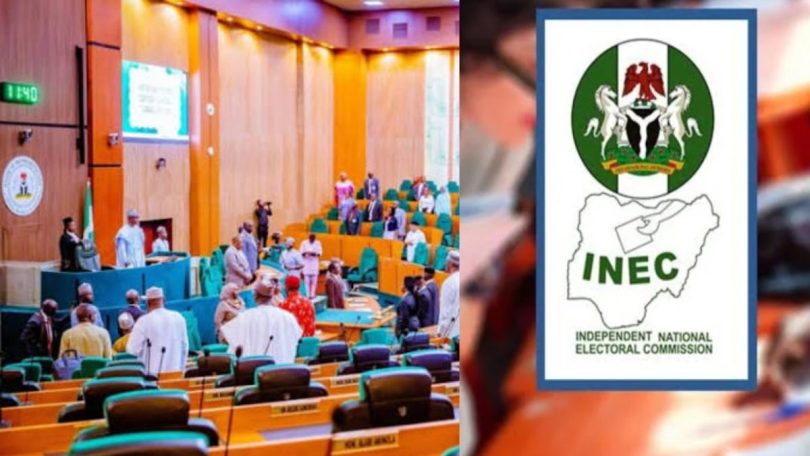
The House of Representatives has directed the Chairman of the Independent National Electoral Commission (INEC) to appear before its Committee on Electoral Matters to explain the commission’s preparedness for the 2027 general elections.
Politics Nigeria reports that the decision followed a debate during Wednesday’s plenary, where lawmakers examined the steps being taken by the electoral body to ensure credible, transparent and inclusive elections across the country.
The lawmakers agreed that INEC must provide clear answers on its readiness, particularly in areas involving voter registration, public awareness, election logistics, technology, personnel training, security arrangements and funding.
They also stressed the need for the commission to implement its election timetable without unnecessary delays.
The motion was jointly sponsored by the House Minority Whip, Mansur Manu Soro, and Abdussamad Dasuki.
It sought a comprehensive assessment of INEC’s preparations ahead of the nationwide polls.
During the debate, Soro argued that the credibility of the 2027 elections would depend largely on how well the commission prepares for the exercise.
He maintained that early planning was necessary to prevent avoidable challenges that could affect the conduct and acceptance of the elections.
The House noted that the 1999 Constitution, as amended, and the Electoral Act, 2022, place the responsibility for organising, conducting and supervising elections on INEC.
The lawmakers cited Sections 76, 116, 132 and 178 of the Constitution, alongside Part I of the Third Schedule, in support of the commission’s constitutional responsibilities.
They maintained that the electoral body must demonstrate its capacity to discharge these duties effectively, especially as preparations for the next general elections gather momentum.
The lawmakers also pointed to the recently concluded Ekiti State governorship election as an opportunity to assess electoral administration in Nigeria.
They said the experience provided lessons on logistics, technology deployment, security coordination, stakeholder engagement and voter participation that should guide preparations for the 2027 polls.
However, the proposal generated disagreement over whether the INEC Chairman should address the entire House during plenary or appear before the relevant committee.
Deputy Speaker Benjamin Kalu opposed the suggestion that the commission’s chairman should be invited to address the full chamber.
Although he acknowledged the importance of the motion, he argued that the House should adopt an approach that would strengthen public confidence in democratic institutions while allowing lawmakers to carry out their oversight responsibilities.
Kalu described the motion as well-written but suggested that some of the concerns raised had already been addressed by the INEC Chairman during a recent public presentation.
He said: “The fulcrum of our democracy, which is the Parliament, has a core duty, which is to strengthen the belief in our democracy, which is to ensure that the advancement of our democracy is ensured.”
The Deputy Speaker further argued that lawmakers should take into account the commission’s public explanations before concluding that there were outstanding concerns about its preparations.
“It appears that the presentation made by the chairman of INEC not too long ago to the public addressing some of these concerns, some of these possible questions, were not listened to by my honourable colleague,” Hon Kalu said.
According to Kalu, INEC had not raised complaints about logistics and had commenced its recruitment process on time.
He also said the commission had not expressed concerns over the deployment of technology for the forthcoming elections.
He subsequently proposed an amendment directing the INEC Chairman to appear before the House Committee on Electoral Matters.
He maintained that the committee could examine the commission’s plans in detail and obtain answers to questions raised by lawmakers.
Deputy Minority Whip Abdussamad Dasuki supported the amendment, explaining that the motion was intended to establish the commission’s level of preparedness and address potential challenges that could undermine participation in the 2027 elections.
Dasuki placed particular emphasis on the security situation in the country, warning that insecurity could affect the ability of some communities to participate in the electoral process.
He argued that preparations should take into account areas where violence and other security challenges could prevent voters from reaching polling units or disrupt the conduct of elections.
“On this floor, Mr Speaker, we have had unprecedented 255 security-related motions that are captured here, and we believe there are a lot of constituencies, a lot of polling units that will not be able to participate in the election,” Hon Dasuki said.
The lawmaker said the sponsors wanted INEC to explain how it planned to address such risks and ensure that eligible voters were not excluded from the elections because of insecurity.
His argument highlighted the need for coordination between INEC and relevant security agencies, particularly in areas where threats to public safety could affect election officials, voters and the movement of electoral materials.
Speaker Abbas Tajudeen, who presided over the session, cautioned lawmakers against allowing the disagreement to become a public contest.
He maintained that the committee should provide an appropriate platform for members to question the INEC Chairman and examine the issues raised in the motion.
Tajudeen also directed that the date of the proposed meeting should be made public so that interested lawmakers could attend, listen to the commission’s explanations and raise further questions.
The Speaker, however, disagreed with the suggestion that the number of security-related motions before the current Assembly automatically proved that insecurity had worsened compared with previous years.
He argued that the figures could also reflect lawmakers’ increased responsiveness to security concerns across their constituencies.
“We are all in agreement that the INEC Chairman should be invited by the committee to answer questions from the members,” the Speaker ruled.
Following the ruling, the motion was referred to the House Committee on Electoral Matters for further legislative action.
The committee will invite the INEC Chairman to provide details of the commission’s preparations and respond to concerns raised during the debate
Although the House did not direct the INEC Chairman to address the full chamber, the decision to refer the matter to the committee means the commission will be required to answer questions through the legislature’s established oversight process.