
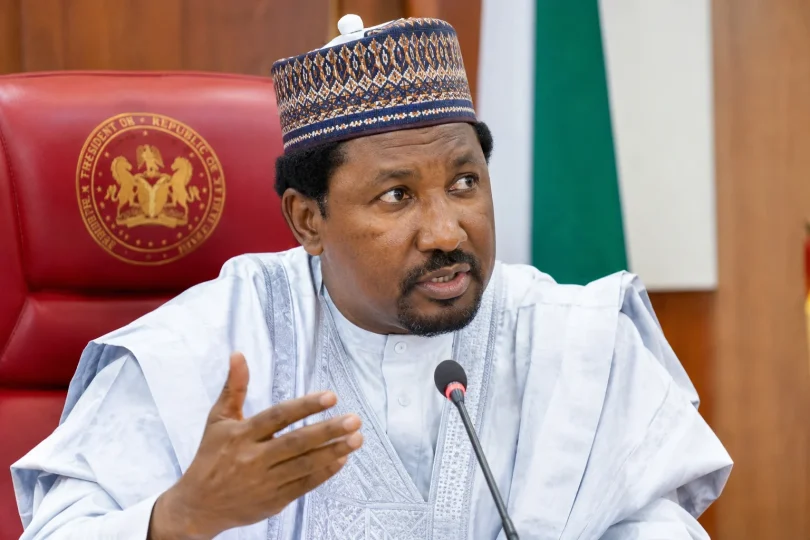
Deputy Senate President, Senator Barau Jibrin, has disagreed with former Vice-President Yemi Osinbajo’s pessimistic assessment of Nigeria’s economy and democratic system.
Barau maintained that the administration of President Bola Tinubu was working to address longstanding national challenges, but stressed the need for the government to communicate its policies and achievements more effectively to Nigerians.
He made the remarks on Tuesday in Yola during a lecture titled “Democracy and Development: Rethinking the Leadership Question,” organised to commemorate the 59th birthday of Adamawa State Governor, Ahmadu Fintiri.
Osinbajo, while citing findings from Afrobarometer surveys, had expressed concern that although 64 per cent of Africans preferred democracy, only 38 per cent were satisfied with how it was functioning. The surveys also indicated that 59 per cent of respondents viewed their economies negatively, while 51 per cent believed economic conditions had deteriorated.
The former vice-president warned that economic hardship, unemployment, inadequate healthcare and declining youth participation in elections were weakening public confidence in democracy.
Reacting to the concerns, Barau described Osinbajo’s lecture as thought-provoking but argued that the negative perception of the country’s situation was partly attributable to inadequate communication between political leaders and citizens.
“There is no proper communication,” Barau said, while acknowledging Osinbajo’s abilities as an orator and intellectual.
The deputy Senate president maintained that both federal and state governments were implementing measures to address the country’s challenges.
On education, he cited the Nigerian Education Loan Fund (NELFUND), which provides eligible students, particularly those from financially disadvantaged backgrounds, with access to education through student loans.
Barau also pointed to major infrastructure projects as evidence of efforts to stimulate economic growth and improve prosperity.
Among the projects he mentioned were the Lagos-Calabar Coastal Highway, the Badagry-Sokoto Highway and infrastructure developments across the North-East and North-West regions.
Addressing the rising cost of living, Barau argued that Nigeria’s economic difficulties were also influenced by international developments, including the Russia-Ukraine war and tensions in the Middle East.
He said these conflicts had disrupted global supply chains and contributed to fluctuations in energy prices, including through strategic shipping routes such as the Strait of Hormuz.
“Nigeria is not an island,” Barau said, stressing that developments in the international environment also affected the country’s economy.
He urged political leaders to improve communication with the public, explaining government policies more clearly so that citizens could better understand the challenges confronting the country and the measures being taken to address them.
Post Views: 0