
CYRIACUS IZUEKWE
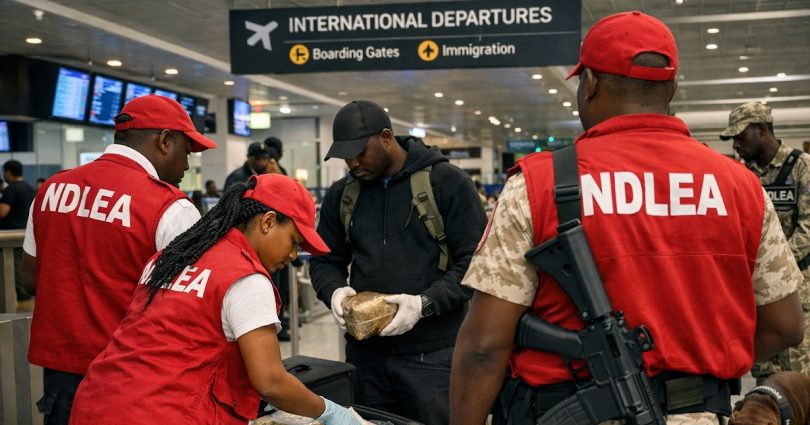
The quest for spiritual intervention took a dark turn at the Murtala Muhammed International Airport (MMIA) in Lagos, after operatives of the National Drug Law Enforcement Agency (NDLEA) arrested a Ugandan national over alleged drug trafficking.
The NDLEA said the suspect, 34-year-old Farida Nansubuga, was arrested on Tuesday, November 3, 2026, at Terminal 2 of the Lagos airport.
According to the agency, Nansubuga arrived in Nigeria on October 29 as part of a foreign church delegation visiting The Synagogue Church of All Nations (SCOAN) in Ikotun.
The agency said while the rest of the delegation finished their visit and returned to Kampala, she allegedly stayed behind alone.
Days later, NDLEA operatives allegedly found 87 wraps of cocaine, weighing 1.15 kilogrammes, strapped to her pelvic region beneath her underwear.
The NDLEA said the suspect allegedly told operatives that she was recruited at a local hotel by a handler and offered $1,000.
The agency said the handler was identified only as “Joy” and investigations are ongoing to trace the person.
The NDLEA has explicitly stated that the church itself is not accused of any wrongdoing in the case.
Pilgrimage As Alleged Cover
Security experts say this case shows a worrying pattern in how drug cartels allegedly operate in West Africa.
According to the NDLEA, religious pilgrimage provides cartels with what investigators describe as a perfect cover story.
A pilgrim travelling with a church group, carrying a Bible, wearing decent clothes, and returning from a well-known place of worship, does not easily attract suspicion at the airport.
The agency said that is exactly why cartels allegedly target religious tourism.
A group trip gives the courier a genuine visa, a genuine flight ticket, a genuine hotel booking, and a genuine reason to travel. All the documents are real. Only the purpose is allegedly criminal.
In this case, the NDLEA said Nansubuga arrived as part of a legitimate delegation. She prayed with the group. She visited the church. She followed the programme like every other pilgrim.
But after the group left, the agency said her journey allegedly changed completely.
Investigators believe the pilgrimage was allegedly used in two stages. The first stage was entry into Nigeria. The second stage was exit from Nigeria with drugs allegedly concealed on her body.
By travelling in a group, the courier allegedly blends in on arrival. By staying behind after the group leaves, the courier allegedly gets time to meet handlers, collect drugs, and arrange a separate return trip without the group noticing.
The NDLEA said this method makes it very difficult for airport officers to detect couriers through normal profiling alone.
A pilgrim does not look like a typical drug courier. She does not behave like one. She does not carry suspicious luggage. She carries the story of faith.
That, according to anti-narcotics experts, is the danger of using pilgrimage as cover. The holiness of the journey becomes the shield for the crime.
The agency said cartels allegedly exploit the trust that border officers naturally have for religious travellers, especially women, elderly pilgrims, and first-time travellers who are going for prayers.
They also allegedly exploit the large number of religious tourists who enter Nigeria every year for crusades, conventions, and church programmes. With thousands of pilgrims moving through Lagos, Abuja, and other airports, a single courier can easily disappear in the crowd.
The NDLEA said it is now reviewing its profiling system for group religious travel. The agency said group travel will no longer be treated as automatic proof of innocence.
Officers will now pay closer attention to pilgrims who arrive with a group but attempt to travel back alone, pilgrims who extend their stay without clear reason, and pilgrims who change hotels after the group leaves.
NDLEA Stance
In its official briefing on the airport operation, the NDLEA said Nigeria welcomes millions of religious tourists annually, but faith-based travel will not serve as an automatic pass against rigorous profiling.
The agency said its forensic units are working with aviation security to trace the hotel and the alleged contact.
The NDLEA stressed that the suspect remains presumed innocent until proven guilty in a court of competent jurisdiction.
Ugandan Diplomatic Response
The arrest has triggered consular protocols from the Ugandan High Commission.
Diplomatic sources said while the mission maintains a strict policy against citizens engaging in transnational narcotics trafficking, it is engaging Nigerian authorities to ensure Nansubuga is granted fair legal representation and that her fundamental human rights are protected during her remand.
The sources said the incident has raised concerns over the potential profiling of legitimate Ugandan pilgrims travelling to West Africa.
Church Clarification
The NDLEA’s official statement explicitly cleared The Synagogue Church of All Nations (SCOAN) of any systemic involvement or institutional wrongdoing.
Investigators said the church’s visitor registry protocols are strictly spiritual and tourism-oriented.
The agency treats the church purely as a landmark allegedly exploited by outside criminal groups looking to build a plausible, low-risk cover story for their couriers.
Investigation Continues
The NDLEA said detectives are focusing on three key areas.
First is the alleged logistics handler, “Joy”. The agency said investigators are analysing telecom data, call logs, and messaging footprints to identify the contact.
Second is the hotel paper trail. Under Lagos State regulations, hotels must maintain guest logs, capture digital registration records, and operate CCTV monitoring. The NDLEA said its teams are auditing the specific hotel where the alleged handover occurred, to examine whether the room was booked under a fraudulent identity or paid for by a third party.
Third is the alleged use of “disposable couriers”. Drug control experts tracking the East-to-West Africa route said cartels allegedly use vulnerable, first-time travellers or low-income members of religious groups who present a low-risk profile to airport profiling systems.
The experts said by offering a meagre $1,000 fee, approximately ₦1.5 million, the cartel allegedly insulates its high-level operators, leaving the courier to face the judicial risk, including a potential long prison sentence under the NDLEA Act.
The NDLEA said investigations are ongoing and no other arrest has been announced in connection with the case as at the time of filing this report.
The suspect remains in custody and is presumed innocent until proven guilty.