
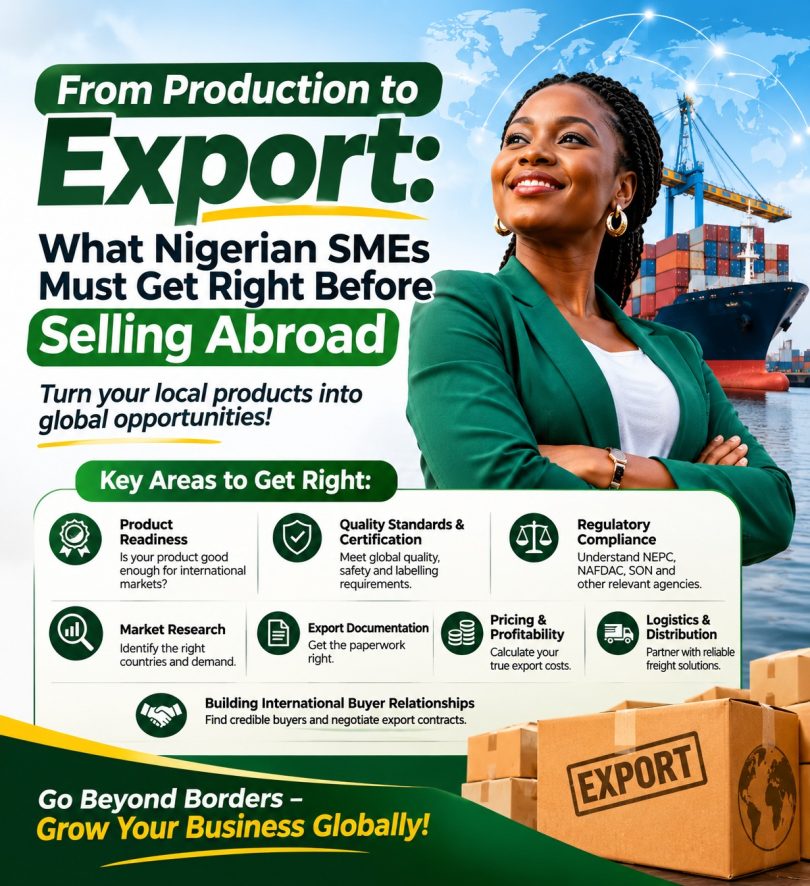
Producing quality goods is only one part of building an export business. For Nigerian small and medium-sized enterprises (SMEs) looking to sell beyond the domestic market, meeting international standards, obtaining the right certifications, preparing export documents and identifying reliable buyers are equally important.
Although Nigeria has products with export potential across agriculture, food processing, fashion, cosmetics and manufacturing, many businesses struggle to turn that potential into consistent international sales.
The challenge goes beyond finding foreign customers. Exporting requires businesses to understand the regulations of their target markets, maintain consistent product quality, meet packaging requirements and manage the logistics involved in moving goods across borders.
A report by FATE Foundation on access to markets for Nigerian entrepreneurs identified several barriers affecting businesses seeking to enter international markets, including inefficient border procedures, limited export financing, inadequate logistics infrastructure and difficulties accessing market information.
The report also highlighted limited awareness of trade opportunities and weak marketing and branding as factors restricting the ability of small businesses to reach foreign customers.
Here are some important areas Nigerian SMEs need to get right before entering the export market.
1. Obtain the Necessary Product Certifications
Product certification is one of the important requirements businesses must consider before exporting.
Foreign buyers and regulatory authorities often require evidence that products meet specific safety, quality, health and technical standards before they can enter their markets.
For Nigerian businesses, the certifications required depend on the product and destination country.
For example, food and agricultural exporters may need relevant health, phytosanitary or quality certificates, while manufactured products may be subject to technical standards and conformity assessments.
The Standards Organisation of Nigeria (SON), National Agency for Food and Drug Administration and Control (NAFDAC), and other relevant regulatory bodies have responsibilities relating to product standards and safety.
The Nigerian Export Promotion Council (NEPC) also provides guidance on certification requirements for Nigerian exporters.
For SMEs, understanding these requirements early can help prevent rejected shipments, additional costs and delays.
2. Invest in Export-Quality Packaging and Labelling
Packaging is another important consideration for businesses planning to sell products internationally.
Products intended for export must be packaged in ways that protect them during storage and transportation while meeting the requirements of their destination markets.
For food products, for instance, labelling requirements may cover ingredients, nutritional information, production and expiry dates, country of origin and other product details, depending on the destination country’s regulations.
Businesses must also consider packaging materials, product presentation, durability and appropriate labelling languages.
For Nigerian SMEs in food processing, cosmetics, fashion and manufacturing, improving packaging can help products meet buyer expectations and compete with established international brands.
3. Complete the Required Export Registration and Documentation
Businesses intending to export formally from Nigeria must understand the registration and documentation process.
According to NEPC, registration with the council is the first step towards obtaining an Exporter’s Certificate.
The council’s e-registration process requires different documents depending on the type of business. For example, limited liability companies are required to provide their Certificate of Incorporation, Memorandum and Articles of Association and relevant corporate records.
Other documents required during export transactions may include:
- Proforma invoice.
- Commercial invoice.
- Packing list.
- Nigeria Export Proceeds (NXP) Form.
- Certificate of Origin.
- Clean Certificate of Inspection, where applicable.
- Bill of Lading or Air Waybill, depending on the transportation method.
These documents help establish the details of the transaction, the value and quantity of goods, their origin, quality and movement to the buyer.
NEPC also provides guidance on export procedures and documentation for businesses preparing to enter international markets.
4. Understand the Standards of the Target Market
Meeting Nigerian product standards does not automatically mean a product will qualify for entry into another country.
Every export destination has its own regulations covering product safety, quality, labelling, packaging and permitted ingredients or materials.
For example, a Nigerian food-processing business targeting the European market must understand the applicable food safety and traceability requirements, while a business exporting agricultural produce may need to comply with phytosanitary requirements.
This means SMEs must research their intended markets before committing resources to production and shipment.
The Nigeria Trade Information Portal provides information on export procedures, product eligibility and regulatory requirements that businesses can consult when preparing to export.
5. Identify Reliable Buyers and Understand Market Demand
Finding international buyers is another challenge for Nigerian businesses.
Having a product with export potential does not automatically guarantee demand in foreign markets. Businesses need to understand what consumers want, the products already available, prevailing prices and the competition they will face.
SMEs should identify potential buyers, distributors, wholesalers and retailers before committing to large-scale production for export.
They can explore international trade fairs, business-to-business platforms, trade missions and export networking opportunities to establish relationships with potential buyers.
NEPC also offers trade linkages, networking opportunities and export capacity-building programmes to support Nigerian exporters.
Businesses should equally understand the payment arrangements, delivery terms and contractual obligations involved in international transactions.
6. Build a Reliable Production and Supply Chain
International buyers often require consistent product quality, quantity and delivery schedules.
For SMEs, this can become difficult when production depends on irregular supplies of raw materials, inadequate storage facilities, unreliable electricity or limited production capacity.
A business may secure an export order but struggle to fulfil it if it cannot maintain the required production volume or deliver within the agreed timeframe.
This is particularly relevant to agricultural exporters dealing with seasonal production, perishable goods and changing market conditions.
Businesses should therefore establish reliable supplier relationships, maintain proper inventory records, invest in appropriate storage and develop production plans that can accommodate export orders.
7. Understand Export Financing and Logistics Costs
Exporting requires capital, and businesses need to account for more than the cost of producing their goods.
Other expenses may include certification, packaging, warehousing, transportation, customs procedures, insurance and shipping.
For small businesses with limited working capital, these expenses can make it difficult to fulfil large orders or maintain regular export operations.
The Market Access Study for Nigeria’s Non-Oil Exports also identified limited access to finance, logistics infrastructure and complex regulatory procedures among the challenges affecting exporters.
SMEs should therefore prepare realistic export budgets, understand their payment arrangements and explore suitable financing options before accepting international orders.
8. Take Advantage of Export Development Support
Nigerian SMEs do not have to navigate the export process without institutional support.
The Nigerian Export Promotion Council provides export registration, training, market information, trade linkages and capacity-building programmes for businesses interested in international trade.
Through its programmes, the council seeks to improve the capacity of Nigerian businesses to meet export requirements and participate in international markets.
Businesses can also explore opportunities under the African Continental Free Trade Area (AfCFTA), which provides a framework for expanding trade among African countries.
However, access to preferential trade arrangements does not remove the need to comply with applicable product standards, rules of origin and customs procedures.
What This Means for Nigerian SMEs
Expanding into international markets presents opportunities for Nigerian businesses to reach more customers, increase sales, diversify revenue sources and earn foreign exchange.
However, export readiness requires more than producing goods and finding someone willing to buy them.
Businesses must understand certification requirements, invest in appropriate packaging, maintain consistent product quality, prepare the necessary documentation and develop reliable supply chains.
For Nigerian SMEs, addressing these areas can help reduce export-related risks and improve their ability to compete in international markets.
Ultimately, the ability to turn locally produced goods into products that meet international market requirements will be important to expanding Nigeria’s non-oil exports and strengthening the contribution of small businesses to the economy.