
This year marked Nigeria’s rare economic turnaround in at least a decade, with citizens beginning to feel the early impact of sweeping government reforms.
In his Independence Day address on October 1, 2025, President Bola Tinubu had declared that “Nigeria has finally turned the corner,” insisting that “the worst is over.”
BusinessDay examined key macroeconomic data and on-the-ground realities to assess whether the country has indeed emerged from its ‘shock therapy,’ a reform drive that fuelled inflation and unleashed the worst cost-of-living crisis in a generation, while simultaneously rebuilding investor confidence and attracting much-needed foreign exchange (FX).
Read also: Five charts show Africa’s best markets of 2025
Nigeria’s disinflationary trend persists in 2025
One of the biggest turnarounds in the Nigerian economy for 2025 was the continued cooling of headline inflation for the eighth consecutive month to 14.45 percent in November, compared with about 34 percent in the same period last year.
The sustained disinflationary trend saw one of Africa’s biggest economies beat its budgetary inflation target for the first time in six years. Though authorities embarked on an overhaul of the Consumer Price Index (CPI) computations, which put the figure at around 24 percent in January, deceleration in prices was largely driven by slowing food inflation.
Food inflation, which also rose to more than 34 percent last year, equallycooled to 11 percent, even though food products in the market were still relatively pricey for ordinary Nigerians.
Experts say that with the continued intervention by the government to ensure food security and the statistical base effect, inflation is expected to trend at a single-digit rate in the coming year.
Annual growth quickened despite volatility of oil prices
Nigeria’s economy expanded for the three quarters ended September 2025, with annual growth picking up the most in the second quarter (Q2) at 4.23 percent, the fastest in about five years. That contrasts with 3.86 percent and 3.76 percent recorded in the third and fourth quarters of 2024.
The expansion was primarily driven by the booming non-oil sector, particularly services, which accounted for about 50 percent of the Gross Domestic Product (GDP), and a significant improvement in agriculture, real estate, and information and communication.
While the country embarked on some statistical recalibration of its economy to reflect new realities at the beginning of the year, economists say key reforms in the oil and non-oil sectors are positioning Africa’s biggest oil producer for sustained growth in the coming year, even as it targets a seven percent growth rate to meet its ambitious $1 trillion economy in the next five years.
The World Bank sees the economy ending 2025 at 4.2 percent while rising to 4.4 percent by 2027, supported by services, agriculture, and the non-oil industry, effectively shifting the country’s growth prospect from oil, which is often prone to volatility and geopolitical shocks.
Read also: Nigeria’s December economy: Plenty of money, not enough market
Naira maintains rare stability as FX reserves swell
From September, the naira broken below the 1500 per dollar psychological level, helped by stronger oil export earnings and improved portfolio inflows that gave the country’s external reserves a boost.
That calmness in the exchange rate market, with about 10 percent gain, contrasts with the sharp swings observed last year when the currency shed 41 percent of its value. Economists see the naira maintaining the 1440/$-1500/$ band even in the coming year.
FX reserves also rose significantly, reaching its highest levels in six years at over $45 billion compared to the $40.8 billion seen last year.
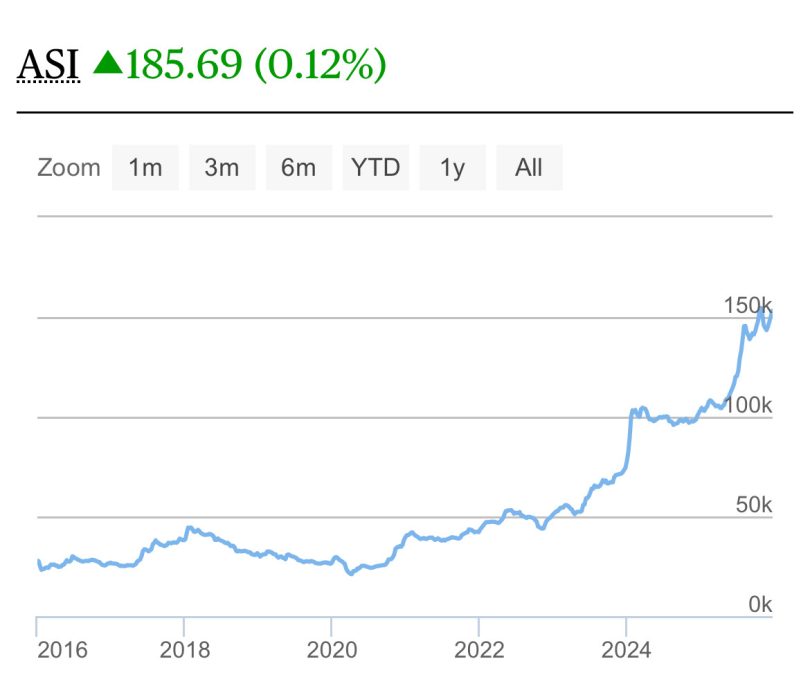
Stock market ASI more than doubled in one year
The Nigerian stock market experienced one of its strongest performances in at least a decade, with the All Share Index surging to 184.69 as of December 23, 2025, compared with about 77 it closed last year.
Despite losing over $3 billion in its biggest single-day fall in 15 years in November, the market came back stronger with about 50 percent year-to-date returns.
The local bourse neared a record N100 trillion valuation as market capitalisation reached N97.9 trillion. Bismarck Rewane, managing director of Financial Derivatives Company, sees the stock market’s valuation reaching N262 trillion in 2026 on anticipated listings of mega corporates, including the Dangote Refinery and the Nigerian National Petroleum Company (NNPC).
Debt pressures call for caution
Nigeria’s debt levels continued to rise, exerting fiscal pressures despite improved revenues.