
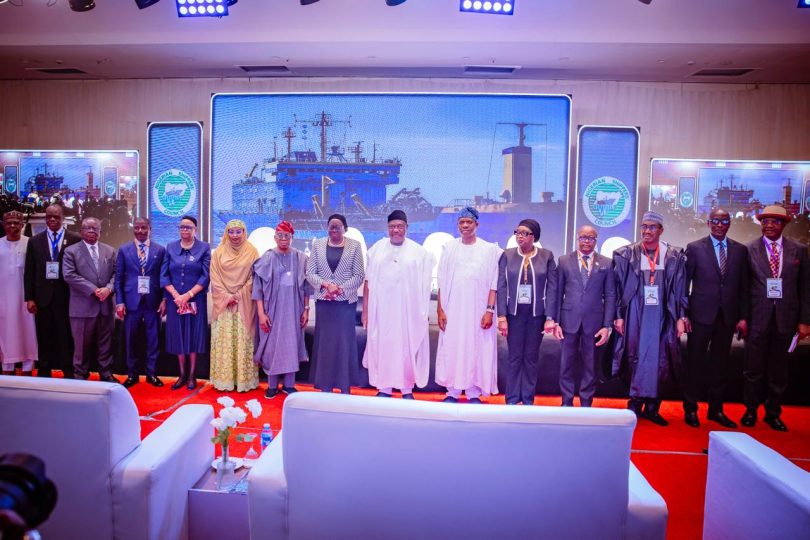
The Federal Government has pledged to implement actionable recommendations from the 18th International Maritime Seminar for Judges, declaring that an efficient and credible maritime justice system is essential to unlocking Nigeria’s blue economy potential, attracting investment and facilitating trade.
Secretary to the Government of the Federation (SGF), Senator George Akume, made the commitment on Wednesday in Abuja while declaring open the three-day seminar organised by the Nigerian Shippers’ Council in collaboration with the National Judicial Institute and the Nigerian Maritime Law Association.
Akume said maritime justice is a critical pillar of the Federal Government’s Renewed Hope Agenda for the Blue Economy, stressing that delays in resolving maritime disputes undermine trade, discourage investors and increase the cost of doing business.
According to him, unresolved cargo liability disputes, prolonged maritime claims and poorly executed ship arrests have far-reaching economic consequences.
“When a maritime claim is delayed in court, trade suffers. When a ship arrest is poorly executed, investor confidence falls. When cargo liability disputes go unresolved, the cost of importing essential goods rises, and it is ordinary Nigerians who bear that cost,” he said.
SGF, in a statement by his Special Adviser, Media and Publicity, Mr Yomi Odunuga, assured participants that the Federal Government would ensure that recommendations from the seminar translate into concrete policy and institutional reforms.
He explained that recommendations requiring legislative amendments would be forwarded to the National Assembly through the Federal Ministry of Justice, while those relating to the ratification of international maritime conventions would receive executive consideration.
“The work done in this hall over the next three days should not remain in this hall. It must find expression in policy, legislation, institutional reform and ultimately in the daily experience of every Nigerian who does business through our ports or seeks justice in our courts,” Akume said.
He noted that no serious investor would commit resources to Nigeria’s maritime sector without confidence in the country’s legal and dispute resolution framework, adding that the government remains committed to building a predictable, transparent and professionally competent maritime ecosystem.
Akume also called for stronger collaboration among key maritime institutions, including the Nigerian Shippers’ Council, the Nigerian Maritime Administration and Safety Agency (NIMASA), the Nigerian Ports Authority (NPA), the Nigeria Customs Service, the Federal Ministry of Marine and Blue Economy and the Federal High Court.
He said improved information sharing, regulatory alignment and institutional cooperation were necessary to enhance efficiency and strengthen Nigeria’s competitiveness in global shipping and maritime trade.
The SGF commended the Nigerian Shippers’ Council for sustaining the International Maritime Seminar for Judges since 1995, describing it as one of Africa’s foremost judicial capacity-building platforms.
He also welcomed judicial officers from Ghana, Sierra Leone, The Gambia, Kenya and Liberia, expressing confidence that the seminar would strengthen regional cooperation, promote harmonisation of maritime laws and deepen intra-African trade.
The three-day seminar has brought together judges, maritime law experts and other stakeholders from across Africa to examine emerging issues in maritime law, dispute resolution and the development of the continent’s blue economy.