
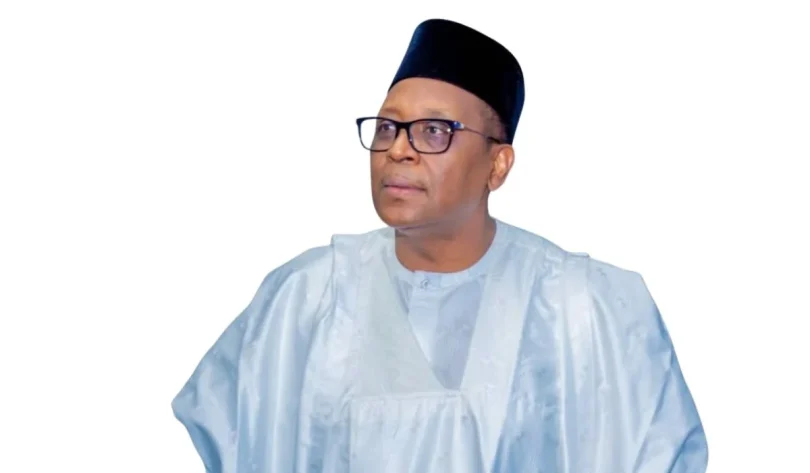
The Federal Government has sought the support of traditional rulers across Northern Nigeria to eliminate the country’s growing number of zero-dose children, urging them to intensify efforts to tackle vaccine hesitancy, identify missed communities and ensure every eligible child receives routine immunisation and other primary healthcare services.
The Coordinating Minister of Health and Social Welfare, Muhammad Ali Pate, made the appeal on Wednesday at the Quarterly Review Meeting of the Northern Traditional Leaders Committee on Primary Health Care (NTLCC), where government officials, traditional rulers and development partners reviewed progress in routine immunisation, polio eradication and primary healthcare delivery across the 19 northern states.
Pate described the Northern Traditional Leaders Committee as one of Nigeria’s strongest platforms for advancing community health, noting that since its establishment in 2009, the body had contributed significantly to improving immunisation uptake, maternal and child health, nutrition and disease prevention.
ALSO READ: Bauchi govt warns residents against building on waterways
“I thank His Eminence for establishing this platform and I thank you for your leadership as members of the NTLCC. Millions of families have embraced immunisation because of the efforts you have put in. Maternal and child health services have been demanded and received, nutrition and other life-saving interventions have reached our people, and millions of children have been saved because of the interventions you have championed,” the minister said.
He commended the Emir of Argungu, the committee’s chairman, other traditional rulers, the National Primary Health Care Development Agency (NPHCDA), frontline health workers and development partners for sustaining progress despite operational challenges.
According to him, Nigeria has maintained its wild polio-free status while recording improvements in routine immunisation, expansion of primary healthcare services, antenatal care attendance and skilled birth attendance.
“We have introduced innovative technologies to improve accountability, strengthened emergency operations and continued to reach children even in the most difficult terrains. Overall, we are moving in the right direction,” he said.
The minister, however, said the country must urgently address the emergence of circulating variant poliovirus in a few high-risk states and close routine immunisation gaps.
“The remaining barriers are no longer purely operational. We have trained frontline workers and deployed resources, but the issues now stem from missed children, routine immunisation gaps, population mobility and insecurity. We rely on your influence to overcome these obstacles,” he told the traditional rulers.
Pate stressed that while the Federal Government would continue investing in primary healthcare, state governments must complement those efforts since they bear primary responsibility for service delivery.
He disclosed that Gavi, the Vaccine Alliance, had approved about $500 million in support for Nigeria between 2026 and 2030, with approximately $345 million dedicated to vaccine procurement, while part of the funding would strengthen cold-chain infrastructure and primary healthcare services.
“We cannot maintain true sovereignty while relying indefinitely on external funding. As a responsible nation, we must invest directly in our population’s health,” he said.
Earlier, the Executive Director of NPHCDA, Muyi Aina, said Nigeria recorded notable improvements in routine immunisation coverage, according to findings from the latest mini-Demographic and Health Survey.
He said coverage for the second dose of the Inactivated Polio Vaccine (IPV2) increased by 10.5 percentage points nationally within one year, while coverage for the third dose of the pentavalent vaccine (Penta3) rose from about 53 per cent to 54.5 per cent.
“We are seeing areas of very significant progress. We are still not where we want to be, but this represents a major improvement within a short period,” Aina said.
He noted that while several states achieved increases of between 15 and 20 percentage points, others continued to struggle because of insecurity and hard-to-reach communities.
“Our conversations today are focused on identifying where those challenges remain and how traditional leaders can help us work with state governments and communities to remove those barriers. President Bola Tinubu is committed to ensuring that no child is left behind,” he added.
The World Health Organization (WHO) Country Representative, Pavel Ursu, described traditional rulers as custodians of public trust whose influence remained critical to improving immunisation uptake.
He announced that Nigeria had secured approximately $515 million in Gavi support for vaccines and immunisation systems for 2026–2030, while the Federal Government had committed about $100 million annually to domestic vaccine financing.
“This is national leadership. This is country ownership in action. Leadership is measured by results—children vaccinated, outbreaks prevented and lives saved,” Ursu said.
He noted that Nigeria records nearly eight million births annually, explaining that every one percentage-point increase in immunisation coverage translates to about 80,000 additional children protected against vaccine-preventable diseases.
Despite recent gains, he said about 2.1 million Nigerian children remain zero-dose, while only 57 per cent of children aged 12 to 23 months are fully vaccinated nationally. In the North-West, he added, full vaccination coverage falls to 41.5 per cent, with 28 per cent of children receiving no routine vaccines.
“Nearly nine out of every 10 variant polioviruses detected this year were found in children who had received zero routine vaccine doses. The challenge is no longer simply reaching communities but finding the specific children who continue to be missed,” he said.
Ursu urged traditional rulers to intensify community mobilisation, identify missed settlements, counter misinformation and ensure every child completes the routine immunisation schedule.
Also speaking, UNICEF Country Representative, Wafaa Saeed Abdelateef, praised Nigeria’s traditional and religious leaders for the role they played in helping the country achieve wild polio-free certification in 2020.
“You convinced families where others could not. You built trust where there was doubt. History will remember the decisive role played by Nigeria’s traditional and religious leaders,” she said.
She said the next phase of the country’s immunisation drive must focus on children living in remote settlements, nomadic communities, border areas, insecure locations and underserved villages, particularly in Kebbi, Sokoto and Zamfara states.
“The challenge before us is no longer simply to eliminate a virus; it is to ensure that every child is reached. No child should be denied protection because of where they were born or where their family lives,” Abdelateef said.
Representing the Sultan of Sokoto, the Chairman of the Northern Traditional Leaders Committee and Emir of Argungu, Samaila Muhammadu Mera, reaffirmed the commitment of northern traditional rulers to sustaining gains in polio eradication and strengthening primary healthcare.
He described polio eradication as the committee’s “foremost, non-negotiable priority” and pledged that traditional institutions would continue mobilising communities, resolving vaccine refusals and supporting maternal and child health, nutrition, malaria control and disease surveillance.
“We have proven that when we combine government resources with community trust, we can overcome even the most daunting health challenges,” Mera said.
Speaking on behalf of the Gates Foundation, Dr. Yusuf Yousufai said recent vaccination campaigns had demonstrated the impact of traditional institutions in increasing acceptance of immunisation.
“Each child reached represents trust—not only in the programme but also in the work that our traditional leaders do. Where traditional leaders are present and engaged, acceptance grows,” he said, urging the committee to sustain efforts to resolve vaccine non-compliance and misinformation.
Also delivering a goodwill message, Danmusa Yakubu, Vice Chairman of the Nigeria National PolioPlus Committee, representing Rotary International, commended the traditional rulers for their grassroots mobilisation, saying their advocacy had been instrumental in helping Nigeria sustain its wild polio-free status since 2020.
He urged the committee to maintain the momentum until all forms of poliovirus transmission are eliminated and every Nigerian child is protected through routine immunisation.