
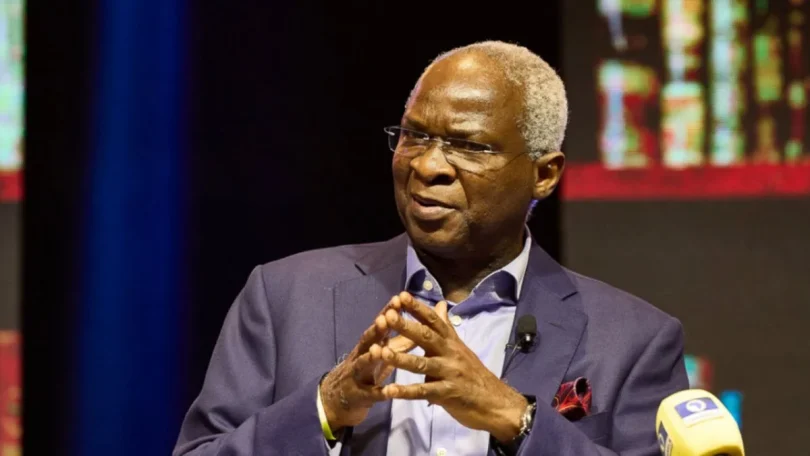
Former Minister of Power, Works and Housing, Babatunde Fashola, has opposed calls for election riggers to be sentenced to death, arguing that electoral offences should attract punishment prescribed by law rather than extreme political rhetoric.
The former governor of Lagos state made the remarks during an exclusive interview with ARISE News which was aired on Friday, while reacting to the “rig and die” slogan attributed to former Deputy Senate President Ovie Omo-Agege and comparisons with former President Muhammadu Buhari’s remarks on ballot-box snatching ahead of the 2019 elections.
He cautioned against the use of extreme language around electoral offences, stressing that the law provides for punishment and that even offences punishable by death require due process.
“I think we must move away from what I think are extreme narratives and rhetoric,” he said.
“The punishment under the Electoral Act is not death. And even if it were death, which I will not support, there’s a process before you take human life; a charge, a trial, an opportunity to defend yourself,” Fashola added.
He urged politicians to focus on campaigning and mobilising voters instead of resorting to electoral manipulation.
“The penalty for rigging is not death. But don’t rig. Go and campaign for your party,” he said.
Fashola noted that political parties have areas where they enjoy considerable support and others where their chances of winning are limited, urging them to concentrate on expanding their voter base and improving their performance rather than attempting to manipulate elections.
However, he called for tougher sanctions for electoral offences, suggesting that some violations should attract defined custodial sentences without the option of fines.
“I think maybe there might be stiffer sentences without option of fine, maybe a defined custodial sentence that is deterrent in nature,” he said.
According to him, offences that undermine democratic processes should not be treated as crimes perpetrators can simply resolve by paying fines.
“I always hold the view that some very serious, really impactful conduct should not be allowed to be monetised, and undermining of democracy is seriously impactful,” he said, while maintaining that such offences should not attract the death penalty.
The former governor also advocated sustained public enlightenment on electoral conduct, proposing that civic and electoral education should begin at primary school level and be taught in Nigeria’s major languages to discourage electoral violence and desperation.
Meanwhile, Fashola also urged state governors to take advantage of the decentralised electricity framework to tackle power supply challenges, saying the reforms have expanded opportunities for states to develop solutions suited to their needs.
Reflecting on his tenure as power minister from 2015 to 2019, he said the removal of previous restrictions had created a more favourable environment for state governments to participate in electricity provision.
“Well, I think that decentralisation has already happened,” he said.
“This is a more enabling environment for governors to play an even bigger role,” he added, noting that Lagos State was already making progress in that direction.
Fashola recalled that his administration in Lagos had worked to provide electricity to streets, communities, schools and other institutions despite the limitations imposed by the electricity framework at the time.
“If, when I was governor, I had this enabling environment, I don’t know what I would have done.
“We were powering streets, we were powering communities, we were powering schools, and we were powering many communal institutions at that time, in spite of the restrictions that we had,” he said.
The former minister also highlighted his record in the power sector, claiming that more than 11 million Nigerians gained access to electricity during his four-year tenure.
“At that time, we connected, I think, 11 million-plus people to electricity supply for the first time in the history of this country.
“That is a record I’m proud of. Eleven million people extra have access to electricity,” he said.