
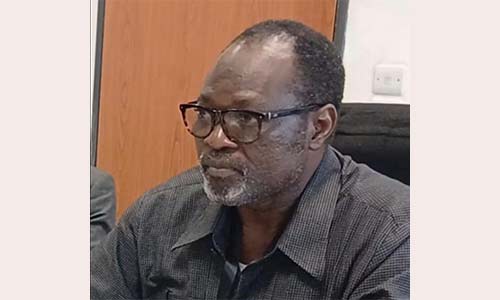
The Economic and Financial Crimes Commission (EFCC) has appealed the Federal High Court judgment rejecting its application for the final forfeiture of $912,550 and two properties linked to Jimoh Olasunkanmi Yisawu, former Managing Director of the Warri Refining and Petrochemical Company.
The appeal followed the judgment delivered on Monday, November 9, 2026, by Justice James Omotosho of the Federal High Court, Abuja, who held that the anti-graft agency failed to establish that the assets were proceeds of unlawful activities.
Justice Omotosho consequently discharged the interim forfeiture order earlier placed on the assets and dismissed the EFCC’s application for their permanent forfeiture to the Federal Government.
Dissatisfied with the decision, the commission filed a notice of appeal before the Court of Appeal in Abuja on Tuesday, November 10, 2026, through its lead counsel, Ekele Iheanacho, SAN.
The EFCC disclosed the development in a statement issued on Wednesday by its spokesperson, Dele Oyewale, maintaining that the trial court failed to properly evaluate material evidence concerning Yisawu’s financial transactions, declared income and the acquisition of the properties.
In its grounds of appeal, the commission argued that Justice Omotosho erred in law by failing to adequately consider the financial records and evidence presented in support of its application.
The EFCC maintained that the transactions attributed to the former refinery chief were inconsistent with his documented earnings as a public officer.
“The case rests on a simple question: how does a public officer whose lawful income is documented give out over $900,000 in cash?” Iheanacho queried.
According to the commission, its investigations revealed that Yisawu paid a total of $912,550 in cash to two bureau de change operators, Samaila Bala and Rasheed Yusuf, between 2021 and 2025 for conversion into naira.
The EFCC stated that the naira equivalent of the foreign currency transactions exceeded ₦1.5 billion.
It argued that although Yisawu claimed that his assets were acquired from legitimate earnings and loans, he failed to demonstrate how those earnings were converted into the substantial amount of foreign currency allegedly handed to the dealers.
“The respondent did not show how he converted his legitimate earnings into foreign currency which he paid to Samaila Bala and Rasheed Yusuf,” the commission stated.
The anti-graft agency further challenged the trial court’s assessment of the respondent’s financial position, insisting that the available records did not sufficiently support the conclusion that the disputed assets were acquired from legitimate income.
According to the EFCC, Yisawu declared that, as of September 17, 2020, his cash holdings and bank balances amounted to ₦647,205.36 and $12,779.26.
The commission also disclosed that his total salaries and allowances between October 2020 and September 2023 amounted to ₦114,548,024.48.
It maintained that the documented earnings were substantially lower than the value of the foreign currency allegedly exchanged through the bureau de change operators.
The EFCC consequently argued that the trial judge failed to properly examine the relationship between the respondent’s declared income, his financial transactions and the funds used to develop the properties.
The commission faulted the judgment for failing to “analyse all these financial outflows from the Respondent’s bank accounts in arriving at the conclusion that the funds used to develop the properties were from the Respondent’s lawful earning”.
Beyond the foreign currency transactions, the EFCC alleged that the two bureau de change operators indirectly paid ₦282,542,000 towards the development of the two properties that formed part of the forfeiture proceedings.
It further alleged that Bala paid ₦65,860,000 in three instalments to Cordros Securities Limited on February 21, 2024, for the purchase of treasury bills.
According to the commission, those payments were not adequately connected to Yisawu’s lawful earnings.
The EFCC maintained that the trial court failed to give sufficient consideration to the transactions and their implications for determining whether the assets were derived from legitimate sources.
It therefore asked the Court of Appeal to allow its appeal, set aside Justice Omotosho’s judgment and grant an order for the final forfeiture of the disputed funds and properties to the Federal Government.
Yisawu, who joined the Nigerian National Petroleum Corporation (NNPC) in August 1991, served in the organisation for approximately 32 years before leaving in September 2023.
He was appointed Managing Director of the Warri Refining and Petrochemical Company in November 2022 and remained in that position until September 2023.
The EFCC commenced investigations involving the former refinery chief in 2024 over allegations of financial impropriety connected with officials of the Nigerian National Petroleum Company Limited.
As part of those investigations, the commission alleged that approximately $56 million had been earmarked in 2022 for the quick repair of the Warri Refinery.
It further alleged that Yisawu supervised the project and awarded contracts to more than 20 local contractors.
The investigation also examined foreign currency transactions allegedly carried out through the two bureau de change operators between 2021 and 2025.
In July 2026, the EFCC separately arraigned Yisawu before Justice Inyang Ekwo of the Federal High Court, Abuja, on an eight-count charge involving alleged money laundering of ₦1.339 billion.
The former refinery chief pleaded not guilty to the charges, following which the court granted him bail in the sum of ₦500 million.
The criminal proceedings are separate from the civil forfeiture case decided by Justice Omotosho.
In opposing the forfeiture application, Yisawu maintained that the two properties were acquired between 2015 and 2020, before his appointment as Managing Director of the Warri Refinery.
He attributed their acquisition and development to income earned during his 32 years of service and loans obtained through legitimate sources.
The former refinery chief’s position was that the properties were not proceeds of unlawful activities as alleged by the commission.
Justice Omotosho, after considering the parties’ positions, held that the EFCC had failed to establish the basis for making a final forfeiture order.
The judge consequently lifted the existing interim forfeiture order and refused the commission’s request to permanently forfeit the assets to the Federal Government.
The EFCC’s appeal now places the trial court’s evaluation of the financial evidence before the Court of Appeal.
The central dispute concerns whether the evidence presented by the commission sufficiently established that the disputed funds and properties were proceeds of unlawful activities, and whether the trial judge properly evaluated that evidence in reaching his decision.
Although the EFCC has challenged the judgment, the filing of an appeal does not, by itself, reverse the decision of the Federal High Court.
Post Title: “Failed To Evaluate Our Evidence” — EFCC Challenges Court Judgment Lifting Forfeiture Order On Ex-Warri Refinery MD’s $912,550, Properties By Naijaonpoint.