
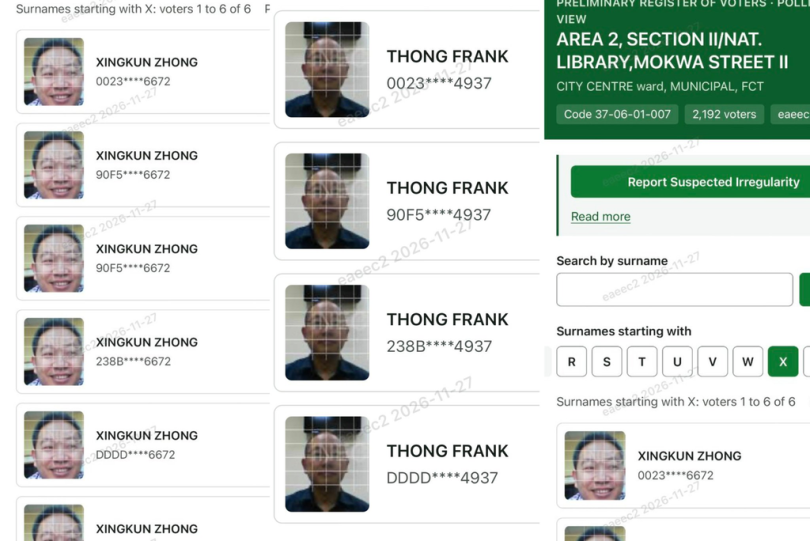
MundX Analytics has uncovered another case of multiple voter registrations involving a Chinese national on the Independent National Electoral Commission (INEC) voter register in Abuja, deepening concerns over widespread irregularities in the commission’s electoral database ahead of the 2027 general election.
The latest discovery adds to a growing list of questionable entries identified through the independent audit of INEC’s preliminary voter register by MundX Analytics, which has been examining voter records for suspicious patterns, repeated photographs, duplicate identities and unusual concentrations of registrations within polling units.
The latest case is particularly significant because the alleged multiple registrations are not isolated from other irregularities uncovered in the preliminary register.
In an earlier finding, MundX Analytics founder Martin Uwakwe, popularly known as Mundus, questioned how an individual identified as Xingkun Zhong could appear seven times in the same polling unit, with the same Chinese-looking face and name attached to multiple voter records.
Another individual, identified as Thong Frank, was also reported to have four entries.
These findings raise several questions about the effectiveness of INEC’s biometric deduplication system, which is supposed to detect and flag multiple registrations by the same individual. INEC’s own documentation describes a system designed to identify and eliminate confirmed duplicate registrations.
The controversy is also significant because Nigerian electoral law restricts voter registration to Nigerian citizens aged 18 and above and expressly prohibits anyone from registering more than once or at multiple registration centres.
The concern, therefore, goes beyond the appearance of foreign-sounding names on the register. The central issue is how the same individual could allegedly have multiple voter records in one polling unit despite the biometric safeguards designed to prevent such occurrences.