
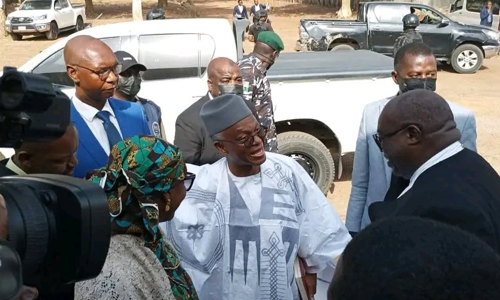
The Federal High Court sitting in Kaduna has granted bail to former Kaduna State Governor Nasir El-Rufai over corruption charges filed by the Independent Corrupt Practices and Other Related Offences Commission but ordered that the former governor remain in the custody of the anti-graft agency until all bail conditions, described by the judge as “strict and extensive,” are fully met.
Justice Rilwanu Aikawa admitted El-Rufai to bail in the sum of N200 million with two sureties in like sum, imposing a set of conditions that include the requirement for a senior civil servant and a recognised traditional ruler as sureties, the deposit of passports, a gag order barring El-Rufai from making public comments about the case, and mandatory attendance at all court sittings.
The ruling came after a dramatic day that saw the former governor shuttled between two courts in Kaduna — first to the Kaduna State High Court, where a separate bail ruling was adjourned to April 21 due to the presiding judge’s bereavement, and then to the Federal High Court where Justice Aikawa delivered the bail ruling.
Justice Aikawa, who had adjourned the matter from April 1 to consider arguments from both the prosecution and defence, set the following conditions for El-Rufai’s bail.
The former governor was admitted to bail in the sum of N200 million with two sureties in like sum. The sureties must deposit their international passports with the court. One surety must be a civil servant not below Grade Level 15 in the federal or state civil service. The other surety must be a recognised traditional ruler. El-Rufai is barred from making any public comments relating to the case. And he must attend all court sittings without fail.
The court explicitly ruled that El-Rufai must remain in ICPC custody until all the bail conditions are fully met meaning the former governor will continue to be detained until he is able to produce sureties who meet the court’s stringent requirements, deposit the required documentation, and satisfy all other conditions.
The condition barring El-Rufai from making public comments about his case is particularly significant. The former governor has been known for his combative public posture, and since his detention, his family members, political associates, and lawyers have made multiple public statements about the case.
The gag order effectively silences El-Rufai on all matters relating to his prosecution — a restriction that, if enforced, would prevent him from publicly responding to allegations, giving media interviews about the charges, or making political statements connected to the case.
Whether the gag order extends to his lawyers and family members speaking on his behalf is a question that may require further clarification from the court.
Earlier on Tuesday, proceedings at the Kaduna State High Court in a separate ICPC case against El-Rufai were stalled when the presiding judge, Justice Darius Khobo, was unable to deliver his ruling on El-Rufai’s bail application as earlier scheduled.
The adjournment was attributed to the judge’s bereavement, which prevented him from preparing the ruling in time.
El-Rufai’s counsel, Ubong Akpan, expressed understanding about the delay.
“His Lordship was bereaved and he was unable to put the ruling together. So, we understand these things happen,” Akpan stated.
The State High Court case involves charges of abuse of office, fraud, intent to commit fraud, and conferring undue advantage, originally filed under Charge No. KDH/KAD/ICPC/01/26. El-Rufai was initially arraigned alongside the Managing Director of TMDK Terminal Limited, Amadu Sule, on March 18, 2026.
The State High Court case involves charges of abuse of office, fraud, intent to commit fraud, and conferring undue advantage, originally filed under Charge No. KDH/KAD/ICPC/01/26. El-Rufai was initially arraigned alongside the Managing Director of TMDK Terminal Limited, Amadu Sule, on March 18, 2026.
However, in a notable development on Monday, the prosecution amended the charges, dropping Sule from the case entirely and narrowing the trial to El-Rufai alone. The reasons for dropping the co-defendant were not publicly disclosed.
After the State High Court adjournment, El-Rufai was moved to the Federal High Court for the separate proceedings before Justice Aikawa — a sequence that his counsel described as evidence of a deliberate prosecutorial strategy.
Akpan accused the ICPC of engaging in “phased litigation” against his client, noting that proceedings were now ongoing in both the state and federal courts simultaneously.
The accusation suggests the defence views the ICPC’s decision to file separate charges at two different courts as a strategy designed to keep El-Rufai entangled in multiple legal proceedings, making it more difficult and more expensive for him to mount a comprehensive defence while ensuring that even if one case falters, the other continues.
The Federal High Court proceedings are based on a 10-count charge that covers a wide range of allegations spanning El-Rufai’s eight-year tenure as Kaduna governor from 2015 to 2023.