
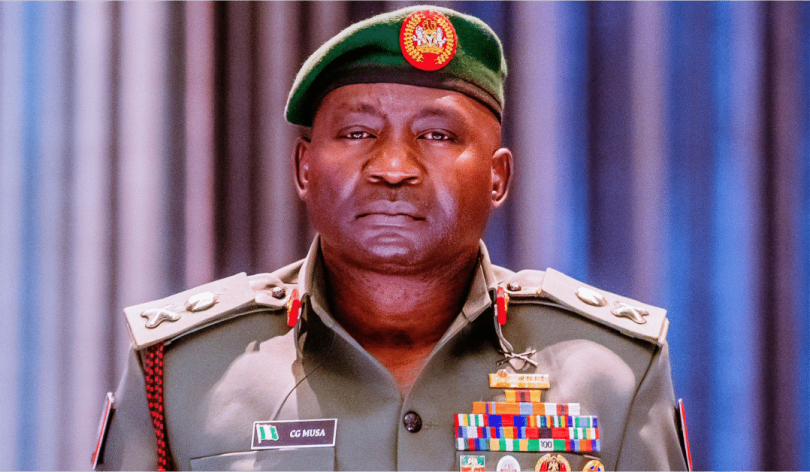
Minister of Defence Christopher Musa has levelled serious allegations against former Kaduna State Governor Nasir El-Rufai, accusing him of deliberately planning the killing of people in Southern Kaduna during his administration.
Musa made the allegation on Thursday while appearing on Channels Television’s Politics Today, where he also discussed the political and security divisions that characterised Kaduna State under the former governor.
According to the minister, El-Rufai’s administration created an atmosphere of deep mistrust between communities in the northern and southern parts of the state.
Musa claimed the situation became so severe that residents from Southern Kaduna found it difficult to live in northern parts of the state, while some people from the north relocated southward.
“We know how it was when El-Rufai was there; it was toxic,” the minister said.
“El-Rufai did a lot of terrible things in Kaduna State. He divided the country, the state, into two. In that, if you are from the south, you cannot go to the north to live. Those ones from the north were moving to the south.”
He, however, credited the administration of Governor Uba Sani with making efforts to reverse the divisions and restore confidence among residents.
Musa said Sani had, within his first year, taken steps to bring people from different parts of the state together, although he acknowledged that the process was not yet complete.
“You see, now everybody is free, everybody has a say. It’s not 100%. Let me tell you, it’s not 100%, but you can see that he’s making deliberate effort in uniting the state,” he said.
‘Southern Kaduna People Are Still Pained’
The Defence Minister said the relationship between El-Rufai and residents of Southern Kaduna remained particularly strained because of the killings recorded in the area during his tenure.
Responding to questions about whether people from Southern Kaduna were unhappy with the former governor, Musa said their grievances went beyond dissatisfaction.
He alleged that El-Rufai had deliberately planned the killing of people in the region.
“I think if there’s anything worse than unhappy, we can never be happy with somebody who has deliberately planned for the killing of our people,” Musa said.
The minister further alleged that statements and past remarks attributed to El-Rufai showed that the former governor had been unapologetic about some of his actions.
Musa also referenced El-Rufai’s previous comments about paying bandits, saying the former governor had publicly spoken about such actions.
“He told us he paid bandits. He told us he did this, he did that. He didn’t hide it,” Musa alleged.
The minister said the impact of the violence had not been forgotten by residents of Southern Kaduna, adding that many people remained traumatised by the killings.
“The Southern Kaduna people are still very pained. Of course, definitely. I mean, if you look at the number of killings that was done there and what is going on now, you can’t compare at all,” he said.
Musa also accused the former governor of denying opportunities to some residents during his administration, claiming that people from El-Rufai’s own part of Kaduna were also affected by some of his policies.
“I can tell you what he has done to people living in Kaduna from his own area. He did a lot of things that I’m sure even him is not proud of,” he added.
Musa Warns Against Divisive Politics
Beyond the allegations against El-Rufai, Musa called for Nigerians to reject political leaders who use ethnic and religious differences to deepen divisions.
Also Read: Nema raises alarm, warns Ogun, 29 states of high risk flooding
The minister argued that Nigeria needs leaders committed to bringing citizens together rather than exploiting existing fault lines for political advantage.
“We should get politicians that want to unite Nigeria,” Musa said.
“For me, any individual who is using either religion, tribe, creed, or anything to divide the state can never be a friend; can never be somebody we look up to.”
He added that politicians who deliberately use religion or ethnicity to create divisions should not be entrusted with public office.
“Anybody who is using religion or tribe or whatever to divide Nigeria is an enemy of the state,” he said.