
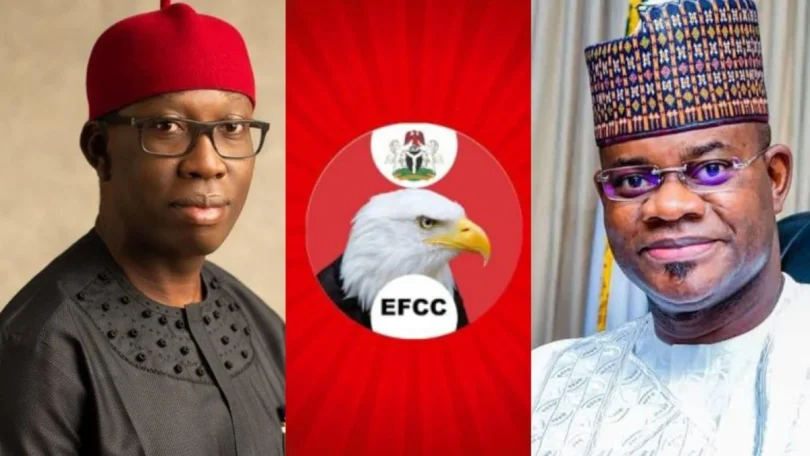
The Economic and Financial Crimes Commission (EFCC) has been given another seven-day ultimatum by the Human Rights Writers Association of Nigeria (HURIWA) to provide an update on its investigations involving former Delta State Governor, Ifeanyi Okowa, and former Kogi State Governor, Yahaya Bello.
The human rights organisation is demanding greater transparency from the anti-graft agency over the allegations involving the two former governors.
It wants the commission to clarify the status of the investigations and explain the steps taken to establish whether public funds were mismanaged during their respective administrations.
HURIWA said it had made previous requests to the EFCC but received no public response.
The organisation subsequently decided to reissue its ultimatum, insisting that Nigerians deserve to know the progress made on investigations involving former public office holders.
The latest demand was contained in a statement dated November 23, 2026, and signed by HURIWA’s National Coordinator, Emmanuel Nnadozie Onwubiko.
In the statement, the organisation directed the EFCC to respond by 9am on Monday, November 30, 2026.
It also demanded that the commission demonstrate within seven working days that it was actively examining the allegations against Okowa.
HURIWA recalled that it first approached the commission on October 9, 2026, asking it to conclude its investigations involving the former governors.
It followed up with another demand on November 13, when it issued a seven-day ultimatum concerning allegations surrounding a reported ₦16 billion contract investigation involving Okowa.
According to the organisation, the absence of a public response from the EFCC informed its decision to issue another ultimatum.
One of the major issues raised by HURIWA concerns an alleged intelligence report titled “Okowa Under Scrutiny Over Alleged ₦16bn Contract, Family-Linked Companies, Security Payments.”
The report reportedly contains allegations relating to contracts, financial transactions and payments made during Okowa’s eight-year administration in Delta State between 2015 and 2023.
HURIWA wants the EFCC to establish whether the document is authentic and whether its contents have been subjected to formal investigation.
The organisation is also asking the commission to clarify whether it has examined relevant government records, including contract agreements, procurement documents, payment vouchers, bank transactions and information relating to the ownership of companies allegedly connected to the transactions.
It further wants the EFCC to explain whether the contracts were awarded in accordance with existing procurement regulations and whether the amounts paid reflected the actual value of the projects.
Another issue raised concerns the physical execution of the projects.
HURIWA wants the commission to establish whether the projects were completed, whether contractors fulfilled their obligations and whether the government received value for the money spent.
The organisation also raised questions about possible relationships between companies that allegedly received government contracts and individuals who occupied public positions during the period under investigation.
It wants the EFCC to identify those who authorised the payments, the individuals or companies that benefited from them and whether there is evidence of any diversion of public funds.
HURIWA also questioned whether President Bola Tinubu had intervened in any way to stop or influence the prosecution of the former Delta governor.
However, the organisation made it clear that its demand for an investigation should not be interpreted as a declaration of guilt against Okowa or any other individual mentioned in the allegations.
It maintained that the former governor and everyone connected to the reported transactions are entitled to the presumption of innocence until a court establishes otherwise.
The controversy surrounding Okowa’s financial dealings dates back to November 2024, when the former governor was reportedly arrested by the EFCC over allegations involving the diversion of approximately ₦1.3 trillion in oil derivation funds.
The allegations generated considerable public attention because of the amount involved and the circumstances surrounding the investigation.
In October 2025, the EFCC’s Director of Legal and Prosecution, Sylvanus Tahir, reportedly stated that investigations into the matter were still ongoing.
Tahir also maintained that joining the ruling All Progressives Congress (APC) would not automatically protect anyone from prosecution if evidence of wrongdoing was established.
Okowa and his successor, Delta State Governor Sheriff Oborevwori, defected from the Peoples Democratic Party (PDP) to the APC in April 2025.
Their decision to join the ruling party generated political reactions, particularly against the backdrop of the ongoing allegations involving the former governor.
Questions were subsequently raised in some quarters about whether political realignments could affect the handling of corruption investigations involving prominent politicians.
Beyond the allegations against Okowa, the organisation also wants the commission to provide a clear update on its investigation involving former Kogi State Governor Yahaya Bello.
Bello has been facing corruption-related proceedings involving allegations of financial misconduct during his administration in Kogi State.
HURIWA is demanding that the commission explain the progress made in the investigation and ensure that the matter is handled without political considerations.
The organisation argued that the EFCC must apply the same standards to former governors and other public officials, irrespective of their political affiliations, positions or connections.
It warned that the credibility of the anti-corruption campaign could be affected if Nigerians are left without clear information about the progress of high-profile investigations.
HURIWA further maintained that the commission has a responsibility to demonstrate that public office holders are not exempted from accountability after leaving office.
The organisation threatened to pursue legal action if the EFCC fails to meet its demands.
It said it could approach the courts to compel the commission to perform its statutory responsibilities.
It also indicated plans to commence national and international advocacy to draw attention to what it described as the need for accountability in the handling of corruption investigations.
Emphasising its position, HURIWA stated: “Public accountability must not be selective,”