
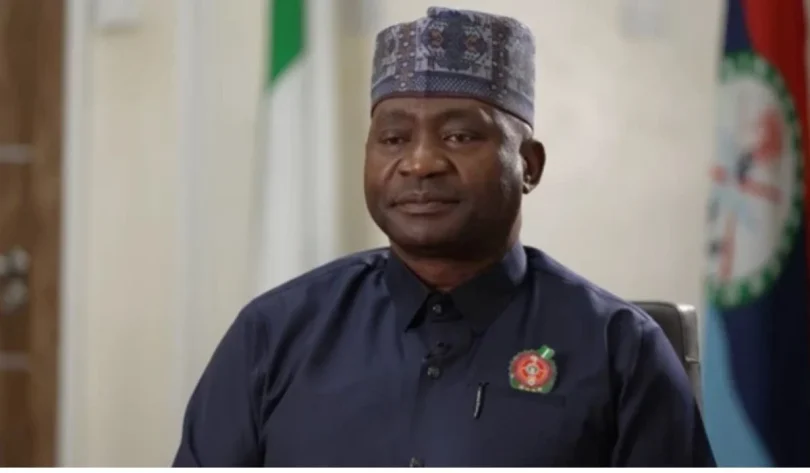
The Minister of Defence, Gen. Christopher Musa, has described the sacrifices made by Nigerian and other West African troops during the civil wars in Liberia, Sierra Leone and Guinea-Bissau as critical to preserving peace and regional unity, urging African countries to unite to prevent the continent from falling apart.
Musa spoke in Abuja on Thursday at the unveiling of Fighting Bushfires: ECOWAS and Peacemaking in West Africa – The Experience and Learning Curves, a book documenting the Economic Community of West African States’ peacekeeping interventions in the three countries.
The event also featured the presentation of the Symbolic Peace of the Rose Award to former commanders of the ECOWAS Monitoring Group (ECOMOG), as well as journalists who documented the conflicts and paid the ultimate price.
The minister disclosed that he lost 10 of his coursemates from the Nigerian Defence Academy during the Liberia conflict, stressing that the sacrifices of the fallen soldiers must not be allowed to become meaningless.
“I finished from Nigerian Defence Academy in 1991, and that’s when we started going to Liberia. I lost 10 of my coursemates in Liberia,” Musa said.
He recalled the story of one of his coursemates from Cross River State who volunteered to join the war in Liberia after returning to a barracks where most of his seniors had already been deployed.
According to him, the officer was advised to remain behind because he was a young officer, but insisted on joining his colleagues at the war front.
“A year later he was killed. Those are the sacrifices that have been made, and that will continue to be made. And I want us to really understand that a lot of people are putting in their lives for us to survive, for us to live,” he said.
Musa urged African countries to honour the sacrifices of the fallen by strengthening unity across the continent.
“What we owe them is to make sure that we unite, and not allow Africa to fall. Other than that, they will not achieve what they died for,” he said.
The minister also challenged narratives that credit foreign powers with restoring peace in Liberia and Sierra Leone, insisting that ECOMOG played a central role in ending the conflicts.
He said it was important for Africans to document their own history rather than allow external actors to define the continent’s contributions to resolving its conflicts.
“If you go to the internet, you see their story that they were the ones that liberated Sierra Leone and Liberia. And so when I watched that video, I asked: ‘Where did you write it?’ You don’t have analytical reference,” Musa said.
“This is where this is very important. We must write the story of our region, otherwise others will write it, and that is very, very critical to all of us.”
He said publications documenting ECOWAS interventions were important not only for preserving history but also for enabling the region to assess its successes and failures.
“These publications are important because they do more than record history. They provide opportunity for us to reflect on what we have done, what worked, where our intentions were and how we can be better,” he said.
Musa noted that Nigeria had consistently contributed troops, resources and political support to ECOWAS peace and security initiatives because the country’s security was closely linked to the stability of neighbouring countries.
“Instability does not respect borders. When conflict persists in one country, its effects can be felt through displaced populations, disrupted trade, organised crime and other forms of insecurity across neighbouring states,” he said.
He stressed that military action alone could not resolve security challenges, saying kinetic and non-kinetic approaches must complement each other.
“The kinetic is just about 30 per cent of the solution; 70 per cent rests with non-kinetic,” he said.
Reflecting on ECOWAS’ 50th anniversary, the minister said the milestone should provide an opportunity for the regional bloc to assess its past interventions and strengthen its capacity to prevent and manage future conflicts.
He cited the experience of The Gambia as an example of what regional diplomacy, collective resolve and commitment to constitutional order could achieve, while saying the experience of Mali offered lessons on the need for honest assessment of ECOWAS’ responses to crises.
Musa, who previously served as Theatre Commander of Operation Lafiya Dole, Commander Infantry Corps and Chief of Defence Staff, also warned countries against allowing asymmetric warfare to take root.
“My advice, having been the Theatre Commander Operation Lafiya Dole, Commander Infantry Corps and Chief of Defence Staff, is that under no condition should an army allow asymmetric warfare to take root in your country, because it is a very, very difficult situation,” he said.
He explained that unlike conventional warfare, which traditionally involves conflicts between states, asymmetric warfare operates within societies and makes the enemy difficult to identify and contain.
“Asymmetric warfare is within. The enemy is within, and that makes it very, very difficult to deal with. So it is important for countries not facing it, please don’t allow it to take root. Nip it in the bud as quickly as possible,” he said.
The ECOWAS event also honoured former ECOMOG commanders, including Lt. Gen. Arnold Quainoo, Maj. Gen. Tunji Olurin, Maj. Gen. Joshua N. Dogonyaro, Maj. Gen. Rufus M. Kupolati, Maj. Gen. J. Ishaya Bakut, Maj. Gen. John Shagaya, Maj. Gen. John Mark Inienger, Maj. Gen. Victor Samuel Leonard Malu, Maj. Gen. Timothy M. Shelpidi, Maj. Gen. Felix Agho Mujakperuo, Brig. Gen. Lamin Mangasouba, Gen. Cheick Oumar Diarra, Gen. (Rtd.) Seth Obeng and Brig. Gen. Maxwell Khobe.
Two Nigerian journalists who were killed while covering the Liberian conflict, Kreed Imodibie of Vanguard and Tayo Awotusin of Champion, were also honoured posthumously.
Veteran freelance journalist Lindsay Barrett and Ben Asante of Ghana were among the other honourees.
The awards came more than two decades after ECOMOG intervened in the conflicts that ravaged Liberia, Sierra Leone and Guinea-Bissau.
Liberia’s civil war began in 1990 and continued through 1997, while Sierra Leone experienced a prolonged conflict between 1997 and 2000. Guinea-Bissau was also engulfed by conflict in 1999.
The book, authored by Prof. Amadu Sesay, chronicles ECOWAS’ experiences in the conflicts and examines the lessons from the regional body’s peacemaking efforts.