
…Christmas menu costs less this year by 20%
…Households restore festive traditions
For the first time in two years, Yemisi Oduola’s family can afford to stock up on food items and buy clothes for the festive season.
With headline inflation dropping to its lowest in over three years and her family’s spending power increasing, she is planning a festive feast and gifts for family and friends, a welcome relief after a two-year pause.
“We couldn’t afford to buy a bag of rice during the festive season last year and in 2022, owing to surging prices,” said Yemisi Olalekan, a sales representative at a carton manufacturing firm in Ogba and mother of three.
“But this year, things are a bit better with food prices dropping,” she noted. “We already bought a 50kg bag of parboiled rice for the festive season, and we plan to give out gifts again for the season after a two-year pause,” she added.
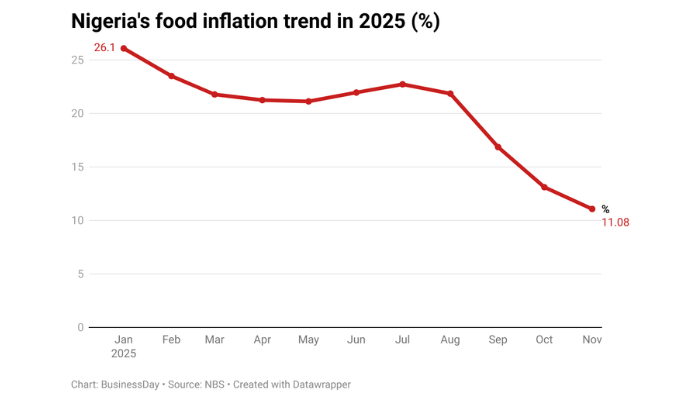
Nigeria’s headline inflation rate eased for the eight consecutive month in November to 14.45 percent and food inflation to 11.08 percent, offering relief for households and businesses.
The slowdown comes as Nigerians continue to grapple with the economic fallout of sweeping reforms introduced by President Tinubu – removal of fuel subsidies and the unification of the exchange rate.
While the policies aimed at restoring fiscal discipline and attracting investment, the measures triggered a sharp rise in the cost of living.
Edward Elechi, a father of four and businessman, couldn’t hide his joy as he stocked up on gifts at Oyingbo/Otto Market, eager to reunite with extended family in Aba for the festive holiday, a trip made possible by recent inflationary easing.
“We usually travel yearly to Aba to celebrate Christmas and New Year with our extended family, but we couldn’t do it in the last two years because things were hard,” he explained.
“This year we are travelling for the festive season. I have already made an early transportation booking to Aba, and you can see I am shopping for the trip,” he said.
He noted that the cost of food, which accounts for over 60 percent of household spending, has eased this year compared to 2024.
“We needed over N500,000 to make our trip last year to the village, which I couldn’t afford and we had to cancel. Rice alone accounted for over N200,000 of the cost because we needed to buy two bags for my family and in-laws. But this year, with N104,000, I have already bought two bags for the trip,” he said.
Titilayo Odumosu, a secondary school teacher at Ojodu, who was at Ketu Market to make purchases, said she can now afford to celebrate this year’s Christmas owing to the drop-in food prices.
“The recent drop in food prices is a big relief for my family. Last year, we couldn’t afford to celebrate the season owing to the constant surge in prices,” said Odumosu, who earns N80,000 monthly.
Olalekan, Elechi and Odumosu, like millions of Nigerians across the country, are stocking up on food and spending on gifts for this year’s festive season as inflation grips loosen.
Market survey shows prices dropping
In a survey of major markets in Nigeria, BusinessDay found that the average prices of some key staples declined in 2025, easing the burden on cash-strapped Nigerians who had been dealing with accelerating inflation since the 2020 pandemic.
BusinessDay surveyed markets in Lagos, Nigeria’s economic capital, and found that the average price of a 50 kg bag of foreign parboiled rice now sells for N54,500, depending on the brand and size of the grain, as against N120,000 sold in the same period of 2024, indicating a 54.5 percent drop in price.
A 50kg bag of local parboiled rice, which was sold for an average of N100,000 a year ago, now sells for an average of N60,000, indicating a 66 percent increase in price.
Similarly, a 10 kg carton of frozen chicken now sells for N57,000 as against N55,000 sold in December 2024, indicating a 3.6 percent increase in price, while a kg sells for N5,500. A 10 kg of frozen turkey now sells for N75,000 as against N85,000 showing last year.
A 25 litres of vegetable oil sells for N70,000 as against N80,000 sold last year in December, a 12.5 percent drop in price.
For fresh tomatoes, a big basket sells for N40,000, same as what was sold last year in December, while a small basket sells for N28,000. A bag of pepper now sells between N45,000 and N50,000.
Prices of onions have declined by 17.8 percent in a year, as a 100kg bag of onions sells for an average of N230,000, as against N280,000 sold in December last year, while a small bag now sells for N160,000.
Foods such as jollof rice, a common feature on the Christmas menu, will cost a Nigerian 20 percent less to prepare this year compared to 2024, according to a BusinessDay’s analysis.
The average cost of preparing a pot of jollof rice, a popular Nigerian delicacy for a family of five, declined 3.17 percent in the third quarter (Q3), falling from N27,528 in June to N26,656 in September, the first time in seven years, according to the latest Jollof Index report.
“The drops in food prices are bringing respite to families, especially in this festive season. Rice, a major staple for millions of households, is selling for the first time in a while below the minimum wage,” said Abiodun Olorundero, managing partner of Prasinos Farms.