
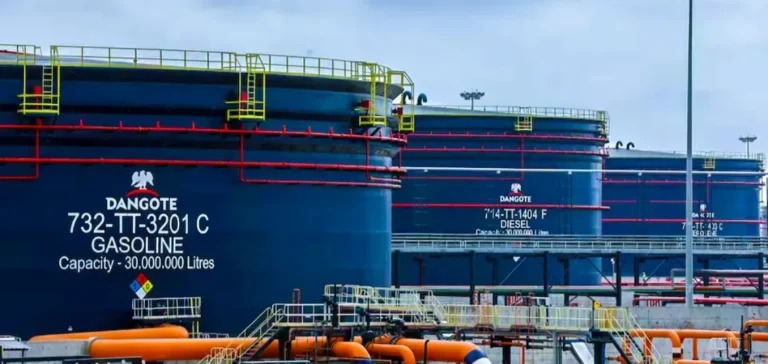
Dangote Petroleum Refinery has successfully raised $750 million through its inaugural Eurobond issuance, a significant move aimed at diversifying its funding base and bolstering its financial standing in anticipation of a planned public listing. This transaction underscores a growing international investor appetite for robust Nigerian corporate credits, distinguishing them from broader sovereign risk perceptions.
The five-year, dollar-denominated bond, maturing in July 2031, was priced at par with a yield of 7.50 per cent. This issuance, conducted via a Rule 144A private placement targeting Qualified Institutional Buyers (QIBs) in the United States and other international markets, mirrors the funding strategy employed by Dangote Fertiliser in April, which raised $750 million through a similar five-year Eurobond priced at 7.75 per cent. According to Eurobond.Africa, the refinery’s ability to secure a pricing 25 basis points lower than the fertiliser unit’s issuance, completed just three months prior, reflects an improved market perception of the refinery project, particularly in light of its operational progress, which has seen refining capacity approach 700,000 barrels per day during test runs.
The pricing of the refinery’s bond is particularly noteworthy as it aligns closely with yields on Nigeria’s sovereign Eurobond curve. This suggests that investors perceive the refinery as a premium corporate credit, even while operating within the Nigerian economic landscape. The bond includes a make-whole call provision, offering investors protection by referencing US Treasury yields plus 50 basis points until July 16, 2028, while simultaneously providing the refinery with flexibility for future refinancing or debt retirement as its operations scale and cash flows strengthen.
This latest issuance brings the Dangote Group’s total international debt raised this year to $1.5 billion, following the earlier fertiliser transaction. The proceeds are earmarked for optimising the group’s debt profile by replacing shorter-term, higher-cost local bank facilities with longer-tenor, fixed-rate dollar debt. This strategic financial manoeuvre is designed to present a more robust balance sheet as the conglomerate prepares for a significant equity fundraising cycle, including a potential secondary listing of Dangote Cement in London around September and a dual-listing Initial Public Offering (IPO) for the Dangote Petroleum Refinery. Successfully securing long-term international funding ahead of these planned listings is expected to enhance the group’s financial position and its attractiveness to global equity investors. The transaction was facilitated by an international syndicate comprising JPMorgan, Bank of America Merrill Lynch, and Standard Chartered.
In parallel with its capital markets activities, Dangote Refinery has announced a further reduction in the ex-depot price of petrol, marking its fourth price cut within a month. The company stated that it continues to pass on lower production costs to consumers, even while processing crude oil acquired at significantly higher international prices. The latest N50 per litre reduction brings the cumulative decrease in the refinery’s Premium Motor Spirit (PMS) ex-depot price to N200 per litre since May 30, 2026, lowering the gantry price to N1,075. Over the same period, the refinery has reduced the ex-depot price of Automotive Gas Oil (AGO) by N300 per litre and Jet A1 aviation fuel by N520 per litre.
The refinery explained that petroleum product pricing cannot directly mirror daily fluctuations in international crude oil markets because crude is purchased weeks, and sometimes months, in advance of processing. The products currently being supplied are derived from crude inventories acquired at substantially higher price points. The average landed cost of crude processed stood at approximately $124.80 per barrel in May and $95.25 per barrel in June, contrasting with the current international benchmark of about $71.01 per barrel. The refinery clarified that its crude procurement costs are not solely based on the headline ICE Brent benchmark but on a Dated Brent basis, inclusive of applicable market premiums, freight, and logistics costs, resulting in actual feedstock costs that differ materially from benchmark prices.
Despite sharp increases in crude acquisition costs, Dangote Refinery deliberately absorbed a significant portion of these additional expenses to support market stability and cushion consumers from global energy market volatility. This pricing strategy has helped maintain petroleum product prices in Nigeria below those in neighbouring countries, even after accounting for applicable taxes. As lower-priced crude cargoes are progressively integrated into its production cycle, the refinery is systematically passing these benefits to the market through phased price reductions. The company expressed confidence that continued favourable international crude prices and the replacement of higher-priced inventories with lower-cost feedstock could lead to further moderation in petroleum product prices for Nigerian consumers. The refinery’s current domestic refining capacity is sufficient to meet national demand, contributing to energy security, reducing import dependence, conserving foreign exchange, and providing greater price stability for consumers and businesses.
... Dangote Refinery Secures $750 Million Eurobond, Signalling Investor Confidence Ahead of IPO and Strategic Debt Restructuring ... Naijaonpoint.