
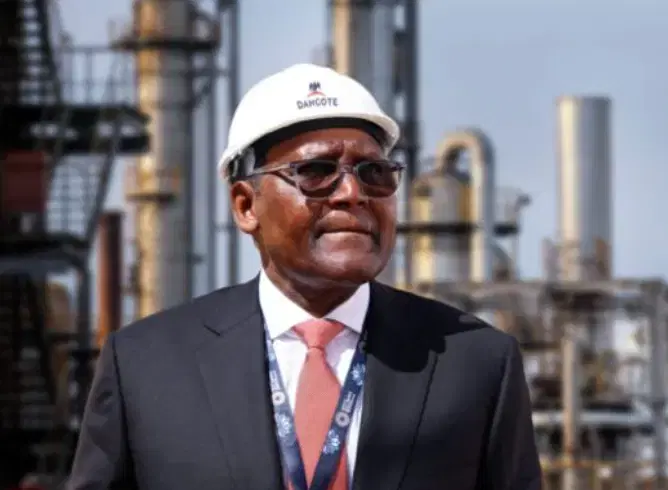
Africa’s richest man and President of the Dangote Group, Aliko Dangote, has alleged that powerful interests in Nigeria’s oil sector attempted to frustrate the construction of the $20 billion Dangote Refinery.
Dangote said some fuel importers feared the refinery would disrupt the long-standing business model that relied heavily on importing refined petroleum products into Nigeria despite the country being a major crude oil producer.
Speaking during an interview with Nicolai Tangen, Dangote said he embarked on the refinery project to end decades of fuel scarcity and long queues at filling stations across Nigeria.
“Africa produces oil, but many countries don’t refine it. They export crude and import refined products, which drains foreign reserves,” he said.
“In Nigeria, we had fuel queues for more than 50 years. People queued for days during Christmas just to buy petrol in an oil-producing country. Government refineries were not functioning properly, so I decided to take the bold step of building a refinery.”
Dangote disclosed that the project, which began in 2013, faced major setbacks, including delays linked to land acquisition and resistance from entrenched interests in the oil industry.
“Some of these obstacles were created by entrenched interests in the oil business — what you might call a mafia — trying to stop us from solving these problems. But we stayed focused,” he said.
He explained that the scale of the project required the company to build extensive infrastructure from scratch, including a dedicated port capable of handling equipment weighing up to 3,000 tonnes, roads, and water treatment facilities.
According to him, the refinery consumes about 440 million litres of treated water, while the water treatment section alone spans more than 30 hectares.
Dangote also highlighted the economic challenges faced during construction, noting that the naira exchanged at about ₦156 to the dollar when the project started but later weakened to as much as ₦1,900 to the dollar.
He said about 67,000 people worked on the refinery project at its peak, adding that the scale of the undertaking became clearer as work progressed.
“It was like swimming across the ocean. Once you’re in the middle, you can’t go back, so you keep moving forward,” he said.
Dangote credited several African and Nigerian financial institutions for supporting the refinery project, including the African Export-Import Bank, African Finance Corporation, Zenith Bank, Access Bank, United Bank for Africa, Standard Bank and Standard Chartered.
He added that despite the difficulties encountered during construction, the refinery’s eventual completion exceeded expectations.