
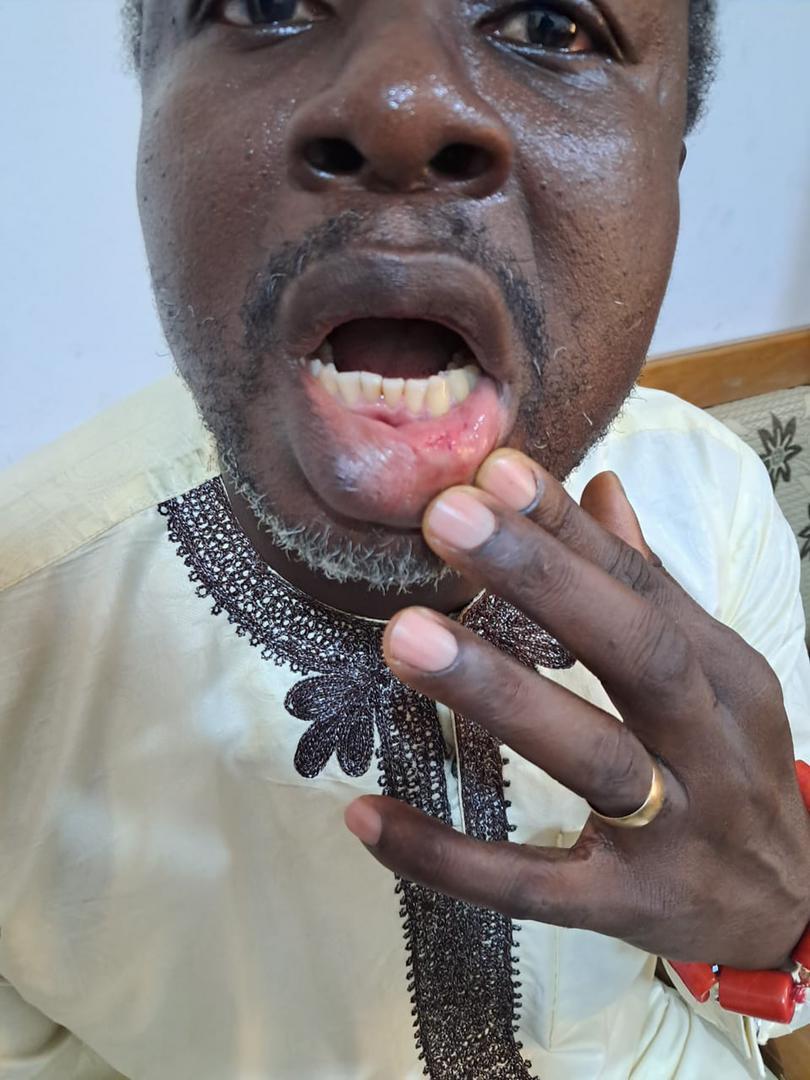
A lecturer in the Department of Theatre Arts at the University of Abuja, Dr Olabode Wale Ojoniyi, has accused the Head of the Department, Dr Awaritoma Agoma, of physically assaulting and threatening to kill him during a confrontation in the HOD’s office.
Ojoniyi, who is also the Acting Director of the Centre for Wole Soyinka Studies at the university, made the allegations in a formal complaint, addressed to the Vice-Chancellor through the Dean of the Faculty of Arts and Head of the Department of Theatre Arts, and obtained by SaharaReporters on Saturday.
He alleged that Agoma pushed, shoved, headbutted, and repeatedly punched him in the face during an argument over academic issues involving a postgraduate student.
According to Ojoniyi, the incident occurred after he went to the HOD’s office following a request for him to see Agoma.
He said another lecturer, Dr Olympus Ejue, was present when the disagreement started over his comments during a seminar presentation by a postgraduate student identified as Richard Gbilekaa.
Ojoniyi said the discussion escalated after he challenged accusations that he had deliberately worked against the progress of the student.
“However, the two of them will not accept my position; instead, the HOD, Dr Awaritoma Agoma, started calling me so many unprintable names, accusing me of being too arrogant and proud, that do I think I am the only intelligent person in a department with many professors,” he wrote.
He alleged that Agoma subsequently ordered him to leave the office and threatened to “cut me to size.”
Ojoniyi said he challenged the order, arguing that the HOD’s office was not a private office, after which Agoma allegedly became violent.
“At that point, he rose up in furious anger, pushed and shoved me, headbutted me and began to punch me severally on the face,” he alleged.
He said the assault left his mouth blistered and his lips and face swollen.
Ojoniyi further alleged that Agoma later pinned his neck against the office door and threatened to kill him.
“I hardly could breathe at that point as he squeezed and pinned my neck to the side of the door,” he stated.
According to the lecturer, a postgraduate student, Femi Emmanuel, intervened during the alleged assault and helped free him from Agoma’s grip.
He also claimed that Agoma threatened the student and warned him against telling anyone that he had witnessed the incident.
Ojoniyi said he subsequently took photographs of the people present in the office because he feared that witnesses could later deny what had happened, insisting that he did not retaliate physically throughout the confrontation.
“In all of these, I did not raise my hands against him to hit him back. I know the value and the worth of civility,” he stated.
The lecturer said he sought treatment at the university clinic following the incident and was still experiencing pain and difficulty swallowing.
“And, ma, as I am writing this, I am finding it very difficult to even swallow my saliva. I am having pains all over my body. This is in spite of the fact that I have earlier gone for treatment at the University clinic,” he wrote.
Ojoniyi linked the alleged assault to a longstanding dispute over the supervision and academic assessment of postgraduate students, particularly Gbilekaa and another student, Sunday Etim.
He said the matter began after he returned from an international conference in June 2025 and was informed by Agoma and another lecturer, Dr Agozie, about petitions allegedly submitted by postgraduate students to the Dean of Postgraduate Studies.
According to him, he was involved in the academic supervision or assessment of the two students and had insisted that they carry out corrections before proceeding with subsequent stages of their postgraduate work.
Ojoniyi claimed that Gbilekaa attempted to submit a second seminar paper without properly addressing corrections from his first seminar.
He also alleged that Etim had failed to implement corrections identified during his internal defence.
He said his insistence on adherence to academic procedures led to disagreements with colleagues and eventually resulted in his removal as Postgraduate Coordinator.
Ojoniyi alleged that Agoma subsequently told him he could not work with him and directed him to hand over the position.
He said he complied and submitted a handover note which, according to him, was signed by Agoma.
The lecturer further claimed that he later overheard Agoma discussing him with Dr Ejue and allegedly boasting that he had “started cutting my feathers” and would “further cut me to size.”
He said he confronted the two lecturers after overhearing the conversation and subsequently reported the matter to several senior academics.
Ojoniyi said the July 23, 2025 confrontation was therefore the culmination of what he described as a campaign against him.
In his formal complaint, he called for an investigation into the alleged assault and demanded protection from further attacks.
“I want to be protected as Dr Awaritoma Agoma has vowed to deal with me. I need to be protected both within and outside the University,” he stated.
“In fact, ma, if anything should further happen to me in the form of any attack on my person, kidnapping, strange disappearance, or assassination, my HOD, Dr Awaritoma Agoma, should be held responsible.”
However, nearly nine months after the alleged incident, a letter dated April 28, 2026, showed that Ojoniyi himself was suspended by the university management.
The suspension letter, signed by the Acting Registrar, Sambo Mohammed, said the Vice-Chancellor had approved Ojoniyi’s suspension following consideration of an Investigation Panel’s report on an alleged case of “assault and battering leading to body injuries.”
The letter stated that Ojoniyi would remain suspended pending the outcome of the Staff Disciplinary Committee’s report.
According to the suspension letter, he would receive half pay during the suspension and would require the Vice-Chancellor’s permission to travel outside Abuja.
“This is to inform you that the Vice-Chancellor, acting on the powers conferred on him under Chapter 16, Section 2 of the University of Abuja Act, has approved your suspension in consideration of the report of the Investigation Panel on the alleged case of assault and battering leading to bodily injuries levelled against you,” the letter read.
“Accordingly, you are hereby suspended with immediate effect pending the outcome of the Staff Disciplinary Committee’s report.
“Pursuant to Section 16, sub-section (4) of the University of Abuja Act, you will be placed on half pay during the period of suspension.
“While on suspension, you are not allowed to travel out of Abuja without the express permission of the Vice-Chancellor.
“Meanwhile, you are directed to hand over any University property in your possession to the Head, Department of Theatre Arts/Dean, Faculty of Arts before proceeding on the suspension.”
Ojoniyi, in a response dated April 30, 2026, rejected the basis of the suspension and argued that the university had wrongly attributed the assault allegation to him.
“Number one, sir, there is no allegation of ‘assault and battering leading to bodily injuries’ levelled against me by anybody in writing or verbally before the university for which I was, or I am being investigated,” he wrote.
“On the contrary, I am the one who, on 23 of July, 2025, reported a case of assault and battering leading to bodily injuries against Dr Awaritoma Agoma, the Head of the Department of Theatre Arts.”
He also stated that he had never appeared before the university’s Staff Disciplinary Committee.
“I sincerely trust that justice will not only be done in the case, but will be seen to have been done,” Ojoniyi stated.
The documents did not indicate the outcome of the investigation into the original assault allegation against Agoma or provide the university’s detailed findings on the circumstances that led to Ojoniyi’s suspension.
The university did also not, in the documents provided, publicly state its response to Ojoniyi’s allegations against Agoma or the claims that he was physically assaulted and threatened with death.
The controversy has raised questions about the handling of internal disputes, academic supervision, and disciplinary procedures at the institution, particularly where allegations of physical violence and counter-allegations against a lecturer are involved.