
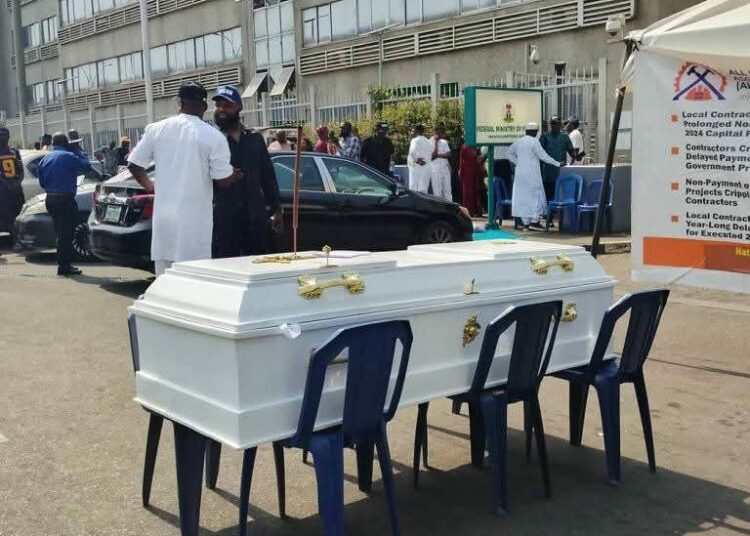
Local contractors under the All-Indigenous Contractors Association of Nigeria on Wednesday intensified their agitation in Abuja, staging a dramatic protest at the Federal Ministry of Finance over what they described as the Federal Government’s refusal to pay more than N500 billion owed for completed projects.
The demonstrators, who arrived early, blocked all entry and exit points to the ministry with a coffin, chanting solidarity songs and vowing not to leave until the outstanding payments were released.
Their blockade caused heavy gridlock across the Central Business District, leaving staff and visitors stranded for hours. This is the second time in a month the group has shut down the ministry’s gate in a bid to press home their demands.
The Federal Ministry of Finance issued no official response to the contractors’ claims, leaving the standoff unresolved as the protesters insisted they would continue occupying the premises.
Led by the association’s National Secretary, Babatunde Seun-Oyeniyi, the group said the latest protest became necessary following repeated “broken promises” and shifting commitments by the ministry.
According to the contractors, several meetings with government officials failed to produce any concrete steps toward clearing the backlog.
Speaking to journalists at the ministry’s gate, Oyeniyi described months of frustration despite earlier assurances. He recalled the intervention of the National Assembly earlier in the year, which persuaded the contractors to suspend their protests after lawmakers assured them that the ministry would fast-track payments.
However, he said the ministry became unresponsive once the demonstrations ceased.
“After the National Assembly stepped in, they told us they would sit the minister down over this issue, and we immediately halted our protest,” Oyeniyi said. “But since then, nothing has changed. We’ve visited this place more than six times. Last week, we were here all night before the Minister of Finance came out to address us.”
He added that contractors had “verifiable” evidence that funds were available, citing their last conversation with the minister. “From our last conversation, the minister told us about N150 billion was ready to pay indigenous contractors. We don’t understand why the delay persists,” he stated.
Although some payment warrants had been sighted, Oyeniyi noted that they had not been cash-backed. “When we collated everything, they are owing more than N500 billion. We only see warrants—there’s no cash,” he said.
The association also accused government officials of attempting to push the payments into the 2026 fiscal year, warning that such a move would plunge many contractors and small businesses into deeper economic hardship. “They want to shift us into a backlog, push our claims to 2026, and turn us into debt. We won’t accept that. We won’t leave here until we are paid,” Oyeniyi vowed.
The group further alleged that the Minister of Finance, Wale Edun, had redirected them back to the National Assembly— the same institution that previously intervened—worsening mistrust between indigenous contractors and government authorities.
Throughout the protest, demonstrators carried placards expressing frustration and accusing the government of crippling local businesses. Many contractors claimed that banks had stopped financing government-related projects due to prolonged non-payment. Some lamented that several colleagues had died by suicide under the burden of mounting debt and financial distress.
Others argued that although inflation had eroded the value of the funds owed, the government still had a duty to honour its contractual commitments. They described withholding payments for nearly a year as an “economic crime,” insisting that the persistent delays were unjust and amounted to fraud.
Wednesday’s protest adds to growing tensions between contractors and government authorities. In November, members of the House of Representatives suspended plenary for one week after contractors stormed the National Assembly Complex, accusing the government of withholding funds appropriated for the 2024 and 2025 fiscal years.