
The Coalition of Indigenous Middle Belt Organisations (CIMBO) has declared its total support for the Middle Belt Forum (MBF) in rejecting the proposed monthly ₦1 billion contribution by northern governors to the Northern Nigeria Security Trust Fund (NNSTF).
It urged governors of Middle Belt states to instead deploy the funds to strengthen security within their respective states through community-based initiatives.
In a press statement jointly signed by its Chairman, Prof. Ejeikwu Emmanuel Oloja, and Secretary, Dr. Billy Ishaya Laah, the umbrella body argued that the proposed contribution would be better invested in supporting local vigilante groups, strengthening intelligence gathering, improving communication networks among states, local government areas and communities, and facilitating the resettlement and protection of internally displaced persons (IDPs).
The coalition said its position aligns with that earlier expressed by the MBF through its spokesman, Luka Binniyat, insisting that security resources should remain under the direct control of individual states to address the peculiar security challenges confronting the Middle Belt rather than being committed to a regional trust fund whose objectives and deployment framework remain unclear.
CIMBO maintained that governors of Middle Belt states would achieve more effective security outcomes by deploying the proposed contributions to strengthen local vigilante groups, improve intelligence gathering, establish effective communication networks among states, local government areas and communities, and facilitate the safe resettlement and protection of internally displaced persons (IDPs).
According to the coalition, rather than contributing to a regional trust fund whose objectives and operational framework it considers unclear, the resources should be channelled into practical, community-based security initiatives capable of addressing the persistent attacks by terrorists, armed bandits and other criminal groups affecting many Middle Belt communities.
The statement questioned the rationale behind the proposed NNSTF, arguing that the purpose and intended deployment of the fund had not been sufficiently defined to justify committing substantial public resources. It contended that any security arrangement that does not expressly guarantee the protection of Middle Belt communities would not adequately serve the interests of the region.
CIMBO further alleged that the NNSTF was not designed to protect the interests of the Middle Belt, asserting that the initiative could ultimately work against the region’s security and political interests. It also said the people of the Middle Belt remained uncertain about how terrorism and banditry escalated across their communities and questioned why governors from the region should contribute to a security fund whose objectives, in its view, remain uncertain.
The organisation claimed that the proposed trust fund was structured primarily to advance interests outside those of the Middle Belt and would not provide adequate guarantees for the protection of lives, communities and territories within the region. It therefore urged Middle Belt governors to reject participation in the funding arrangement entirely.
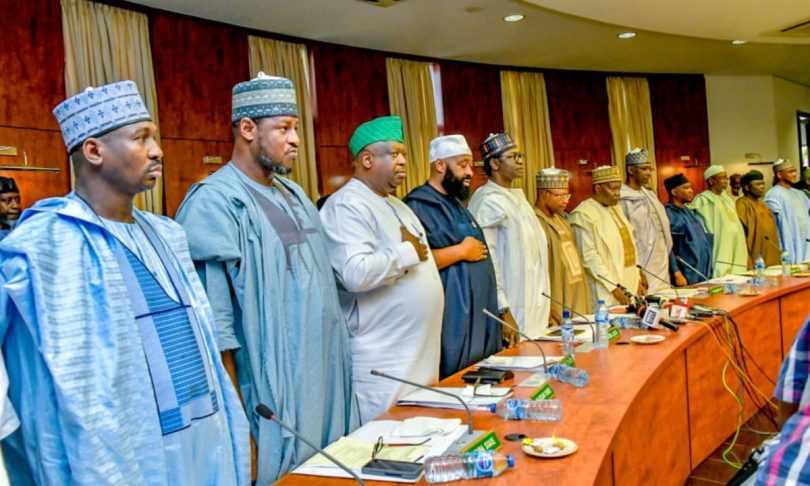
However, the coalition’s position contrasts with that of the Northern States Governors’ Forum, which established the Northern Nigeria Security Trust Fund following a joint meeting with the Northern Traditional Rulers’ Council in Kaduna.
Under the arrangement, each of the 19 northern states is expected to contribute ₦1 billion monthly to finance regional security coordination, intelligence sharing, logistics and other measures aimed at combating terrorism, banditry, kidnapping and related crimes.
The governors have maintained that the trust fund is intended to complement federal security efforts through stronger collaboration among security agencies and traditional institutions in response to the region’s numerous security challenges.
Beyond the security debate, CIMBO renewed its longstanding advocacy for the recognition of the Middle Belt as a distinct socio-political bloc. The organisation argued that there is no single “Northern Nigerian Region,” insisting instead that the North-East and North-West should be regarded as separate regions, while the present North-Central should be recognised as the Middle Belt Region.
According to the coalition, the concept of one Northern region has historically been used to politically dominate and suppress the peoples of the Middle Belt. It maintained that this historical reality informed its rejection of the proposed security fund contributions by governors from the region, arguing that participation would ultimately benefit interests outside the Middle Belt.
CIMBO also highlighted its historical roots, describing itself as an umbrella platform uniting socio-cultural organisations across Benue, Plateau, Nasarawa, Niger, Kogi, Kwara, Taraba, the Federal Capital Territory and indigenous communities in parts of Southern Kaduna, Bauchi, Gombe, Adamawa, Kebbi and Northern Cross River. It said its ideological foundation traces back to the political movement led by figures such as the late Joseph Sarwuan Tarka, Patrick Dokotri, David Lot and Gwamna Awan, whose efforts culminated in the formation of the United Middle Belt Congress (UMBC) in 1957 to advocate the political rights and identity of minority ethnic nationalities in the region.
The coalition noted that the Middle Belt occupies a strategic place in Nigeria’s political landscape because of its population, electoral significance and geographical location, while also bearing the brunt of recurring farmer-herder conflicts, terrorism, armed banditry and communal violence that have displaced hundreds of thousands of residents across several states.