
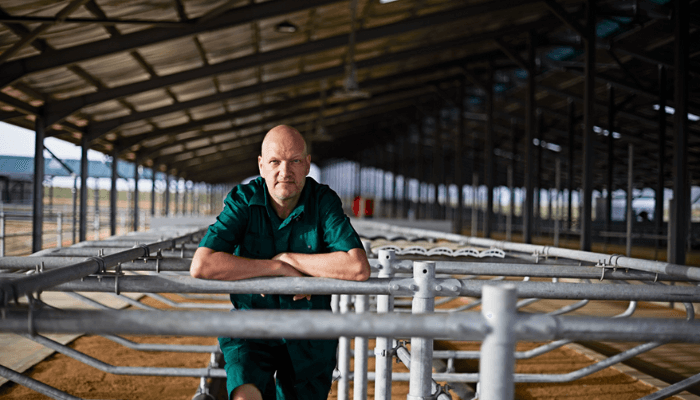
Global food giant, Arla Foods is ramping up efforts to boost dairy production in Nigeria with an ambitious plan to produce half of its milk production in Africa’s largest consumer market while the other half is expected to come from Europe in a new push to slash imports and strengthen local production. In this interview with Snorri Sigurdsson, head, Raw Milk Supply, and Production, Arla Foods, Nigeria, he explains how the consumer goods maker is contributing to the dairy sector in the country alongside the significance of its multifaceted investments. BusinessDay’s Wasiu Alli comes with the excerpt:
What is the significance of Arla’s 2025 Open Day at the Arla Damau Site, and what does this event represent for the company?
The 2025 Arla-Dano Farm Open Day was a powerful reflection of our mission to contribute to a stronger, healthier, and more nourished Nigeria through sustainable dairy development. Every innovation showcased on the farm demonstrates our commitment to turning dairy into a driver of nutrition, livelihood, and meaningful progress. This farm is not just a facility, it is purpose in action, enabling learning, collaboration, and real impact across the dairy value chain.
The new yoghurt factory commissioned at the open day further reinforces our mission to build local capacity, producing delicious yoghurt with 100% fresh milk sourced directly at the farm.
Our vision remains clear: a future where every child, every family, and every community can thrive through the power of high-quality dairy nutrition. Together, we continue to champion food security in Nigeria, support farming communities, and build a dairy sector we can all be proud of.
In the context of Arla’s operations across Africa, what sets the Arla-Dano Farm apart as a unique model?
The Arla-Dano Farm is a state-of-the-art farm and one of its kind in not only Nigeria but all West Africa. It has unique cow monitoring systems, to electronically follow the cows and their behaviour. All animals are free, none are tied up, all animals sleep on soft dry sand from the Sahara and in the periods when it is hot, the specially designed cooling systems for animals are activated with fans, misting systems and wetting systems to make sure animal welfare is always at its peak. Additionally, the Arla-Dano farm has a quite unique milk cooling system, that uses the energy from the sun to produce ice that then rapidly cools down the milk after milking. This makes the milk quality outstanding and in a league of its own in the Country.
Beyond Damau, how is Arla contributing to the broader development of Nigeria’s dairy sector?
By leading the way for other dairy farmers in the country by sharing our knowledge from the Arla-Dano farm and by opening our doors up for guests. Furthermore through the Nigerian Dairy Centre of Excellence Arla is leading the way for professionals, students, farmers and others in the dairy farming industry by collecting knowledge within the field and sharing it centrally for everyone to gain from it.
Our work directly contributes to food security, youth employment, and economic empowerment demonstrating that dairy is a tool for nation building. We are committed to a Nigeria where dairy supports both nutrition and prosperity.
The Arla-Dano Farm is seen as a benchmark for sustainable dairy production. What key progress has been made since its establishment?
There are several things to have in mind when it comes to sustainability and the Arla-Dano Farm. Firstly it is the production of milk per cow that should be mentioned. The carbon footprint on milk is quite strongly related to the yield and the lower the milk yield per day per cow is, the bigger the carbon footprint. At the Arla-Dano Farm the yield is currently clocking on 30 kg per cow per day and the goal is to reach 35 kg/cow/day within a short time. This will have a huge impact on the carbon footprint of the produced milk. Additionally, the farm is equipped with solar panels that provide electricity for its operations. The surrounding fields are used optimally by using irrigation powered by solar energy while manure is collected and used as fertilizer. Many other initiatives can be named such as the optimal growth of calves to enable them reach maturity at an early age as well as focus on longevity of the cows etc.
The Open day and Nigerian Dairy Centre of Excellence have also been birthed from our activities at the Arla-Dano farm, strengthening our knowledge sharing which is instrumental in the development of a sustainable dairy sector in Nigeria.
Another key milestone since inception is now the recent set-up of the Yoghurt factory right beside the farm. Our raw milk is now being used to produce our own cool cow yoghurt right there at the farm made with 100% milk bringing commercial value to our operations.
Animal wellbeing is central to milk quality. How does your team ensure that the cows remain healthy, comfortable, and optimally productive?
The Arla-Dano farm has uniquely designed barns with sand in the bedding area so that all animals rest on sand except smallest calves that rest on rice husk. This makes the lying comfort optimal for the animals that can rest well and relax properly. Furthermore the unique cooling system makes them even more comfortable and finally the feed is specially designed and mixed for different ages and production groups to optimize the well-being of the animals.
Arla recently commissioned the Cool Cow Yoghurt factory using 100% fresh local milk. What does this milestone mean for Nigeria’s dairy industry?
This brings us a step closer to our goal of advancing local milk production, building local capacity and developing a sustainable dairy sector in Nigeria. It exemplifies our vision of transforming raw milk into nutritious, affordable products made in Nigeria for Nigerians and it strengthens the local economy and builds consumer confidence in dairy produced at home.
Collaboration appears to be a core part of Arla’s strategy. How critical are partnerships in achieving your dairy development goals in Nigeria?
Partnerships are absolutely fundamental to our success. The transformation of Nigeria’s dairy sector requires collective action, shared expertise, and coordinated investment. No single organization can solve the systemic challenges alone, from inadequate infrastructure to farmer and expertise capacity gaps and market access.
At Arla, collaboration is not just a strategy; it is a philosophy. We work closely with Federal and State Governments, the Ministry of Agriculture, Kaduna State, universities, development agencies and financial institutions to create pathways that enable long-term dairy sustainability. Through initiatives like the Arla-Dano Farm and smallholder training programs, our partnerships allow us to accelerate farmer productivity, expand local milk sourcing, and scale innovation.
Since the Arla Damau Site’s establishment, how has support from the Federal and Kaduna State Governments contributed to the farm’s success?
Government support has been instrumental from the very beginning. Both the Federal Government and Kaduna State have provided infrastructure backing, regulatory support, land access, and an enabling environment that allows innovation to scale.
Their commitment to dairy development has empowered us to build a farm that is not only commercially viable but a national learning model for future dairy investments. Through structured engagement, capacity development programs, the government’ssupport has strengthened the dairy value chain and the sustainability of local milk sourcing.
These collaborations demonstrates how strong policy frameworks can attract global expertise, build local competence, and stimulate rural economic growth. It also reinforces that Nigeria is serious about reducing dependency on imports and harnessing local production to drive food security and shared prosperity.
Arla recently launched the Nigerian Dairy Centre of Excellence at the Open Day. Can you tell us more about this?
The Nigerian Dairy Centre of Excellence is a flagship knowledge exchange platform designed to revolutionize dairy education, skills development, and research in Nigeria. It is a national innovation and training hub that will equip farmers, veterinarians, processors, students, and industry professionals with world-class knowledge and practical experience.
The platform will provide structured training in areas such as animal nutrition and welfare, breeding, milk hygiene, farm technology, and commercial dairy operations enabling a new generation of highly skilled dairy professionals.
Its mission is simple: to professionalize dairy farming in Nigeria and to build a sustainable talent pipeline that supports the entire value chain. By combining scientific research with hands-on learning, the Centre will empower thousands of farmers and ultimately contribute to industrial scale local milk production.
This is a long term investment in human capital because at Arla, we believe dairy is not just food, it is livelihood, nutrition, and progress.