
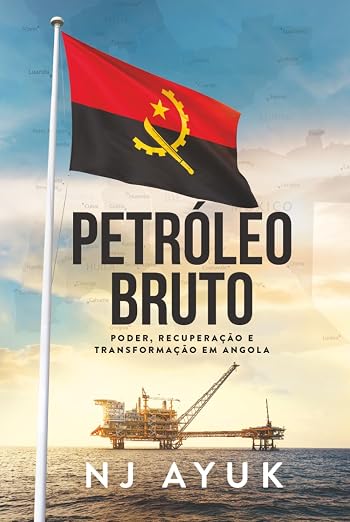
NJ Ayuk’s seminal work, “Crude Oil: Power, Turnaround, and Transformation in Angola,” has been released in Portuguese, significantly broadening its accessibility to stakeholders across Lusophone markets. This bestseller, which debuted as an Amazon “New Releases” top pick earlier this year and is slated for adaptation into a feature-length documentary by Soyini Tales, offers a comprehensive analysis of Angola’s oil industry. It meticulously details how political leadership, institutional reform, and strategic investment have fundamentally reshaped one of Africa’s most significant crude-producing nations.
The book provides a dual perspective, blending historical political context with in-depth sector analysis and firsthand accounts from key decision-makers. It critically examines the policy reforms that have not only revitalised Angola’s investment climate but also strategically positioned the country for a new era of growth within the upstream sector. The release of the Portuguese edition coincides with a pivotal moment for Angola’s energy landscape, as the nation continues to attract substantial investment across upstream, gas, and downstream segments. Projections indicate up to $70 billion in upstream investments alone over the next five years, underscoring the global interest in Angola’s oil and gas opportunities.
This publication aims to democratise access to the critical lessons driving Angola’s energy sector transformation, fostering deeper engagement among policymakers, industry professionals, students, and investors. Insights from prominent figures, including the Minister of Mineral Resources, Petroleum, and Gas, Diamantino Azevedo, Sonangol CEO Sebastião Gaspar Martins, and the President of the National Oil, Gas, and Biofuels Agency (ANPG), offer readers an unparalleled view into the institutional reforms and strategic decisions that have successfully restored investor confidence and revitalised exploration activities.
The book delves into specific reforms that have redefined Angola’s oil industry, such as the establishment of the ANPG, the implementation of a multi-year licensing strategy, the Permanent Offer Regime, and the Incremental Production Initiative. These measures have been instrumental in attracting new capital from international operators and independent companies, while simultaneously facilitating the development of major upstream projects.
Evidence of these reforms is clearly visible in Angola’s expanding exploration and production portfolio. Major international oil companies, including TotalEnergies, Azule Energy, ExxonMobil, and Chevron, have advanced exploration agreements, intensifying drilling in established basins like Cuanza and Lower Congo, and venturing into frontier areas such as Namibe and Benguela. Concurrently, independent companies like Afentra, Corcel, Alfort Petroleum, and Etu Energias are spearheading seismic acquisition and drilling onshore, supported by the flexible policies enacted in recent years.
Angola’s production trajectory reflects this renewed dynamism. The commissioning of the Begonia and CLOV Phase 3 developments in 2025 added 60,000 barrels per day to the market, while the Agogo FPSO commencement boosted production for the Integrated West Agogo Field Development. Progress continues on the Kaminho deepwater project, with significant operator investment in developing already explored fields to enhance output. These developments signal a market that has successfully transitioned from production decline to sustained growth.
Beyond documenting Angola’s remarkable turnaround, the book presents its experience as a valuable case study for other resource-rich nations aiming to enhance governance, bolster regulatory certainty, and cultivate more competitive investment environments. It underscores how institutional reform, rather than solely focusing on production metrics, can serve as the bedrock for long-term economic development within the energy sector. As Ayuk states, “Angola’s story is not just about oil production. It’s about reform, resilience, and the will to face difficult realities to build a stronger future.” The Portuguese edition ensures that this narrative and its applicable lessons for Angola and the broader African continent are accessible to a wider audience.
... Angola’s Energy Reforms Under Scrutiny: Bestselling Book on Oil Sector Transformation Now in Portuguese ... Naijaonpoint.