
Africa’s private capital market is showing a paradox that could redefine how investors interpret fundraising activity across the continent.
While the amount of disclosed capital flowing into African investment funds collapsed by more than 75 percent in the second quarter of 2026, the number of institutional investors committing money remained one of the strongest on record, suggesting confidence in Africa’s long-term investment story has not faded but is becoming more fragmented.
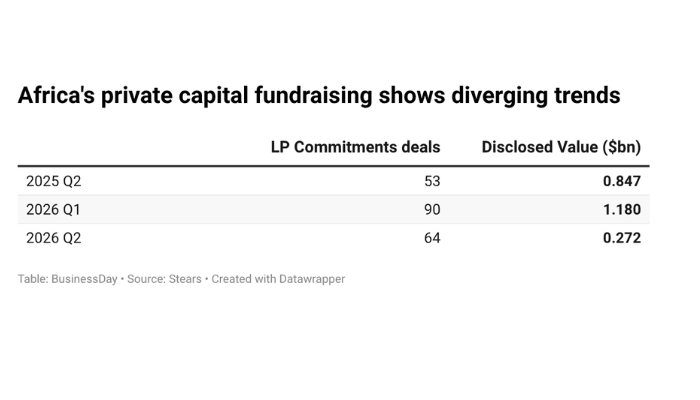
A BusinessDay analysis of the Stears Q2 2026 GP-LP Fundraising Report shows African private capital funds attracted 64 Limited Partner (LP) commitments during the second quarter, the highest second-quarter commitment volume since 2021 and significantly above the 53 commitments recorded in Q2 2025. However, disclosed fundraising value plunged to $272 million, down from $1.18 billion in Q1 2026 and $847 million a year earlier.
The figures illustrate a market that is attracting more institutional investors, even as the average size of disclosed commitments declines.
As the report notes, “Q2 2026 was a relatively strong quarter by commitment volume but weak by disclosed value.”
For African fund managers, this could signal an important structural shift.
Instead of depending on a handful of development finance institutions (DFIs) making large allocations, fundraising increasingly reflects a wider base of investors deploying smaller amounts across multiple funds.
More investors, smaller tickets
The divergence between fundraising volume and value is perhaps the quarter’s biggest story.
While LP commitments fell from 90 in Q1 to 64 in Q2, the number remained comfortably above the 53 commitments recorded during the same period last year. Meanwhile, disclosed capital plunged to its lowest second-quarter level since Stears began tracking the data.
According to the report, “LP commitment volume reached its highest second-quarter level since 2021, signalling continued LP engagement with African private capital funds.” However, it added that disclosed value “fell to the lowest second-quarter total in the dataset.”
One reason is transparency. Only 30 percent of LP commitments disclosed investment amounts during the quarter, compared with 41 percent in Q1 and 45 percent a year earlier.
The report explains that the weaker disclosure rate partly explains the weaker headline value, although it also acknowledges the market experienced a quieter quarter for large disclosed commitments.
Venture capital reclaims the spotlight
Another notable development is the return of venture capital as Africa’s leading fundraising strategy.
VC accounted for 50 percent of all LP commitments, rising from 37 percent in the previous quarter, while also representing 34 percent of disclosed fundraising value.
That makes venture capital the continent’s dominant fundraising asset class once again. Stears attributed the performance to active fundraising by vehicles such as Sony Innovation Fund IV, Working Capital Fund III, and Endeavor Harvest Fund III, each of which attracted multiple institutional investors.
The report concluded that VC-led activity by volume and value, while private equity, infrastructure, and private credit each captured roughly one-fifth of disclosed fundraising value, demonstrating that investor appetite remains diversified despite weaker overall fundraising.
Private equity, which dominated value in Q1, lost momentum during the quarter, accounting for 22 percent of LP commitments and 23 percent of disclosed capital.
Infrastructure, despite accounting for only 11 percent of commitment volume, represented 22 percent of disclosed value, highlighting investors’ continued willingness to finance capital-intensive projects.
Technology replaces energy as investors’ favourite sector
Perhaps the clearest evidence of changing investor priorities is found at the sector level.
For the first time in recent quarters, information technology displaced Energy & Utilities as Africa’s leading investment destination.
Technology appeared in 61 percent of all LP commitments, more than tripling from 17 percent recorded during the same quarter last year. By disclosed investment value, technology also ranked first, accounting for 56 percent of fundraising.
According to the report, “Information technology became the leading sector across both measures, marking a major shift from Q2 2025.” Stears believes the change reflects renewed momentum in venture capital fundraising rather than a wholesale shift away from traditional sectors.
Indeed, Energy & Utilities still appeared in 44 percent of commitments, while Agriculture and Financial Services each featured in 31 percent. The report argues that “LP attention is rotating within a stable set of core African investment themes, instead of moving into a completely different sector base.”
Mega deals disappear
The fundraising profile also changed significantly. Nearly 58 percent of disclosed commitments were below $10 million, while the remaining commitments were concentrated in the $10-20 million and $20-50 million categories.
Notably, no disclosed commitment exceeded $50 million. Stears observed that this reinforces the absence of large anchor allocations in the period, contrasting sharply with the previous quarter when several sizeable institutional investments boosted fundraising totals.
BusinessDay’s analysis suggests this increasingly diversified fundraising structure may ultimately improve resilience within Africa’s private capital market by reducing dependence on a small number of institutional investors.