
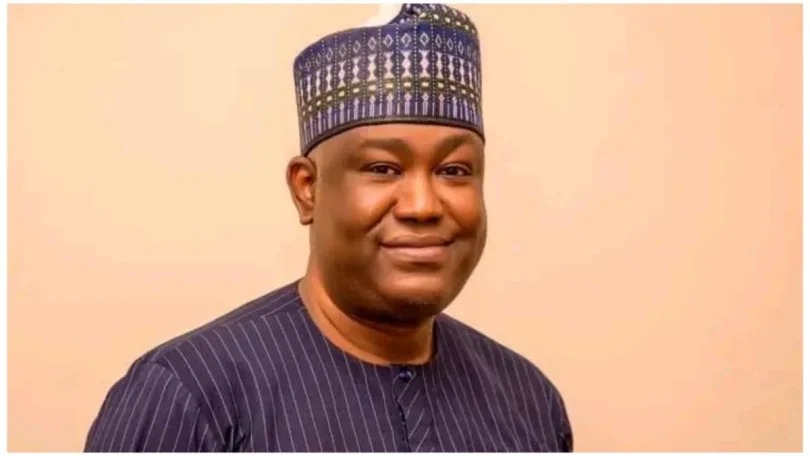
Accord Party chieftain and Co-Chairman of the Movement for Democratic Renewal, Dr. Gbenga Hashim, has called for the disbandment and reconstitution of the Independent National Electoral Commission (INEC) over its handling of the legal dispute surrounding provisions of the Electoral Act 2026.
Hashim said the electoral commission should be reconstituted ahead of the 2027 general elections, arguing that INEC must be an institution that places constitutional supremacy above statutory provisions.
His demand comes days after the Supreme Court heard arguments in the legal dispute between INEC and the Zenith Labour Party (ZLP) over provisions of the Electoral Act 2026.
The apex court on Wednesday, September 16, 2026, reserved judgment in the matter after a seven-member panel led by Justice Adamu Jauro heard submissions from the parties. The court said the date for judgment would be communicated to the parties.
The case centres on Sections 77(5), 77(6), 77(7) and 84(2) of the Electoral Act 2026.
The provisions deal mainly with political party membership registers and the methods through which parties nominate candidates for elections.
The dispute started after the Zenith Labour Party challenged the provisions at the Federal High Court in Abuja.
The party argued that the provisions were inconsistent with the 1999 Constitution and amounted to interference in the internal affairs of political parties.
The Federal High Court dismissed the suit on May 5, 2026. ZLP subsequently appealed the decision at the Abuja Division of the Court of Appeal.
On July 16, 2026, the Court of Appeal allowed the appeal in part and voided the disputed provisions.
The appellate court held that the affected provisions were inconsistent with Sections 221 and 222 of the 1999 Constitution, as amended.
The judgment became the basis of INEC’s appeal before the Supreme Court.
Hashim, however, said the electoral commission’s decision to challenge the Court of Appeal judgment raises questions about its role as the institution responsible for conducting elections.
He argued that INEC should not be seen as defending provisions that an appellate court had already declared inconsistent with the Constitution.
“The Constitution is supreme. The National Assembly makes laws. INEC administers elections. INEC is not the Parliament and INEC did not make the Constitution.
“So when a competent Court of Appeal declares specific provisions of an Electoral Act inconsistent with the Constitution, why is INEC fighting in court to restore those provisions rather than working with relevant political parties to address previous infractions?”
Hashim stressed that his objection was not based on INEC’s right to appeal.
He acknowledged that the commission was entitled to approach the Supreme Court but questioned the institutional interest behind the decision to pursue the appeal.
“Of course, INEC can appeal. The issue is not whether it has the right to appeal. The question Nigerians should ask is; ‘what institutional interest does the electoral umpire have in sustaining provisions which a competent appellate court has declared inconsistent with the Constitution?’
“Does this not raise questions about INEC’s complicity in the very process that Nigerians are asking it to be an umpire over?”
According to Hashim, the dispute is significant because the interpretation of the disputed provisions could affect political parties and the process of selecting candidates for the 2027 elections.
He said actions taken under the disputed provisions should be reconsidered, pending the Supreme Court’s final decision.
Hashim also criticised what he described as INEC’s continued defence of the provisions.
“INEC is fighting in all courts, including the Supreme Court, wasting public resources to hire big lawyers to sustain provisions of the Electoral Act that contradicts the Constitution. INEC is complicit in the perfidy to rape Nigeria’s democracy.
“INEC, as presently constituted, is a threat to Nigeria’s democratic order.”
The Accord chieftain maintained that the electoral commission should instead take the lead in ensuring that every aspect of the electoral process complies with the Constitution.
“An electoral commission should be the first institution to insist on constitutional compliance.
“It should not be seen as defending a statutory arrangement that has been judicially declared unconstitutional designed primarily by the ruling party legislators to constrict the democratic space”
Hashim linked the dispute to his earlier concerns about the 2027 electoral process.
He said the controversy surrounding party nominations and the interpretation of electoral laws could affect the ability of political parties and their members to participate fully in the democratic process.
“We warned ever before now that what INEC seeks to do in 2027 is a coronation, not an election.”
He explained what he meant by the distinction between an election and a coronation.
“An election means that citizens and members of political parties genuinely participate in choosing their candidates and ultimately their leaders.
“A coronation is the presentation of a predetermined choice for public endorsement through a process that constricts rather than widens the political space,”
Hashim added that, “from all indication, INEC is supervising coronation, not conducting election.”
He also took aim at some opposition politicians who, according to him, had become less vocal after securing party tickets.
“Some opposition candidates are deceived because they have been given gate-pass to attend the coronation ceremony and so, have lost their voices.
“We shall continue to speak because we are not just politicians. We are democrats.”
The politician further questioned the level of public discussion surrounding the legal dispute.
He argued that the case deserved wider attention because the Supreme Court’s eventual decision could have implications for the legal framework governing political parties and candidate selection ahead of 2027.
“How can a Court of Appeal judgment declaring portions of the Electoral Act unconstitutional, followed by an appeal by INEC to the Supreme Court, not be one of the biggest stories in Nigeria?
“How can a matter with direct implications for the rules governing political parties and candidates nomination ahead of 2027 election receive so little sustained national attention?”
Hashim said Nigerians should be able to understand the constitutional issues before the Supreme Court without interfering with the independence of the judiciary.
“I am asking Nigerians to understand what is before the Court. Judicial independence does not mean public silence,” Hashim insisted.
He also asked why the legal dispute had not received sustained public attention from major media organisations.
“Where are the front-page investigations? Where are the prime-time constitutional debates? Where are the legal experts explaining to Nigerians what the Court of Appeal actually declared and what the Supreme Court has been asked to determine?
“Why are we discussing the politics of 2027 without sufficiently discussing the legal architecture under which the 2027 election will be conducted?”
The Supreme Court has now reserved judgment after hearing the arguments in the appeal. The decision will determine the fate of the disputed provisions and provide further clarity on the extent of the statutory requirements imposed on political parties under the Electoral Act 2026.
Hashim said the fact that judgment had been reserved makes public understanding of the case even more important.
“The case is now before the Supreme Court. The parties have argued their positions. Judgment has been reserved.”
He warned that Nigerians should not wait until after the 2027 elections before understanding the implications of the legal dispute.
Hashim also rejected suggestions that his position was driven only by his political interest as an Accord Party figure.
“I am not just a politician. I am first and foremost a crusader for the establishment and sustenance of the democratic order.
“My commitment to democratic governance predates this particular contest. I will continue to defend the Constitution and Nigeria’s democratic order; whether the issue concerns me personally or another Nigerian.”
He said he would continue to pursue the matter through constitutional and lawful channels.
“I will pursue every lawful avenue available to defend democratic choice. I will challenge, through constitutional means, any action by public institutions which I believe compromises the democratic rights of Nigerians.”

Hashim consequently called for the dissolution and reconstitution of INEC.
He said the proposal was not aimed at ending the country’s electoral system but at rebuilding public confidence in the institution responsible for conducting elections.
“I believe INEC should be disbanded and reconstituted.
“This is not a call to abolish elections or destroy electoral administration. It is a call to rebuild the institution responsible for conducting our elections.”
He said the reconstituted electoral commission must be professionally competent and institutionally independent.
“We need an electoral commission that is constitutionally grounded, professionally competent, transparent and genuinely independent of the political interests of the government of the day.
“INEC must be stronger than individual politicians. It must be stronger than the government.
“It must be stronger than the opposition. And, its first loyalty must be to the Constitution and the democratic choice of Nigerians.”
Hashim further argued that the 2027 elections must allow voters and political parties to exercise their constitutional rights without restrictions that could narrow political participation.
“The 2027 election must not become a ceremony for endorsing decisions already made elsewhere.
“It must be an authentic democratic contest in which the constitutional rights of political parties, candidates and voters are upheld.”
He concluded by framing the dispute as part of a wider debate over the credibility and constitutional foundation of Nigeria’s electoral system.
“Nigeria needs an election, not a coronation; constitutional supremacy, not administrative complicity with evil and impunity; and democratic choice, not institutional capture.”