
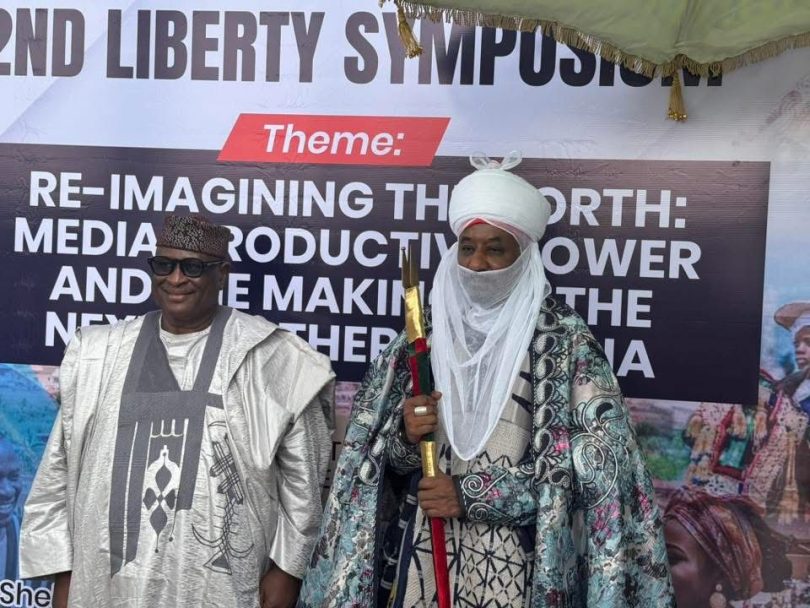
- As Ramalan calls for information sovereignty
Emir of Kano, His Highness Muhammadu Sanusi II, has urged Nigerians to reject religious and ethnic sentiments in choosing political leaders, insisting that competence, integrity and capacity should remain the foremost considerations during elections.
Sanusi made the call Tuesday, while delivering remarks at the 2nd Liberty Media Group Symposium held at the Yar’Adua Centre, Abuja, with the theme: ‘Re-imagining the North: Media, Productive Power and the Making of the Next Northern Nigeria’.
The traditional ruler warned that religion alone could not guarantee good governance or effective leadership, stressing that the country’s development depends on electing individuals with the requisite skills and vision to address its complex challenges.
In his Keynote address, the Convener of the symposium and Executive Chairman of Liberty Media Group, (Dr.) Tijjani Ramalan, made a passionate case for Nigeria to strengthen its information sovereignty amid the rapidly evolving digital and broadcasting landscape.
According to him, Nigeria cannot build a resilient broadcasting sector or secure its digital future while remaining indifferent to the ownership and control of its information ecosystem. “Investment is important; technology is important; global connectivity is important. But balance is equally important”, Ramalan stated.
“A nation must retain the capacity to tell its own stories, distribute trusted information, sustain local content creation and derive economic value from its own information environment”, he further said.
He noted that issues such as advertising equity, support for local and community content, content auditing, platform accountability and value retention have moved beyond industry concerns to become critical national development issues.
Ramalan argued that protecting the country’s information architecture is as important as safeguarding its physical infrastructure, warning that excessive dependence on external platforms could undermine local media sustainability and national interests.
Describing communication as a strategic national asset, he said every generation is confronted with defining responsibilities and that the responsibility of the present generation extends beyond consuming information to protecting the institutions that produce credible and trusted information.
“The future of independent broadcasting must not be left to chance. It must be intentionally designed, collectively protected, professionally managed, commercially sustainable and nationally valued,” he stated.
He further stressed that the broader objective of the symposium transcends broadcasting and media business concerns, describing it as a conversation about nation-building and the preservation of truth, trust and local voices.
“The conversation we begin today is larger than Liberty, larger than broadcasting and larger than advertising. It is about the kind of Nigeria we wish to build—a Nigeria that values truth, values trust, values local voices and protects its information sovereignty.
“Communication is not simply an industry; it is national infrastructure”, Ramalan declared.
Participants at the symposium underscored the need for stronger institutions, responsible media engagement, economic empowerment and strategic investments in information and communication systems as critical pillars for the future development of Northern Nigeria and the country as a whole.
The symposium brought together policymakers, media practitioners, academics, business leaders and development stakeholders to examine the role of media and productive power in shaping the future of Northern Nigeria and the nation at large.