
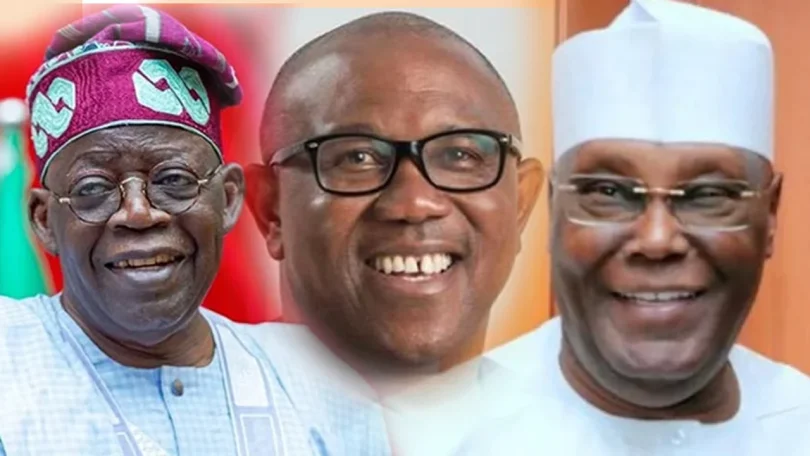
President Bola Ahmed Tinubu and other presidential candidates on Tuesday signed the first National Peace Accord on issue-based campaigns ahead of the 2027 general elections, with former Vice President Atiku Abubakar and the African Democratic Congress (ADC) absent from the ceremony.
The accord, organised by the National Peace Committee in partnership with The Kukah Centre, commits political parties, presidential candidates and their supporters to peaceful campaigns, respect for electoral institutions and issue-based engagement ahead of the elections.
The signing took place in Abuja on the eve of the official commencement of public campaigns for the 2027 presidential and National Assembly elections.
The National Peace Committee is chaired by former Head of State, General Abdulsalami Abubakar, while Bishop Matthew Hassan Kukah serves as its convener.
Among those present at the event were President Tinubu, represented by the Secretary to the Government of the Federation, Senator George Akume; presidential candidate of the Nigeria Democratic Congress (NDC), Peter Obi; presidential candidate of the Social Democratic Party (SDP), Adewole Adebayo; presidential candidate of the African Action Congress (AAC), Omoyele Sowore; and other political leaders and candidates.
The absence of Atiku and the ADC was notable as the political parties and candidates began preparations for what is expected to be one of Nigeria’s most competitive election cycles.
Speaking at the ceremony, the Chairman of the Independent National Electoral Commission (INEC), Prof. Joash Amupitan, said the accord was being signed at a critical point in the electoral calendar, with campaigns scheduled to commence on Wednesday, August 19.
He said the presidential and National Assembly elections would hold on January 16, 2027, while the governorship and House of Assembly elections would take place on February 6.
Amupitan said the timing of the accord was deliberate, stressing that political actors needed to establish the ethical boundaries of their campaigns before rallies and political activities commenced nationwide.
He expressed concern over the resurgence of hate speech, toxic polarisation, coordinated misinformation and personality-driven political discourse.
According to him, political campaigns were increasingly shifting from policy discussions to character assassination, identity-based provocation and inflammatory rhetoric.
He urged candidates to focus on the major challenges confronting Nigerians, including economic growth, insecurity, infrastructure, healthcare, education and social inclusion.
“Electoral contests in a constitutional democracy are not total wars; they are competitive job interviews before the electorate,” Amupitan said.
The INEC chairman urged political parties to make the 2027 elections a “marketplace of ideas” where candidates would explain not only what they intended to do but how they planned to achieve their objectives.
He also warned political parties against using social media and digital platforms to spread false information, premature election results and other content capable of undermining confidence in the electoral process.
Amupitan said INEC was preparing to deploy about 1.4 million ad-hoc personnel across more than 176,000 polling units, adding that the commission had spent the past eight months improving its technology, logistics and personnel training.
He, however, cautioned that technological improvements could not substitute for responsible political behaviour.
“It is not the signatures written on this Accord today that preserve democracy; it is the character of the leaders who hold the pen,” he said.
The INEC chairman also urged political leaders to ensure that the commitments contained in the accord were communicated to their supporters at state, local government, ward and grassroots levels.
He stressed that INEC had no interest in determining who would win the election, saying its responsibility was to provide a transparent, credible and level playing field.
The Inspector-General of Police, Tunji Disu, represented by Deputy Inspector-General of Police Umar Shehu, also warned political actors against conduct capable of threatening electoral security.
Disu said election security was not created on election day but built throughout the electoral cycle through the conduct of political parties, candidates and supporters.
He called for campaigns centred on policies and competing visions rather than ethnic mobilisation, religious division, hatred, intimidation and violence.
The police chief warned that inflammatory statements could spread rapidly through television and social media and trigger violence within communities.
He also said the police would not tolerate the use of armed groups, criminal elements or illegal firearms to intimidate political opponents or disrupt political activities.
According to him, political parties must take responsibility for the behaviour of their supporters and campaign organisations. “You cannot publicly preach peace while privately encouraging violence,” he said.
Disu also called for greater inclusion of women, youths, persons with disabilities and other traditionally underrepresented groups in political activities.
He said a peaceful election was not merely one without violence but one in which citizens felt sufficiently safe to exercise their democratic rights.
Former Head of State and Chairman of the National Peace Committee, General Abdulsalami Abubakar, said the committee had facilitated 30 peace accords since 2015, including five national accords ahead of the 2015, 2019 and 2023 elections and 25 at the subnational level.
He said the committee had also established faith-based peace structures in 23 states to complement its peace-building efforts.
Abdulsalami said the issue-based peace accord was introduced in 2019 in response to the increasing use of personal attacks, insults and character assassination during political campaigns.
He said political parties and candidates were expected to compete on the basis of ideas, policies and programmes, debate opposing views respectfully, organise their supporters peacefully and respect electoral institutions.
The former Head of State said the accord was anchored on the Constitution, Electoral Act and other relevant laws, stressing that it was intended to remind political actors of their legal and moral responsibilities throughout the electoral process.
He disclosed that the committee had also established an Election Security Information Hub to monitor electoral offences and security developments and provide early warning information ahead of elections.
Abdulsalami urged candidates and party spokespersons to avoid fake news, personal attacks and inflammatory statements, while encouraging them to focus on issues that mattered to Nigerians.
Representing President Tinubu, SGF George Akume said the President and the All Progressives Congress (APC) were committed to the principles contained in the accord.
Akume commended the National Peace Committee for its efforts in promoting peaceful elections and said Nigeria had recorded improvements in election management through the deployment of technology by INEC.
He cited the permanent voter cards, biometric voter accreditation and other technological measures as developments that had strengthened the electoral process.
According to him, recent off-cycle elections had also demonstrated Nigerians’ capacity to conduct elections peacefully when the process and outcomes were transparent.
Akume urged political parties to avoid ethnic and religious sentiments and instead campaign on policies capable of expanding opportunities and improving the lives of Nigerians.
“As the campaign season kicks off, I commit myself and my party, the All Progressives Congress, to the tenets of this accord,” he said.
He added that the APC rejected violence, hate speech, misinformation, including misinformation generated through artificial intelligence, and incitement on social media. However, the signing attracted criticism from some opposition candidates.
Obi said political actors should ensure that no Nigerian died because of an election, while urging candidates to demonstrate the character expected of people seeking public office.
Reacting to deaths recorded during the recently concluded Osun governorship election, Obi urged politicians to remember the victims and support their families.
“Nobody needs to die for an election,” he said.
The NDC candidate also questioned the need for politicians to sign a peace accord, arguing that candidates seeking public office should naturally conduct themselves responsibly.
“We don’t even need to sign this. We’re seeking an office where we should be exemplary,” Obi said.
He called for an electoral system in which citizens’ votes would genuinely count, saying voters should punish politicians who violate their commitments by refusing to vote for them.
The SDP presidential candidate, Adebayo, was more critical, describing the accord as meaningless without justice, accountability and respect for democratic principles.
He argued that previous peace agreements had been violated without consequences and accused the government of intimidating opposition politicians.
Adebayo said a credible electoral environment would require government institutions, security agencies and INEC to perform their constitutional duties independently and transparently.
He also questioned whether the recently concluded Osun election represented an improvement in Nigeria’s electoral process, citing the deaths recorded during the poll.
Despite the divergent positions, the National Peace Committee maintained that the accord was intended to create a framework for peaceful political competition as campaigns begin.
The central from the organisers, electoral commission and security agencies was that the 2027 contest should be decided by voters through ideas, policies and programmes rather than violence, intimidation or inflammatory rhetoric.
With campaigns officially beginning on Wednesday, the effectiveness of the accord will now depend on whether political parties and candidates translate their commitments at the signing ceremony into conduct across the country.