
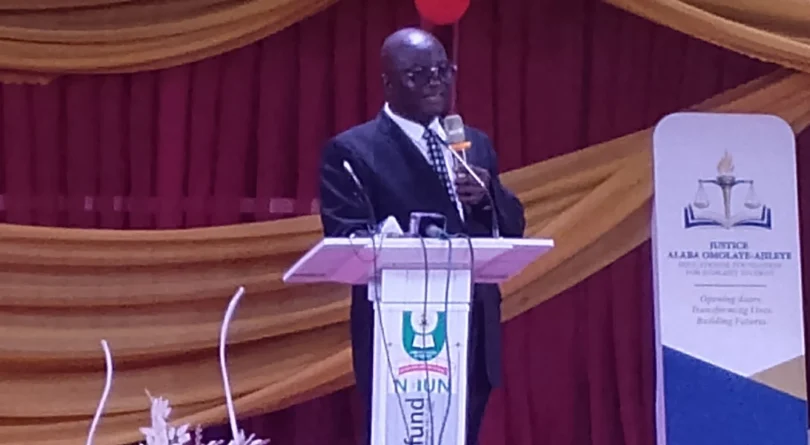
A retired High Court judge and renowned scholar on electronic evidence, Hon. Justice Alabama Omolaye-Ajileye, has faulted the amendment to the Electoral Act 2026, describing its provisions on electronic transmission of election results as inconsistent and lacking sincerity.
Justice Omolaye-Ajileye made the remarks on Thursday in Abuja during the public presentation of his books, Electronic Evidence (Second Edition) and Compendium of Cases on Electronic Evidence, Volume II (2020–2025), as well as the launch of the Justice Alabama Omolaye-Ajileye Educational Foundation for Indigent Students.
Speaking on the amended Electoral Act ahead of the 2027 general elections, the retired judge argued that while the law makes the use of the Bimodal Voter Accreditation System (BVAS) compulsory for voter accreditation, it weakens the integrity of the electoral process by allowing manual handling of results whenever electronic transmission fails.
According to him, the amendment creates a contradiction in the law by treating technology as indispensable during accreditation but optional during result transmission.
He maintained that although it is realistic for the law to anticipate network or communication failures, the automatic fallback to manual result management without stringent safeguards opens the process to manipulation.
“The weakness of the amendment is not that it recognises the possibility of technological failure. The defect lies in making manual recording or manual collation the automatic fallback without imposing strict safeguards,” he said.
Justice Omolaye-Ajileye warned that the provision could encourage electoral actors to deliberately manufacture or exaggerate claims of communication failure in disputed polling units.
He stressed that the law should clearly define who determines communication failure, the number of transmission attempts required, how such failures should be documented, and whether technical evidence should be produced before manual procedures are allowed.
The retired jurist proposed that where electronic transmission fails, presiding officers should be required to file prescribed incident reports, make repeated logged transmission attempts, obtain confirmation from party agents and security personnel, preserve results electronically offline, and transmit them at the nearest secure transmission point before collation.
He also recommended that the Independent National Electoral Commission (INEC) publish a list of polling units where electronic transmission failed, including reasons and supporting technical logs.
Without such safeguards, he said, the amendment merely gives “statutory cover to the very opacity that electronic transmission was intended to cure.”
In an interview with journalists after the event, Justice Omolaye-Ajileye said he sensed “some kind of insincerity” in the amendment dealing with electronic transmission of election results.
“My main point is that I find some kind of insincerity in that amendment. This is because similar provisions are contained in Section 47 of the Electoral Act. Section 47 provides that if there is failure of the BVAS device, they should wait for service to return. But in respect of electronic transmission of results, the amendment does not contain a similar provision. Instead, it allows manual recording and transmission. There ought to have been a similar provision requiring officials to wait for the restoration of service,” he said.
He, however, agreed with the position that ballot box snatching is becoming outdated in the digital age but cautioned against complacency.
Referring to comments credited to the INEC Chairman that ballot box snatching is no longer fashionable, the retired judge noted that despite the deployment of BVAS during the 2023 elections, incidents of ballot box snatching still occurred.
He said the real solution lies in strict enforcement of Sections 47 and 51 of the Electoral Act.
According to him, Section 51, which empowers presiding officers to cancel results where votes cast exceed the number of accredited voters, remains a strong legal safeguard against ballot stuffing.
“If a primitive man in 2027 goes to snatch a ballot box and stuffs it with thumb-printed ballot papers, he will come to meet Section 51 of the Electoral Act in court,” he said.
Beyond electoral reforms, Justice Omolaye-Ajileye reflected on his journey from knowing virtually nothing about electronic evidence in 2010 to becoming one of Nigeria’s leading authorities on the subject, urging lawyers to continually develop themselves through learning and preparation.
He advised legal practitioners handling electronically generated documents not to wait until objections are raised in court before preparing to satisfy the requirements of Section 84 of the Evidence Act on admissibility of electronic evidence.
He also encouraged young Nigerians to remain focused, embrace integrity, work hard, and invest in self-development, saying determination and continuous learning remain the keys to success.