
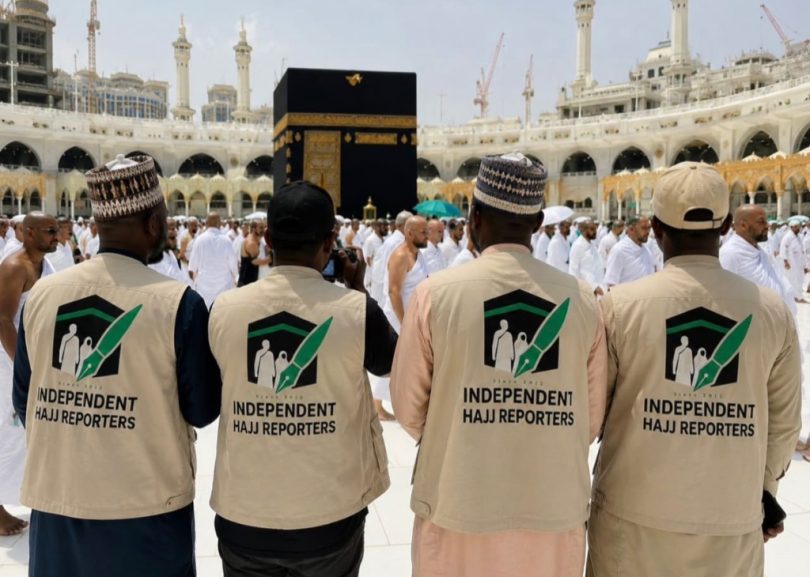
The Independent Hajj Reporters, IHR, Media Monitoring Team has reported significant gaps between pilgrims’ expectations and actual services provided during the 2026 Hajj operations in Mina and Arafat, citing issues with meal distribution, official presence, and lack of transparency in animal sacrifice.
In its assessment report released Friday, June 5, 2026, IHR said it monitored feeding, pilgrims’ welfare, official presence, orientation, and Hadaya services across Nigerian pilgrim camps. The report was signed by Nasiru Lawal, Chairman of the IHR Media Monitoring Team 2026 Hajj.
“On feeding in Mina, the team observed poor coordination in meal distribution. While some camps received meals early, others faced considerable delays. Although approved quantities were largely maintained, food quality in some instances fell below acceptable standards,” the report said.
Consequently, IHR called for refunds to be made to states where meal supplies were missed entirely or where the quality did not meet approved standards for pilgrims.
The monitoring team also noted a shortage of officials in some state pilgrims’ tents, with many officials “virtually unreachable” during visits.
“While some states officials adorn their uniforms, others were dressed in ihram, making it difficult for pilgrims to identify and approach them for any assistance,” the report stated.
However, IHR commended staff of the National Hajj Commission of Nigeria, NAHCON, for their commitment throughout Mina.
“IHR members observed NAHCON personnel across the Nigerian pilgrims’ camp, either attending to pilgrims or assisting in the distribution of meals with their official uniforms.”
Based on observations from random tents, IHR recommended that NAHCON and State Muslim Pilgrims Welfare Boards introduce mandatory lectures on discipline, moral values, and expected religious conduct before pilgrims proceed to Mina.
Such orientation, it said, would strengthen adherence to the spiritual objectives of Hajj and promote better behaviour among pilgrims.
The team also expressed concern over the lack of transparency in the conduct of Hadaya, animal sacrifice, for Nigerian pilgrims. It noted there is no clear regulatory framework governing payment collection and implementation, leaving pilgrims vulnerable to exploitation.
While some states successfully conducted the exercise and set up committees to supervise it, others merely collected payments without providing verifiable evidence that the sacrifice was carried out.
IHR urged NAHCON, in its oversight capacity, to develop and enforce a standard framework for Hadaya payments and implementation in future Hajj operations to enhance transparency, accountability, and public confidence.