
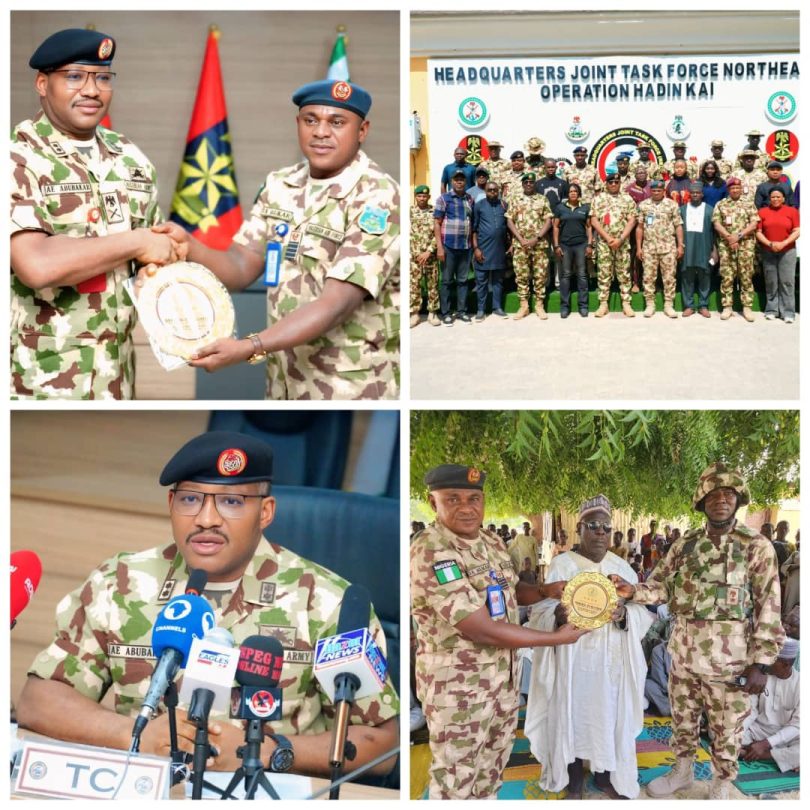
By Chimezie Godfrey
In the complex theatre of modern warfare, victory is no longer measured solely by territory captured or enemies neutralised. It is also measured by perception, confidence, and the resilience of a nation under pressure. In Nigeria’s North-East, where insurgency once held entire communities hostage to fear, Operation HADIN KAI has emerged not only as a formidable fighting force but as a stabilising institution determined to restore security, dignity, and normalcy.
At the heart of this evolving success story is a deliberate strategy: fight the terrorists on all fronts—military, intelligence, humanitarian, and narrative—while denying them the oxygen of propaganda.
Senior commanders of Operation HADIN KAI have been unequivocal on this point. In engagements with defence correspondents and media professionals, they have repeatedly stressed that terrorism feeds on fear and distorted narratives. When only the horrors of attacks dominate headlines, terrorists achieve psychological victories even in defeat.
The Theatre Commander of Operation Hadin Kai, Maj-Gen. Abdulsalam Abubakar illustrated this starkly with an example. During an attack on a military location last year, troops decisively repelled the terrorists, killing about 25 insurgents in a fierce engagement. However, one gallant officer lost his life in the line of duty. The following day, media reports focused almost entirely on the fallen officer, with headlines declaring that a lieutenant had been killed during a terrorist attack.
“What was missing,” the commander observed, “was the full story. The real story was that troops neutralised 25 terrorists. That is what serves the Nigerian people better—because it shows that the Armed Forces are winning, even when sacrifices are made.”
This emphasis on balanced storytelling is not an attempt to downplay sacrifice, but to honour it within the broader context of national defence. The Armed Forces, commanders insist, belong to the Nigerian people, funded by them and mandated to protect them. Telling their story accurately is both a civic responsibility and a strategic necessity.
Encouragingly, the military notes a marked improvement in media engagement. Journalists now increasingly verify facts from the theatre, maintain open lines of communication with commanders, and seek clarity before publication. This partnership, anchored on transparency and trust, has strengthened public understanding of the war effort.
Beyond narrative, the achievements of Operation HADIN KAI are most visible on the battlefield. Troops have received clear marching orders to sustain intensive kinetic operations simultaneously across multiple terrorist strongholds.
From the Sambisa Forest to the Timbuktu Triangle, the rugged Mandara Mountains, and the treacherous Lake Chad islands, military pressure has been relentless. These areas, once regarded as near-impenetrable terrorist sanctuaries, are now under constant surveillance and assault.
In the last few months alone, operations across these fronts have recorded what commanders describe as “commendable milestones.” The sustained onslaught has forced terrorists into disarray, fractured their command structures, and significantly reduced their operational freedom.
Perhaps the clearest indicator of this pressure is the wave of mass surrenders. Over 16,000 terrorists and collaborators have laid down their arms, overwhelmed by the combined weight of military action, intelligence penetration, and psychological operations.
“These surrenders did not happen by accident,” a senior officer explained. “They happened because the terrorists realised that the space to operate was closing rapidly.”
The impact on civilian life has been profound. As terrorists are pushed back, communities that once lived in constant fear now enjoy renewed peace. Markets reopen, children return to school, and families sleep with both eyes closed—an everyday luxury that had become rare during the height of insurgency.
While bullets and bombs dominate public imagination, Operation HADIN KAI’s success is equally rooted in non-kinetic operations that protect civilians and rebuild trust.
Troops provide daily armed escorts for United Nations agencies and non-governmental organisations delivering humanitarian assistance to remote hinterlands. These escorts ensure that food, medicine, and relief materials reach those most in need without interference from armed groups.
Agriculture, the backbone of the North-East economy, has also been prioritised. During planting seasons, troops conduct regular farm patrols, securing farmlands so farmers can cultivate without fear. The same protection is extended during harvest periods, ensuring crops are not lost to banditry or extortion.
“Food security is national security,” commanders emphasise. “If farmers cannot farm, the war cannot truly be won.”
Recognising the evolving nature of threats, Operation HADIN KAI has restructured its operational footprint. The theatre now operates four sectors instead of three, with the newly created fourth sector headquartered in Mubi, Adamawa State.
This expansion is designed to block terrorist movement between Northern Adamawa and Southern Borno, while protecting isolated and vulnerable communities—many of them Christian settlements historically targeted by insurgents.