
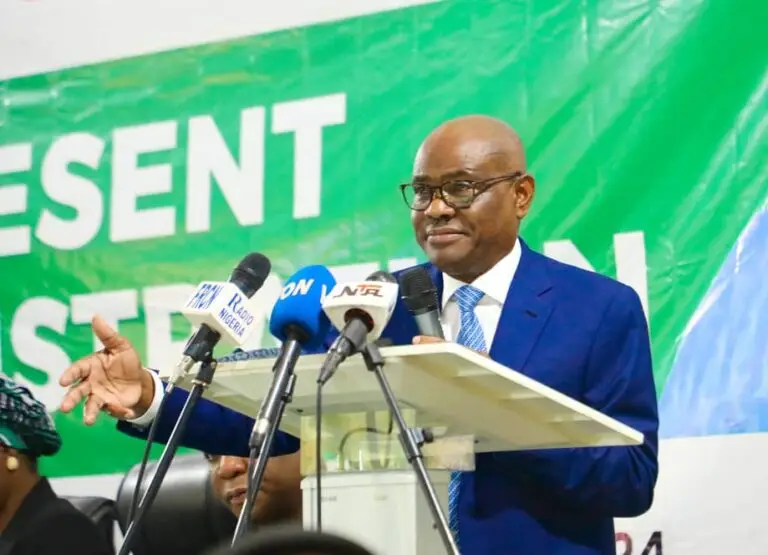
Amid the ongoing legal tussle surrounding the ownership of the River Park Estate in Abuja, indications have emerged that the Minister of the Federal Capital Territory (FCT), Nyesom Wike, may not have been neutral and unbiased as he claimed.
His continuous utterances over the ownership of the estate even though there’s ongoing litigation process has raised serious questions about his impartiality.
Recall that on September 18, 2025, Wike declared live on a national television that the Ghanaian businessman, Sir Sam Esson Jonah was the owner and controller of Jonahcapital Nigeria Limited (JCNL)—the company holding development rights to the 500-hectare River Park Estate in Abuja.
Meanwhile, the Minister’s public assertions starkly contradict the official findings and report from multiple Nigerian institutions, including the Corporate Affairs Commission (CAC), the Inspector General of Police (IGP), and even the Minister’s own committee.
The CAC and the facts on record
On December 9, 2025, the Registration – General of the Corporate Affairs Commission, Hussaini Ishaq Magaji, SAN, formally confirmed that Dr. Adeniran Ogunmuyiwa and his wife are the majority shareholders (60 per cent) and the only directors of JCNL. Sir Sam Jonah was recorded as a minority shareholder (40 per cent) and not a board member.
These findings directly contradict Minister Wike’s televised assertion that Jonah was the sole owner and controlling owner of JCNL and, by extension, River Park Estate.
But this conclusion is not new. Y September 2, 2025, the FCT Ministerial Committee—established by Minister Wike himself in response to a petition by Jonah’s lawyer, Sunday I. Ameh (SAN), presented the same shareholding breakdown to the minister.
That presentation, filmed and publicly made available, clearly affirmed Nigerian majority ownership.
Yet, notwithstanding the advice of his own committee which he set up, Minister Wike proceeded days after to publicly endorse a position that erased the interests of the Nigerian majority shareholders entirely.
Termination of development rights and court intervention
The minister did not stop there. In September 2025, they announced the immediate termination of an 18-year Development Lease Agreement signed between Dr. Ogunmuyiwa and a former FCT Minister, Mallam Nasir El-Rufai, and ordered that up to 20 per cent of undeveloped or partially developed land be returned to the FCDA.
This action was swiftly followed by a demolition exercise at River Park Estate—without notice and reportedly affecting tens of structures, including a Cancer Care hospital under construction — until the courts intervened.
Disregarding police findings
Minister Wike’s public stance also clashes with findings from the Nigeria Police Force. In September 2024, Sir Sam Jonah petitioned the IGP alleging land grabbing and harassment by developers at River Park. The IGP directed DCP Akin Fakorede, Head of IGP Monitoring and a forensic specialist, to investigate.
DCP Fakorede’s report concluded that documents submitted by Jonah and his associates were forged and that attempts were made to manipulate CAC records, including the misrepresentation of nationality—an issue with significant implications under the Land Use Act, which restricts foreign ownership of large tracts of land.
Criminal charges were subsequently filed against Jonah and his associates. That police report was tendered to the Ministerial Committee—but Minister Wike publicly rejected it, launching a televised tirade against DCP Fakorede.
Such conduct raises legitimate concerns about whether personal animosity and aggrandizement rather than merit and evidence influenced the minister’s rejection of an official police report.
Conflicts, relationships, and motivations
Additional questions arise from Minister Wike’s professional proximity to Sunday I. Ameh (SAN), the lawyer who authored Jonah’s petition.
Ameh has acknowledged working intermittently with the FCDA, though he denied any conflict of interest. Even if technically defensible, the optics are troubling in a dispute requiring scrupulous neutrality.
If neither personal hostility toward the investigating officer nor proximity to Jonah’s counsel explains the minister’s conduct, another possibility remains: the recovery of undeveloped land for the FCT.
The unilateral termination of the development agreement conveniently positioned the FCT to reclaim up to 100 hectares or 20 per cent of River Park Estate—an outcome with significant fiscal and political implications.
A question of institutional integrity
These issues when looked at holistically, paint a troubling picture: Wike’s public outbursts and actions contradict official records; his disregard for institutional findings, including those of the Minister’s own committee; rejection of police reports and his executive actions which are now under judicial scrutiny.
For a minister who is also a trained lawyer, these actions pose a fundamental question: Is the FCT Minister acting as an impartial umpire—or as an interested party?