
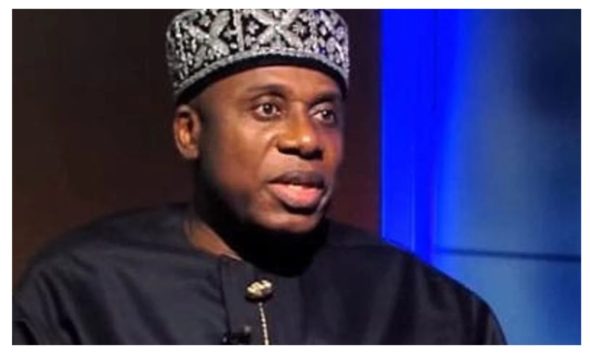
According to a report by Daily Post on Friday, February 27, 2026, Rotimi Amaechi, former Minister of Transportation, has stated that President Bola Tinubu is not Nigeria’s main problem, insisting that the weakness of the opposition is responsible for the country’s political challenges.
He said the key issue confronting the country is the inability of opposition parties to provide a strong and credible alternative, stressing that without a clear distinction from the ruling government, they cannot gain the trust of Nigerians.
Amaechi made the remarks following a press conference held in Abuja on Thursday by leaders of opposition parties.
The briefing was themed Urgent Call to Save Nigeria’s Democracy and brought together prominent opposition figures who addressed the state of the nation.
He maintained that while criticisms of the current administration continue, the greater responsibility lies with opposition parties to reorganize and present themselves as a viable option to the electorate.
According to him, a weak opposition creates an environment where the ruling party faces little resistance, thereby deepening political imbalance.
Amaechi stressed that for democracy to function effectively, opposition parties must clearly distinguish their policies and actions from those of the government in power.
He said Nigerians would only place their confidence in opposition leaders if they demonstrate independence, clarity of purpose, and commitment to reform.
The former minister reflected on his experience in government under former President Muhammadu Buhari.
He recalled that during that period, discussions around electoral reform were initiated at the highest level of government.
Amaechi alleged that despite the initial willingness to implement changes, the proposed electoral reform bill did not receive presidential assent.
He stated that certain members of the cabinet influenced the decision at the time.
According to him, the advice given to the president contributed to the refusal to sign the bill into law.
He linked that episode to broader concerns about internal political resistance to reforms that could strengthen democratic processes.
Amaechi used the example to illustrate what he described as systemic weaknesses within political structures that go beyond the current administration.
“When I was in government during Buhari’s time, he wanted electoral reform. A few ministers went to him and convinced him not to sign, saying that if he signed, Russia would hack the system and impose the wrong president on us, and he refused to sign,” he said.See_More…