
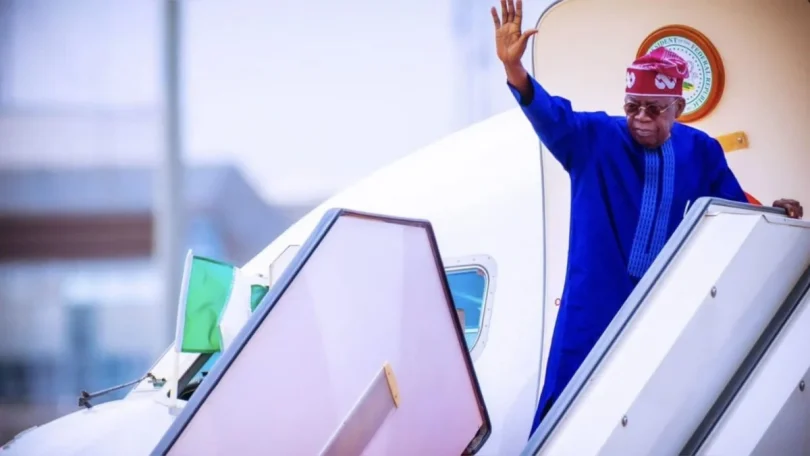
President Bola Tinubu has arrived in Paris, France, as he continues his three-week vacation in Europe.
Tinubu travelled out of Nigeria on August 30 as part of his annual leave, with London, United Kingdom, announced as his first destination by the Presidency.
The President’s trip was disclosed in a statement issued by his Special Adviser on Information and Strategy, Bayo Onanuga, who said the vacation would also involve some working engagements.
“President Bola Ahmed Tinubu will depart Abuja today for Europe to begin a three-week vacation as part of his annual leave,” Onanuga said in the statement.
The Presidency did not initially disclose all the European destinations Tinubu would visit during the period. It, however, said he would return to Nigeria at the end of the three-week break to resume his official responsibilities.
According to the Presidency, Tinubu would return home “to join the hectic campaign for the January 2027 election.”
Tinubu, who was elected president in 2023 on the platform of the All Progressives Congress, is seeking another term in office.
The President’s European vacation has attracted political reactions, particularly from opposition figures who have questioned the timing of his departure amid economic and security challenges confronting Nigerians.
The 2027 presidential candidate of the Nigeria Democratic Congress, Peter Obi, criticised the decision, arguing that the President should remain more focused on domestic challenges.
Obi said Nigeria was dealing with serious problems involving insecurity, rising food and transportation costs, unemployment and limited access to essential services when Tinubu embarked on the holiday.
“Yet, at this critical moment, the President has left the country for another holiday,” Obi said.
The former Anambra State governor also questioned the amount allegedly spent on presidential travels. He claimed that expenditure on presidential trips and related travel costs between June 2023 and April 2026 had reached about N37.64 billion, while Tinubu had reportedly spent approximately 261 days outside Nigeria during the period.
Obi contrasted the alleged travel spending with what he described as inadequate funding for critical sectors, particularly healthcare.
He claimed that only N36 million was released to the Federal Ministry of Health in 2025 despite a capital allocation of N218 billion.
“This is the calamity befalling our country today,” Obi declared.
The NDC candidate stressed that his criticism was not directed at the idea of a president taking a vacation but at what he described as the circumstances and timing of Tinubu’s latest trip.
“When citizens cannot feed their families, move safely, access healthcare, send their children to school, or sleep peacefully in their homes, the President should be more concerned about fixing the country than repeatedly leaving it,” Obi said.
He also called on Nigerian leaders and other influential citizens to promote domestic tourism rather than travelling abroad for leisure.
Obi mentioned Kano, Katsina, Sokoto, Cross River, Bauchi and Ebonyi among Nigerian destinations that could benefit from increased attention from political leaders and tourists.
He argued that greater investment in domestic tourism could create employment and support businesses in hospitality, transportation, agriculture, entertainment and crafts.
“Tourism creates jobs. It supports hospitality, transportation, agriculture, entertainment, crafts, and small businesses. It brings investment and foreign exchange and allows communities to benefit directly from their natural and cultural assets,” he said.
Obi further argued that Nigeria should stop “exporting our wealth and importing our pleasures” when the country itself has significant tourism and economic potential.
He linked his position to his political partnership with Rabiu Musa Kwankwaso, saying their proposed approach to governance would place greater emphasis on Nigeria’s domestic needs.
“We deserve leadership that puts Nigeria first; leadership that cares and plans for a better Nigeria. That is the kind of leadership that the partnership between H.E. Rabiu Musa Kwankwaso and me will bring,” Obi said.
Tinubu’s vacation has also coincided with fresh developments in the United States involving records from an old investigation concerning him.
The Federal Bureau of Investigation recently submitted documents connected to its 1993 investigation involving Tinubu to a US federal judge for confidential review. The material was submitted under seal following an order in a long-running Freedom of Information Act case seeking access to the records.
The documents were not released publicly and were not handed over to American transparency campaigner Aaron Greenspan, who has been pursuing the records through the courts.
Instead, the FBI submitted them “under seal, ex parte, in camera” for Judge Beryl Howell of the United States District Court for the District of Columbia to examine privately.
The development does not constitute a public release of the records or a new judicial finding against Tinubu. The judge is expected to determine whether the FBI has adequate legal grounds to withhold portions or all of the material.
The dispute concerns records relating to investigations involving Tinubu in the early 1990s, including FBI files and interview reports from the period.
One related matter involved a 1993 civil forfeiture case in Chicago involving approximately $460,000. Public US court records have previously shown that funds linked to Tinubu were forfeited to the US government.
Tinubu has denied wrongdoing and has not been criminally convicted in connection with the matter.
The FBI had previously argued that some of the information could not be fully explained publicly without disclosing sensitive law-enforcement details. In an earlier filing, the agency said, “The FBI has determined that it cannot provide on the public record the full basis for the application of Exemptions 7(E) and 7(F) to certain withholdings and that, therefore, an ex parte, under seal declaration is necessary.”