
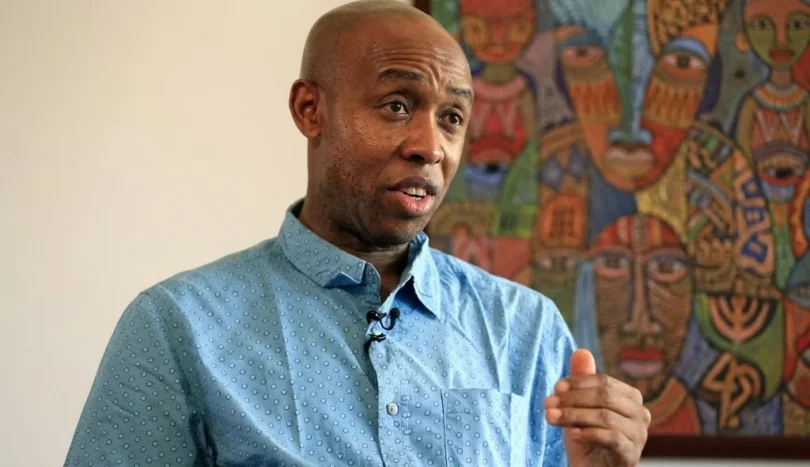
Human rights lawyer and former Chairman of the National Human Rights Commission (NHRC), Professor Chidi Odinkalu, has described President Bola Tinubu’s prolonged absence from Nigeria as a situation that raises serious constitutional and governance concerns.
Odinkalu, who spoke on Channels Television’s Politics Today, said the Constitution did not recognise the concept of a “working vacation” for the President, stressing that Section 145 of the 1999 Constitution provides for the President’s absence from the country and the transfer of authority to the Vice President under specified circumstances.
He said while the President was not automatically stripped of his powers simply because he was outside Nigeria, the country should not be left without a clear line of constitutional authority.
According to him, “the idea of working vacation does not exist” in Section 145, which deals with presidential absence from the country and provides a mechanism for the Vice President to act where the President is unable to discharge his functions.
Odinkalu said the argument that the President could continue to run the country remotely was not sufficient to address the constitutional and governance issues arising from prolonged absence.
He explained that the Constitution envisaged situations where the President might be outside the country, adding that the provision was designed to ensure that there was no vacuum in the exercise of executive authority.
The legal expert, however, noted that the interpretation of the 21-day period contained in Section 145 could be subject to legal argument.
“When you look at the Interpretation Act, the 21 days would mean 21 working days,” he said, adding that such an interpretation would exclude weekends and public holidays.
He nevertheless argued that the central issue went beyond a technical interpretation of constitutional provisions.
“Running a country requires common sense,” Odinkalu said, arguing that constitutional conventions had historically discouraged the President and Vice President from being outside the country simultaneously.
He cited previous administrations, saying former Presidents Olusegun Obasanjo, Umaru Yar’Adua and Goodluck Jonathan did not allow such a situation to become a regular practice, while former President Muhammadu Buhari ensured that then Vice President Yemi Osinbajo was in the country when he travelled.
Odinkalu said Section 145(2) provided a mechanism for the National Assembly to act if the President failed to transmit a written declaration and the constitutional threshold was reached.
“If the President fails to do that, and you have a clear onset of the 21-day trigger depending on how 21 days is interpreted, the obligation shifts from the Presidency, the Executive, to the Legislature, who, by joint resolution adopted by a simple majority, should take responsibility to confer that authority to act on the Vice President,” he said.
He also dismissed suggestions that the Secretary to the Government of the Federation could assume responsibility for running the country in the absence of the President.
“That possibility of the SGF does not exist within the contemplation of Section 145,” Odinkalu said.
On whether the President automatically loses his powers by being outside Nigeria, the lawyer answered in the negative, noting that the functions of the presidency, particularly national security and foreign policy, could at times require international travel.
“The straightforward answer to that, of course, is no. No president is required by virtue of assuming office to also assume the status of a prisoner,” he said.
However, Odinkalu argued that prolonged absence without a clear constitutional arrangement could create a governance problem.
“The presidency has abdicated and rendered Nigeria into an ungoverned territory,” he said.
He also criticised the reliance on the argument that the President was physically engaged in meetings and other official activities while abroad, saying physical engagement outside the country did not by itself resolve the constitutional questions surrounding the exercise of presidential authority.
Odinkalu said the issue should ultimately be considered from the standpoint of constitutional responsibility and the need to prevent a leadership vacuum.
He added that while Section 145 allowed for presidential travel, “the design is not so that we just read off” the provision mechanically, but to ensure that those exercising state power understand the responsibility of preventing a vacuum in governance.