
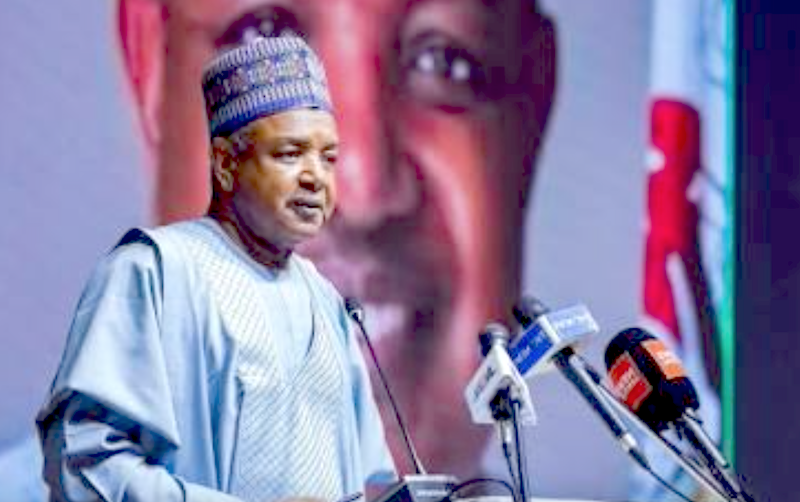
Minister of Budget and Economic Planning, Alhaji Atiku Bagudu, has urged Nigerians to mount pressure on State and local governments over the increased revenues accruing to them from the Federal Government’s economic reforms, saying President Bola Tinubu is taking the political “bullets” for policies whose financial benefits are being shared across the federation.
TheNewsGuru (TNG) reports Bagudu made the call in Abuja on Wednesday while speaking during the presentation of “Nigeria’s Reform Scorecard: The Benefits, Costs and Harms Prevented”, an assessment of the economic reforms introduced by the President Bola Tinubu administration.
The Federal Government defended its economic reform programme and sought greater public understanding of the costs, benefits and resources generated since the removal of the petrol subsidy and the unification of the foreign exchange market.
The Minister in his remarks stressed that Nigeria remained far from where it wanted to be, despite the significant increase in government revenue, stressing that the country’s economic transformation remained “a work in progress”.
He said citizens should not focus exclusively on the Federal Government when assessing the impact of the reforms, particularly because a substantial portion of the additional resources generated had accrued to States and local governments.
His comments came against the backdrop of figures released by the Minister of Finance and Coordinating Minister of the Economy, Taiwo Oyedele, showing that subsidy savings generated between June 2023 and December 2025 amounted to ₦15.8 trillion, of which ₦5.4 trillion accrued to the Federal Government, while ₦10.4 trillion was shared by States and local governments through the Federation Account.
Bagudu, therefore, urged Nigerians to demand accountability from the sub-national governments over how the increased allocations were being utilised.
The Minister also drew attention to the country’s historically weak revenue base, saying the Tinubu administration inherited one of the world’s lowest revenue-to-GDP ratios.
According to him, Nigeria’s population and economic potential were not reflected in the size of its national budget, with the country still operating one of the smallest budgets relative to its population and development needs.
“Nigeria is still not where it wants to be despite increased government revenue following the removal of fuel subsidy, but it’s a work in progress,” he said.
The Minister said improving the country’s revenue-to-GDP ratio was therefore critical to enabling government to finance infrastructure, security and social interventions on a sustainable basis.
The argument is reinforced by the Federal Government’s reform scorecard, which shows that Nigeria’s tax-to-GDP ratio has risen from below 10 per cent in the pre-reform period to about 12.5 per cent, although the government still considers the improvement to be in its growth phase.
Tinubu administration inherited major fiscal pressures
Bagudu also disclosed that the administration inherited more than $6 billion in unpaid petroleum import obligations, saying the burden had contributed to the difficult fiscal position inherited by the government.
He said the Nigerian National Petroleum Corporation had been compelled to borrow money to finance petroleum imports, underscoring the extent of the financial pressures associated with the former subsidy regime.
The revelation provides further context to the government’s decision to remove the petrol subsidy, which the Finance Ministry has described as a system that created significant distortions while placing pressure on public finances.
According to the reform scorecard, the government mobilised ₦20.4 trillion in incremental resources between June 2023 and December 2025. Of this amount, ₦5.4 trillion came from subsidy savings accruing to the Federal Government, ₦3.1 trillion from incremental revenue—principally remittances from government-owned entities—and ₦11.9 trillion from incremental borrowing.
The Ministry of Finance, however, stressed that the additional resources did not merely accumulate as cash.
It said the Federal Government recorded ₦30.64 trillion in incremental expenses, with ₦9.39 trillion spent on wage adjustments, minimum wage increases and allowances; ₦9.37 trillion on external debt service arising from exchange-rate depreciation; and ₦6.47 trillion on strategic infrastructure.
About two-thirds of the incremental expenditure was funded by the additional resources generated, while approximately ₦10.24 trillion was absorbed from the existing revenue base.
‘Reforms came at a cost’
The government’s defence of the reforms comes as households continue to contend with the consequences of higher energy and living costs.
Presenting the reform scorecard, the Minister of Finance and Coordinating Minister of the Economy, Prof. Taiwo Oyedele, acknowledged that the reforms had imposed significant costs on Nigerians, including the sharp increase in petrol prices and higher interest rates.
Oyedele said petrol, which sold for approximately ₦185 per litre before the reforms, now sells within a range of ₦1,100 to ₦1,400, while the Monetary Policy Rate has risen from 18.5 per cent to 26.5 per cent.
But he argued that the alternative would have been considerably more damaging, with the government’s counterfactual assessment projecting that petrol could have become unavailable at the official price while trading above ₦3,000 per litre on the black market.
The government also said headline inflation had moderated from 22.41 per cent in May 2023 to 15.91 per cent in June 2026, while food inflation fell from 24.82 per cent to 17.52 per cent over the same broad period.
States move from salary crisis to improved fiscal position
One of the central arguments in the government’s reform defence is that the additional resources have strengthened the finances of sub-national governments.
The reform scorecard states that 27 states were unable to reliably pay salaries in 2023, compared with none in 2026. It estimates that, without the reforms, at least 30 states could have been in that position by now.
Oyedele similarly said the ₦15.8 trillion in subsidy savings shared across the federation demonstrated that the benefits of the reforms were not confined to Abuja.
The Federal Government’s share represented only 34 per cent of the subsidy savings under the statutory Federation Account Allocation Committee formula, according to the Finance Ministry’s presentation.
This distribution forms the basis of Bagudu’s call for Nigerians to hold state and local governments accountable for the additional funds they now receive.
Government points to stronger reserves, growth
The Federal Government also pointed to improvements in several macroeconomic indicators as evidence that the reforms are beginning to produce structural changes.
Gross foreign reserves have risen from about $35 billion to $52.5 billion, while net reserves increased from roughly $3 billion to $34.8 billion.
The stock market’s capitalisation has also grown from about ₦31 trillion in May 2023 to roughly ₦150 trillion by June 2026.
Real GDP growth, according to the scorecard, has strengthened from 2.31 per cent in the first quarter of 2023 to 3.89 per cent in the first quarter of 2026.
The government also cited increased capital importation, stronger foreign direct investment and improved sovereign credit standing as signs of recovering investor confidence.
However, the Finance Ministry acknowledged that improved macroeconomic indicators had yet to translate fully into better household welfare.
Oyedele specifically classified poverty and household welfare recovery as “unfinished business,” rather than declaring victory.
Bagudu seeks support for revenue mobilisation
Against this backdrop, Bagudu called for broader support for efforts to increase Nigeria’s revenue-to-GDP ratio, arguing that the country could not sustainably finance its development ambitions without significantly expanding its fiscal capacity.
He said the administration was prioritising security, infrastructure and support for Nigerians bearing the burden of the reforms.
Bagudu added that investments were being distributed across the six geopolitical zones to improve connectivity and strengthen the federation.
The Finance Ministry’s reform scorecard similarly identifies strategic infrastructure, agricultural interventions, social transfers, housing support, student loans and wage increases among the areas where the government says the additional resources are being deployed.
The government’s next phase, according to the scorecard, will focus on translating macroeconomic improvements into tangible household relief, including expanded cash transfers, deeper agricultural interventions to reduce food prices and closer collaboration with states and local governments.