
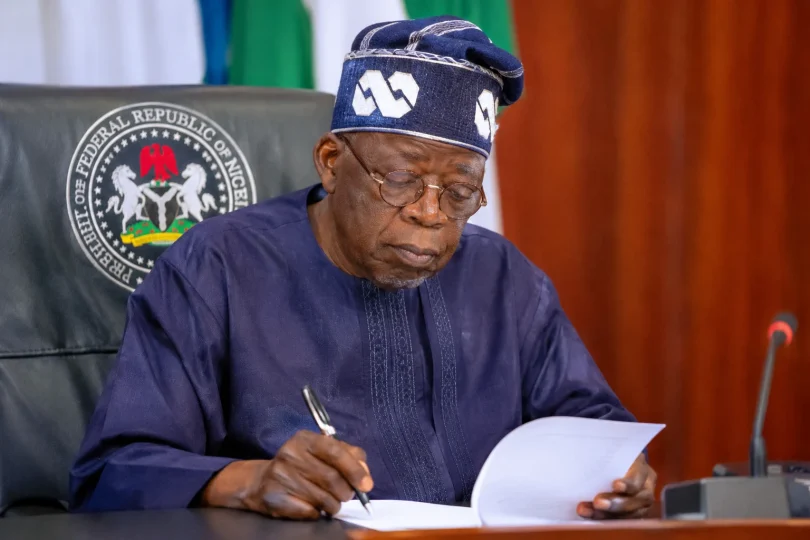
President Bola Tinubu has asked the House of Representatives to approve the implementation of the N10.79tn external borrowing component of the 2026 Appropriation Act to finance part of the Federal Government’s budget deficit.
The request, contained in a letter addressed to the Speaker of the House, Tajudeen Abbas, was read during Wednesday’s plenary.
Tinubu requested approval to raise $7.71bn, equivalent to N10.79tn at the budget exchange rate of N1,400 to the dollar.
The President explained that the request was in line with Sections 21(1) and 27(1) of the Debt Management Office (DMO) Establishment Act, 2003, which require the terms and conditions of external loans to be presented to and approved by the National Assembly.
He noted that the proposed borrowing was already captured in the 2026 Appropriation Act as part of the N29.22tn approved new borrowing to finance the Federal Government’s budget deficit.
According to him, the borrowing plan comprises N18.28tn in domestic loans and N10.79tn in external borrowing.
Tinubu said the government would explore different financing options simultaneously, taking into account borrowing costs and the time required to access the funds.
However, he indicated that priority would be given to Eurobond issuance, describing it as a faster means of raising substantial funds at relatively lower costs.
He added that the final terms and conditions of the proposed Eurobond issuance would depend on prevailing international market conditions at the time of pricing.
The President assured that the Federal Ministry of Finance and the DMO would work towards securing the most favourable borrowing terms available in the international market.
He explained that the proceeds would finance projects and programmes contained in the 2026 budget, particularly in defence and security, transportation, agriculture, power, education and health.
Tinubu also said the external borrowing would help strengthen Nigeria’s foreign reserves and support the naira, noting that the funds would be received by the Central Bank of Nigeria on behalf of the Federal Government.
In his request, the President sought authorisation to raise the funds through multilateral and bilateral institutions, commercial lending arrangements, the International Monetary Fund, bridge financing facilities and Eurobond issuance.
He also requested approval for the Minister of Finance and Coordinating Minister of the Economy, in collaboration with the DMO, to take necessary steps to implement the borrowing plan.
Responding, Abbas clarified that the President was not seeking approval for fresh borrowing, stressing that the N10.79tn external borrowing had already been approved under the 2026 Appropriation Act.
He explained that the request was specifically to fulfil the statutory requirement for legislative approval of the terms and conditions governing external loans before implementation.
Abbas cited Sections 21(1) and 27(1) of the DMO Act, which provide for the presentation and approval of external borrowing terms and conditions by the National Assembly.
The Speaker also distinguished the request from the President’s separate proposal for additional borrowing, stressing that both matters were independent and would be considered separately.
He said the current request neither superseded nor withdrew the separate borrowing proposal, which remained before the legislature for consideration.
The clarification comes amid concerns over the Federal Government’s reliance on borrowing to finance budget deficits and the implications for public debt and fiscal sustainability.
Nigeria’s 2026 budget provides for a deficit of N31.55tn, with N29.22tn in new borrowing identified as a major financing component.
The latest request, therefore, does not introduce additional borrowing into the approved 2026 budget but seeks the legislative authorisation required to access its external borrowing component.
Post Views: 0