
By Diana Omueza
The Minister of Marine and Blue Economy, Adegboyega Oyetola, says President Bola Tinubu’s administration has changed Nigeria’s maritime sector trajectory through landmark reforms, urging sustained efforts to consolidate the gains.
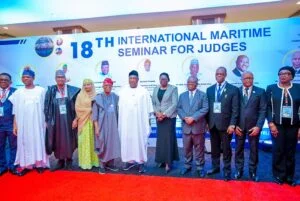
Oyetola said this on Wednesday in Abuja at the opening of the 18th International Maritime Seminar for Judges.
The News Agency of Nigeria (NAN) reports that the seminar organised by the Nigerian Shippers’ Council (NSC), under the auspices of the Federal Ministry of Marine and Blue Economy, was in collaboration with the National Judicial Institute (NJI).
Oyetola said Tinubu’s administration had laid strong institutional, regulatory and economic foundations to unlock the country’s marine and blue economy for sustainable national development, economic diversification and increased private sector investments.
He lauded the Nigerian Shippers’ Council for initiating and sustaining the international seminar for judges.
He described it as one of Nigeria’s foremost platforms for strengthening maritime jurisprudence, enhancing judicial capacity and promoting excellence in maritime justice.
“President Tinubu’s administration has fundamentally changed the trajectory of the maritime sector through deliberate reforms that are already delivering measurable economic and institutional results.
“Our responsibility now is to sustain these reforms by strengthening institutions, promoting legal certainty and expanding opportunities across the blue economy.
“A predictable judicial system remains indispensable to protecting investments and supporting Nigeria’s aspiration to become Africa’s leading maritime nation,” he said.
Oyetola said that the seminar remained crucial in equipping judicial officers with contemporary knowledge required to address emerging issues in international maritime law and global shipping practices.
He urged judges to continually update their knowledge on autonomous vessels, digital shipping, artificial intelligence-driven maritime operations, maritime security and evolving international environmental regulations.
“Rapid technological advancement is creating unprecedented legal questions relating to liability, navigational responsibility, insurance, collision regulations and allocation of responsibility when autonomous vessels malfunction.
“The courts will increasingly adjudicate disputes involving decarbonisation, environmental compliance, block chain-enabled cargo documentation, electronic bills of lading and other evolving international maritime legal frameworks.
“The emergence of autonomous vessels demands a judiciary equipped to resolve complex legal questions involving liability, insurance, navigation and technological accountability.
“Judicial officers must remain abreast of evolving international maritime law to ensure justice keeps pace with technological innovation.
“A knowledgeable judiciary remains fundamental to strengthening confidence in Nigeria’s maritime legal system and dispute resolution framework,” he said.
The minister said that prompt and efficient resolution of maritime disputes through litigation and arbitration remained essential to sustaining commercial confidence and attracting maritime investments into Nigeria.
He said that every maritime judgment sent a powerful message to investors, ship owners, financiers, insurers and commercial operators about the credibility and predictability of Nigeria’s judicial system.
Oyetola said the government would continue to support specialised maritime divisions within the Federal High Court, align domestic maritime legislation with contemporary international conventions and strengthen maritime arbitration.
He also pledged stronger collaboration between the ministry, its agencies and the judiciary to provide technical expertise for effective determination of increasingly complex maritime disputes.
“Every maritime judgment sends a powerful signal to investors, ship owners, insurers and commercial operators about the credibility of Nigeria’s justice system.
“Predictable and well-reasoned judicial decisions encourage parties to utilise Nigerian courts and arbitration centres for maritime dispute resolution.
“Judicial excellence is not merely a legal objective; it is an important pillar of commercial confidence and institutional credibility,” he said.
The minister said the establishment of the Federal Ministry of Marine and Blue Economy in 2023, demonstrated the government’s commitment to harnessing maritime resources for employment generation, food security and environmental sustainability.
He said the government had developed Nigeria’s first National Policy on Marine and Blue Economy, maintained zero piracy in Nigerian waters for four consecutive years and secured a 746 million pound sterling financing agreement to modernise Apapa and Tin Can Island ports.
According to him, approval of the Cabotage Vessel Financing Fund (CVFF), Nigeria’s return to Category C of the International Maritime Organisation Council after 15 years and increased fish production reflected the impact of ongoing reforms.
Oyetola added that agencies under the ministry generated more than N1.8 trillion in revenue in 2025, underscoring the growing contribution of the marine and blue economy to national economic growth.
“These milestones demonstrate that the marine and blue economy has become a major contributor to national economic growth under the Renewed Hope Agenda.
“Infrastructure development and policy reforms must be complemented by a judiciary that delivers timely, fair and commercially predictable decisions.
“Investor confidence depends not only on sound policies but also on the integrity, consistency and professionalism of our judicial system,” he said.
Speaking, the Chief Justice of Nigeria, Justice Kudirat Kekere-Ekun, said maritime disputes were often complex, time-sensitive and cross-border, making efficient admiralty justice essential to commercial certainty.
She said that delays in resolving maritime disputes could increase business costs, disrupt trade and undermine investor confidence, and called for a responsive and specialised maritime judicial system.
Kekere-Ekun also underscored the importance of judicial cooperation across jurisdictions.
She said that the international nature of maritime commerce required continuous collaboration among courts, regulators, legal practitioners and other stakeholders.
She described the seminar as an important platform for judicial engagement, knowledge-sharing and capacity building to strengthen maritime jurisprudence and improve the administration of admiralty justice.(NAN)(www.nannews.ng)