
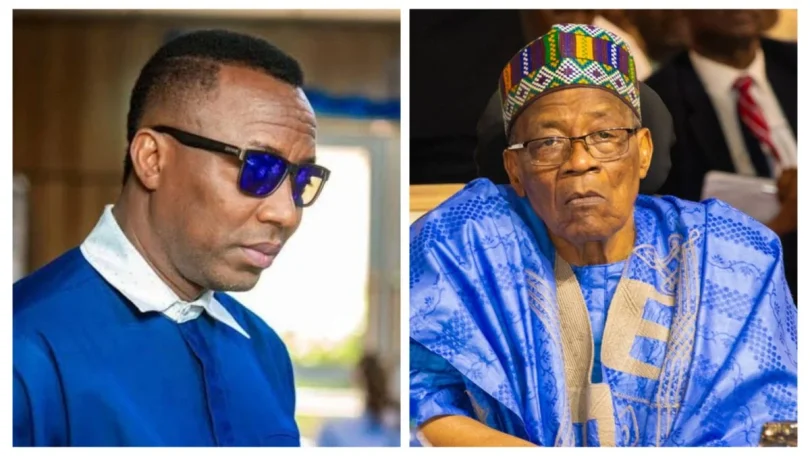
The African Action Congress (AAC) presidential candidate, Omoyele Sowore, has called for the arrest and prosecution of former military Head of State, Ibrahim Badamasi Babangida, over alleged crimes and abuses committed during his years in power.
Sowore made the demand in a statement posted on his social media handles on Thursday where he insisted that Babangida’s age should not shield him from accountability for decisions taken during his military administration.
Politics Nigeria recalls that the former military ruler, who governed Nigeria from 1985 to 1993, turned 85 recently.
Sowore argued that Nigeria should investigate unresolved allegations of killings, human rights abuses, corruption and other violations associated with Babangida’s regime and prosecute him if evidence establishes criminal responsibility.
“It is not too late to arrest and prosecute Ibrahim Badamasi Babangida for crimes committed under his military dictatorship,” Sowore said.
He cited the case of former Chilean dictator Augusto Pinochet, who faced arrest and extensive legal proceedings in his 80s, arguing that advanced age should not automatically place former leaders beyond the reach of justice.
“IBB is 85. His age should not confer immunity from justice. The unresolved killings, abuses, corruption, and other grave violations associated with his regime deserve proper investigation and, where the evidence supports it, prosecution,” he said.
The latest demand followed a public disagreement between Sowore and the Labour Party’s 2023 vice-presidential candidate, Datti Baba-Ahmed, over the AAC candidate’s criticism of Babangida.
Sowore had earlier condemned celebrations marking Babangida’s 85th birthday, accusing the former military ruler of leaving behind a damaging legacy.
“Ibrahim Badamasi Babangida, the man who did Nigeria dirty, is being celebrated by his cronies on his 85th birthday,” he had said.
He subsequently accused Baba-Ahmed of defending a political culture in which influential figures are shielded from scrutiny.
Sowore maintained that his criticism was directed at Babangida’s record in office and not his age.
“I did not attack Ibrahim Babangida because he is 85 years old. My criticism was about his record in power and what his decisions did to Nigeria,” he said.
He specifically cited the annulment of the June 12, 1993 presidential election, which he described as one of the most consequential controversies of Babangida’s administration.
According to Sowore, the election was won by the late businessman and politician, MKO Abiola, but the democratic process was subsequently truncated.
“The June 12 election was not some minor administrative disagreement. Nigerians voted. MKO Abiola won. The democratic process was cruelly truncated for selfish reasons,” he said.
He also listed the execution of Mamman Vatsa, the killing of journalist Dele Giwa and controversies surrounding the 1990 Gulf War oil windfall among issues that, in his view, require renewed scrutiny of Babangida’s administration.
Sowore rejected Baba-Ahmed’s characterisation of Babangida as a “revered former Nigerian leader”, arguing that Nigerians had the right to assess the former military ruler’s legacy differently.
“Datti is entitled to revere him. Millions of Nigerians are equally entitled to remember his disastrous rule differently. History is not determined by the affection of political elites,” he said.
The AAC candidate also criticised what he described as excessive deference to powerful political figures, recalling Baba-Ahmed’s description of President Bola Tinubu as “Uncle” during the 2023 election campaign.
“A President is a public servant, not my uncle,” Sowore said.
He argued that former military rulers should be subjected to historical and institutional scrutiny rather than treated as untouchable elders because of their age or status.
Sowore further rejected accusations that his position amounted to cruelty, insisting that accountability should apply to everyone who holds public office.
He said Nigerians should equally scrutinise his own record if he ever betrayed the democratic will of the people or violated their rights.
“If I betray the democratic will of Nigerians, they should say so. If I impoverish people through disastrous policies, they should say so. If I violate their rights, they should say so,” he stated.
Sowore described the political culture of protecting powerful figures from scrutiny as a greater threat to Nigeria than citizens who criticise former rulers.
“No, Datti. The danger to Nigeria is not citizens who refuse to worship former wicked rulers,” he said.
According to him, Nigeria’s problems are compounded by “historical amnesia” and the tendency to rehabilitate controversial political figures while demanding silence from their critics.
“My politics has never been about hatred of individuals. It is about systems. It is about accountability. It is about institutions that work for all citizens regardless of class or social status,” Sowore said.
He maintained that Nigeria must confront controversial episodes from its past if it is to build stronger democratic institutions.
“Growing old is a privilege. It is not immunity from history,” he said.
“Nigeria must stop worshipping its rulers and start holding them accountable. That is not hatred. That is how a serious country learns from its past and builds a different future.”