
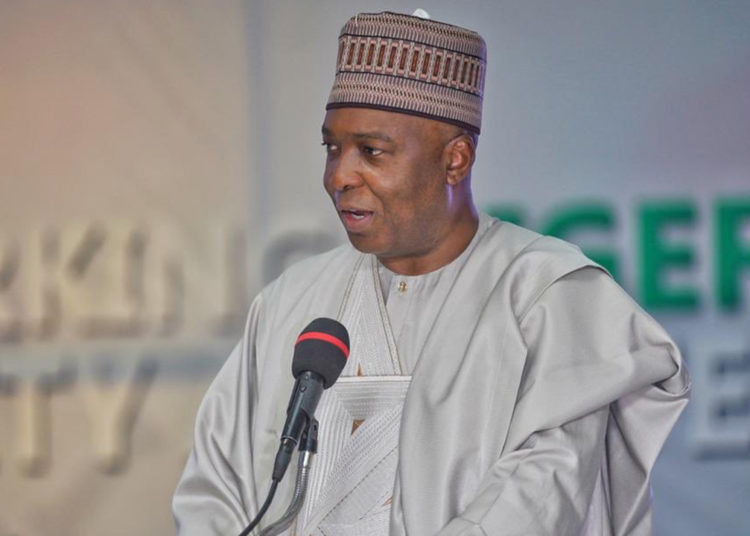
A former president of the Senate, Abubakar Bukola Saraki, in this interview with LEADERSHIP, speaks on the crisis in the Peoples Democratic Party (PDP), the state of the National Assembly and the quest for state police.
You have served as chairman of the PDP reconciliation committee on several occasions. Why has it been difficult for the PDP to get its house in order since it lost power at the centre? And what did you find to be the biggest obstacle to its unity?
It is even more challenging when you’re not in a ruling party. Command and control is not as easy, put it that way. People with different views and hierarchies are the issue. So, you are always contending with people with different personalities, have differences, and nobody is listening to anybody. In the sense that when you’re in a ruling party, you always have a president, or, like in the days when the PDP was in power, it was easier to reconcile differences. But when you are in opposition, you really have to give and take, because nobody is superior to anyone else. You can’t just, as a fiat, say, well, the villa has said the party should do this, and everybody falls in line. But once you’re in an opposition party with a lot of people who have different positions, former governors, former senators, and former presidents of the senate, former vice presidents, and former presidents. So, it takes a lot, and that’s where sacrifice comes into it. People have different egos, but you have to do your best to put the party, the nation, and the country’s democracy first. And in doing that, there are challenges all the time.
Advertisement
Unfortunately, as much as the ruling party would like us to believe that all this we are seeing is just within our own party, we all know that things are happening outside the party that are influencing what is happening within it. So, let’s not be deceived by that. But, you know, that is part of the environment we find ourselves in today. We must take that into account and seek solutions. We have been battling that since after the elections, and the efforts some of us have made have brought us to this point.
If you realise, until now, PDP was the only opposition party that had not reached the stage of factional splitting, when there were two different groups. There were issues, but we always tried to contain it until, unfortunately, the event that led to Ibadan, in which some of us screamed and shouted, “Don’t go this route, because we are going this route. But up to then, we had contained it. There were some meetings we had to contain to keep that under control. Unfortunately, that happened.
So, we’re now trying to pull back from this. We’ve done that. As we all know, courts are not where you resolve political issues. You still have to come back to the table and find a solution. So, it has been difficult, but it’s normal for opposition parties, especially larger ones. And then when you have a ruling party that’s also getting too involved in our own party. So, you should expect that. It’s part of the challenges that we’ve been fighting. But the incentive, or what keeps us going, is that, in reality, when you go down to the grassroots today, PDP is a household name. It’s a party that’s in people’s minds. Go to villages, go to towns, across.
It’s not something you can wipe out. Crises like this cannot wipe out the party. That’s why sometimes you hear commentators, not you, some say PDP is dead. When you go around the states, you still find today that the main opposition party is the PDP. So, I believe that many of us, as leaders, have the responsibility to find a solution, no matter how difficult it appears. And I think that we have done so well up to this Ibadan Convention. It wasn’t easy, but we’re keeping it together.
Unfortunately, we made mistakes there, and that led us to the courts. Now we have to come out of the courts, go back to the table. I think that’s what we want to do over the next few days, which will lead us to a convention. Hopefully, post-convention, we’ll be able to come together and do the most important thing we need to do, which is what Nigerians want to see: that PDP is on the ballot paper in 2027.
You highlighted the ego of issues among some leaders. And the two major figures in the party right now, the FCT Minister and the Governor of Oyo State, have been having ego at each other. How is the party resolving this at the moment?
Let us talk about the positions of things. Let’s leave the personal issues. What is the position of things? The position of things today, as I said, the majority of people who are PDP members, PDP lovers, members who want to aspire under PDP, Nigerians who have seen the value when PDP was in power, is that PDP must be on the ballot paper in the 2027 elections. All efforts must be made so that people can seek elected positions in the PDP. And I’m happy to say that, despite whatever side anybody finds themselves in these disagreements, everybody has resolved that that is a number one priority for all of us, wherever you find yourself. Whether you are Governor Seyi Makinde, Governor Bala, the FCT Minister, or anyone, or those who are neither, the number one priority is that the PDP must be able to field candidates for the 2027 election.
And anything that will harm that, or make that not possible, we need to drop it and resolve it. That’s where we are. And that’s not easy to get to that position. And we hope we can maintain that position and take us through. Now, the processes that take you there are very, very clear. We must have a national working committee that can do that. If you remember, some of us had advised that, to prevent this crisis, let us have a caretaker committee. Post primaries, post-election 2027, when the temperatures have cooled, and the issues are fewer, it’s easier for us to hold a convention. But that’s past now, we didn’t do that.
Now, where we are, the courts have ruled, pretty much nullifying a convention, creating an opportunity for the PDP to hold another convention. And that’s the only pathway to electing an NWC. The question now is for everybody to key in on that. Concessions probably made here and there, you know, that people have a sense of belonging. But whatever that sense of belonging is, it must align with, or queue behind, the number one objective: that PDP must present candidates for the 2027 election.
So the discussion now is: let’s all agree that’s our primary objective. Secondly, how do we ensure that we accommodate as many people as possible who key into that project? How do we pacify those who need to be pacified? How do we ensure that those who have won in court can also be magnanimous about it, and that we’ll see that as a victory? Victory is only when we have resolved all those issues, and there is no more litigation.
So that takes us to the only other process, a convention coming up at the end of the week. I hope that will be successful. And that sees INEC present because they are regulators, and that is part of where we’ll get the legality and the authenticity of that process. Seeing INEC there, then we know that we now have a party that can conduct primaries for our candidates who want to contest the election. If we can achieve that, the message to the public is that PDP is back on track in the field of candidates.
One of the reasons we’ve been bleeding and losing a lot of people is the anxiety among people who want to contest the election, who say that, with this crisis, I don’t think you’ll be able to be in a position to present a candidate. But if we can do those things we’re saying we’re doing, we won’t continue to provide litigation that questions the authenticity of who emerges on a Sunday or Monday as the NWC. INEC is there; we have a convention, and those people now have the authority to conduct primaries. Then, PDP is good from that perspective. It is. It’s the only pathway available today. That’s the reality.
Do you think the Abuja national convention is one of the pathways to resolving the PDP crisis?
It’s the only pathway as we are today. What we have to do is accept that there is another pathway. Today, there’s no other pathway available for us to do so, having NWC that meets the Electoral Act and INEC guidelines and ensures that the candidates who emerge are acceptable by law. Now, what are the interests of those who are not satisfying people’s interests, because clearly, there are some people before them who thought they were chairmen, secretaries, assistant secretaries, auditors, who have now lost out. But because we are part of one family, nobody should be seen to have lost out, per se. Losing out means we cannot fill the candidates; then we have lost out. But because it is one family member who is now the secretary or the chairman, rather than another, we should not see that as anyone losing out. If that enables us to fill the positions, we are all winners. That’s the mindset that we’re trying to push to sell to everybody in PDP. If we can do that, I think that we’ve definitely gone far and made a lot happen.
You sound optimistic. But there are, of course, concerns that the convention may aggravate or deepen the crisis in PDP.
The biggest thought is for any truly committed member of PDP, any true lover of the PDP, anybody that believes that PDP is an option by which he can exercise his wish or desire to participate and contest for election, or also believes that PDP provides a platform by which a better state, a better country would be that the primary election is, look, do whatever you’re going to do. You leaders of PDP, you members of PDP, you who sit down and decide this, do all that must be done and make sure that PDP fields candidates in 2027. That’s my major, and anybody who truly loves PDP, that’s now.
After that comes interest, personal interest. Personal interest of, well, you know, I won an election in Ibadan, and I was elected as the publicity secretary. Now I no longer have that position. Where am I? That’s where sacrifices come into place. Now, if there was another option available that could ensure that we keep within, because the time is not on our side, which is another problem, if time were on our side, we could have gone through other options. We could say we have time on our side. Fight on, because we have time. Keep on fighting, and let’s see what happens, even at the Supreme Court, because time is not on our side. And there’s no point for you to say, you know, you win this battle but lose the war. What is the war? The war is: PDP must be on that platform and on that ballot paper in 2027.
So, since our main objective is that, everything else must centre around it, and that is the appeal.
When you say that things will go smoothly, the only thing that will not go smoothly is for individuals to accept that there’s a time, even in political play, that you must just put the bigger picture ahead of your own picture. You know, it doesn’t mean you’re smaller. It doesn’t mean you are not right. It doesn’t mean, but when you look at the issues ahead and say to us, okay, if our interest is for PDP to be on that ballot paper, if it means that I have to sacrifice my position or have to fight for what I’m fighting for, I can do that because there can be other positions later in life, later down the line for other positions. Still, history will not be fair if they were part of what prevented the PDP from being on the ballot paper. Don’t let us look at it as Mr X won or Mr B lost in the exercise. That is not the approach, and I think that’s what we’re trying to do.
Are you optimistic that both sides of the PDP divide will participate in that convention now?
I’m hoping that we might not get 100% of both sides. I’m hoping we will get 100% on one side and 50-60% on the other. We should hopefully get people coming together. And when they come together, I don’t think we will have the issue of division anymore. Because what are we all fighting for? As I said in my opening line, the only thing we should be fighting for, whichever side of the party you think you’re on, is that PDP should be on the ballot paper. That’s what all of us should be fighting for. Everything else is secondary. Whether I’m the auditor, you are the auditor, I’m the chairman, you are the chairman, it should be secondary. Without a political platform where people can contest, what do you need a political platform for?
Some PDP leaders have openly declared support for President Tinubu in 2027. What’s your position on this?
Well, you have been in this political game long enough to know what people say, what they do, and when they finally do. So, is the election tomorrow? It’s not tomorrow. So, that’s not my concern now, because people say what they want. What is important? We let ourselves get to this position. Those of you who remember, before the Ibadan Convention, there was a big frenzy. People were getting excited about what PDP was going to do. If we don’t clean our house and make our party viable for credible, serious contenders. So, this process that I’m doing is part of preparing the party for the election.
You know, politicians, what they say is not what they do. Elections are in January next year. We are in March 2026. That’s a long time to go. Please don’t worry yourself at all. Let’s take it step by step. First, let us get a party. If you come out of that convention this weekend and people now see because, for example, I give my state, for example, they go to a lot of my people in my state and say, what are you doing in PDP? You people are not going to have a party. Saraki is deceiving you. Come to our party. There will be no party. So, you’ll be surprised. A lot of people are confused. They believe it. Do you get what I’m saying?
So, when people now say, PDP will not even have any candidate. People will believe it because of what they’re seeing happening today. If we can cross that line, Insha Allah, we’ll have stability. You’ll begin to see people start coming back in. They will now be seeing strong aspirants and strong contenders at all levels.
There is a rising feeling that PDP may not be able to regain national relevance and may ultimately fade away like AD and ANPP, considering its loss of 11 PDP governors to the APC in the space of one year. What is your take on this?
No, not at all. Not at all, not at all. You see, many people are aware of what is happening in Abuja. Go to the states, send people to the states, and let them do a sample of where the majority of Nigerians are. As far as most Nigerians are concerned, there are only two parties in Nigeria. Despite all the noise I hear about PDP, if PDP truly did not have that strong foundation, it should not even exist in most states by now. But if you go to many states today, you’ll still find that PDP is very, very strong. Yes, there’s been a lot of this, but it has not helped us. I mean, I’ll be the first to admit it. It has not helped anybody. But at the end of the day, people sometimes ask themselves, ‘Why am I still staying with PDP?’ Because they say to themselves, when the PDP was in government, they could see some of the benefits they have now. So they will still give PDP a chance.
Now, I am confident that once we get through this period of time and can, particularly, have PDP and candidates, you will see people coming back. I always tell people, I’ve said it before, that the APC bus is overloaded. It is overloaded. It is not the first time a political party has said it has 34 or 30-something states. It’s definitely overloaded. There’s no doubt about it. And you’re long in this game to know that there are going to be issues.
Not because they don’t know how to manage it. There are bound to be issues. Whether you’re in PDP, it’s the same Nigerians. Same attitude. Same approaches to politics. I’m sure in that party (APC), in one place now, you might have 20 people looking for a senate seat. 40 people are seeking a House of Representatives seat, and 10 are seeking a governor’s seat. How do they want to manage those crises? So they will have their own issues. I’m not concerned about what it looks like now. You understand that? What I’m concerned about is getting my own house in order. The election is not tomorrow. We have time, let’s see what happens.
Opposition leaders have alleged that Nigeria is drifting towards a one-party system under the APC. Do you share this concern?
No. That is not my view. It’s not acceptable, and I’ve made it very clear that that is not true. If you remember, it was sometime last year, some of us made clear statements about that. And I think even the APC pulled back on that and came to say that that is not their intention. Whether their statement was sincere or not, I can assure you that, for some of us, it was not their intention. Look, we all have options. I mean, as you know, some of us were part of those who started APC. So it’s not a place that we are not familiar with. So if I tell you tomorrow that someone wants to go there, it’s not that. But it’s the choices that we have made.
Look, we are staying at this party. We will see it through to the end. We believe this is just a phase. We should not view the party’s activity solely around elections. There’s more to the party than just elections. We must have a very vibrant and active opposition. Democracy is not defined by one party, just the ruling party. Before you have a democratic environment, you must have a ruling party and an opposition.
So, forget the issue of a one-party country. It’s not tangible. And a lot of us will work against that.
You have friends in APC and ADC. Have you been approached to join either of these parties?
With all humility, of course, you get that. Some in banters said, “Come back home. This is the home you built.” Some say, “Oh, we’ve always been passengers on a journey. We’re going to this place now. I’ve been approached. But I’ve decided to stay with PDP.
Some reason that the ruling party may have a hand in the PDP crisis. What do you have to say about that?
Well, look, you can’t put all the blame on just the ruling party. The ruling party is like someone actively going to market, trying to convince people to join. Whether it’s a fair game is a different debate. Some of us say it’s not a fair game because we must not have a one-party state. It’s part of our democracy that we must have a multi-party system. So even if I’m in the ruling party and you say you want to come, there’s a point where I say, look, we still must have opposition.
My personal opinion is no. The ruling party should encourage us to have a vibrant democracy. And democracy is not democracy until you have a ruling party and opposition. If you don’t have opposition, you don’t have democracy. That’s my view. And a country like Nigeria should serve as an example for others to follow. And definitely, we must have a political environment with a ruling party and an opposition. But I think the opposition reflects what I believe is the character of the people leading us. Let’s say it as it is. Character in the sense that people must stand for something. You must believe in something and stand for something. That’s why I laugh when people say, ‘ You have been very quiet. ‘ Maybe you’re even closer to APC. I said, by my antecedents, what I’ve stood for in my politics over the years: most people know that if I have a view about something, I stand strong on it. And I take whatever I take in the person I stand for. I’m not someone who tells you one thing in the afternoon and another in the evening.
So I find it sometimes difficult. I commented when the former vice presidential candidate moved to the APC. He is my friend, but having been a ticket holder of an opposition party, how do you move to the ruling party? So when you talk about some of these governors, you ask yourself sometimes, how? Of course, there are some you can’t blame, because the PDP crisis got to a certain stage. For example, I give the case of Osun State. Osun is one of the states where he (the governor) had no choice. He didn’t want to go, but at that point in the crisis, PDP could not field candidates in Osun and Ekiti. Could you look at the reasons why some others are leaving? So when you say you blame the ruling party, I think we should also look inwards and ask if, truly, we have been fair to people who voted for us? Are we standing on what we believe?
I know there are challenging times. It’s not easy to speak the truth to power or to stand. I mean, I’ve experienced it. And I know it takes a lot for you to make those choices. It’s always easier to take the easier option. The option, of course, is to be in government. The government is nice to you and your friends. It’s not easy, either as a governor or as anybody, to take opposition. So when you see the result of that, the issues are on both sides. The issues are on the part of the ruling party, you know, ensuring that they want to recruit as many people as possible. Then, on the part of those who cannot stand and say, I will take my destiny in my own hands and I will stand on an opposition platform.
What is PDP doing to enlighten, to mobilise people, let them know the real situation as you highlighted?
This is part of what these kinds of discussions I’m having, and others the leaders are having, are about: trying to keep explaining to people. But I believe many people who left, are leaving, or left the PDP genuinely did so because of their fear that the PDP will not be on the ballot paper in 2027. I’ll put them in different categories. Those who left genuinely because of that, and those who, I believe, will come back after Sunday and Monday, we will come back after we do a convention. They will see INEC, which pretty much endorses what we have done. We have an NWC that comes out of that convention, and it is now fit to conduct our primaries for candidates. Then aspirants can go and collect the PDP’s form and aspire to be a member of the House of Assembly, governor, president, whatever. So that’s one group of people. For example, that chap in Nasarawa, David Emmanuel Ombugadu, has come back. Then the comments by some party that, whatever the differences, we all believe the most important thing is that PDP must be on the ballot paper. Take my own state, for example, they just finished a meeting two days ago. All the people who want to contest sent a message: look, our first choice is to contest on the PDP. So, for people like that, if they see a resolution of the process, which we will see after the convention, and it goes through smoothly, the people will have confidence that they can go and buy nomination forms on the PDP platform.
Even those who have left. They just bolted out because they felt they could not contest in the party. Now, where they have landed, there are problems. Why do I say that? In ADC, they have now started their own litigation. Nobody knows where that is going to end. So, you thought there were uncertainties in PDP. You have now reached the ADC, and they want to start their own process, where a chairmanship dispute is on, and you don’t know where that’s going to land. So, someone like you will be thinking, ” Look, since they have resolved their own issues, I’d better go back to where I can contest.”
Then there’s the third group. There are those in the APC who know that, with this new Electoral Act, they, too, are boxed in. Under the Electoral Act, it says that once you are in a party, you contest the primary of that party. If you lose or are edged out, you cannot go to another party. So, for example, I won’t even go to the Senate; there are some people in the House of Representatives who, on their own, are so popular that they can win elections on any platform. So, some people like that now, maybe because they don’t get on with the governor of that state, who wants to make his PA a member of the House of Representatives. Now, you are a sitting member of the House of Reps in that party, and you believe that, well, if it’s left to consensus, you definitely won’t be chosen. People like that are now starting to look at other options. Before, PDP was not an option again.
Some were promised an automatic ticket upon arrival. They will get there now and find out that what they say in Abuja and what they say in the state might not be the same thing. Now, again, for those, you have to start thinking. So, the dynamics are going to change. Then, for those observers who are looking at where I vote and have been told that our PDP is gone, now they begin to see a PDP convention, people contesting, people like that. I hope we start coming back to that. But definitely, we did a lot of harm to ourselves and lost a lot of time. But luckily, as I said, the election is not tomorrow. The election is still months ahead. Other parties will still face their own challenges. Hopefully, we’ve had our challenges early. What we need to do now is, hopefully, have a full reconciliation, where we allow the past to be the past and create a platform for people to contest elections.
You mentioned the Electoral Act. What are your observations about the way that the National Assembly passed it?
Usually, I try as much as possible not to speak about an institution that I’ve been to, and I’ve put a lot into that institution. It’s very close to my heart because I really believe that the parliament, or the legislative arm of the government, is what democracies are about. Unfortunately, where we find ourselves in that institution today, it’s quite unfortunate. I think we need to really reset, and the National Assembly needs to play the role that it has to play.
But even this: when in the 8th National Assembly, we attempted to amend the Electoral Act. One of the key issues I still think is fundamental in the electoral process is the transmission of results. In the 8th Senate, we passed it. We saw it as a danger; it was a game-changer in the electoral process, and we passed it in the 8th Senate. In the Senate, we said ‘SHALL’, in the House, they said ‘MAY BE’.
We were able to do it in the Senate, but then the House did not go with us, and when they went to conference, they had the day. That’s why at that time, it remained as may, or the powers were given to INEC to decide. This time around, there was another opportunity. This time, it was the House that said SHALL. It came to the Senate, they said MAY.
My concern is that our institutions are just too weak. Whether it is INEC, the National Assembly, or the judiciary, these institutions are too weak. And we need to strengthen these institutions if we truly want a strong democratic system. One of those is holding an election that is seen as credible. The moment we can do that, the rest will begin to fall in line.
... REVEALED! Why PDP Is In Crisis – Saraki ... Sportify Post.