
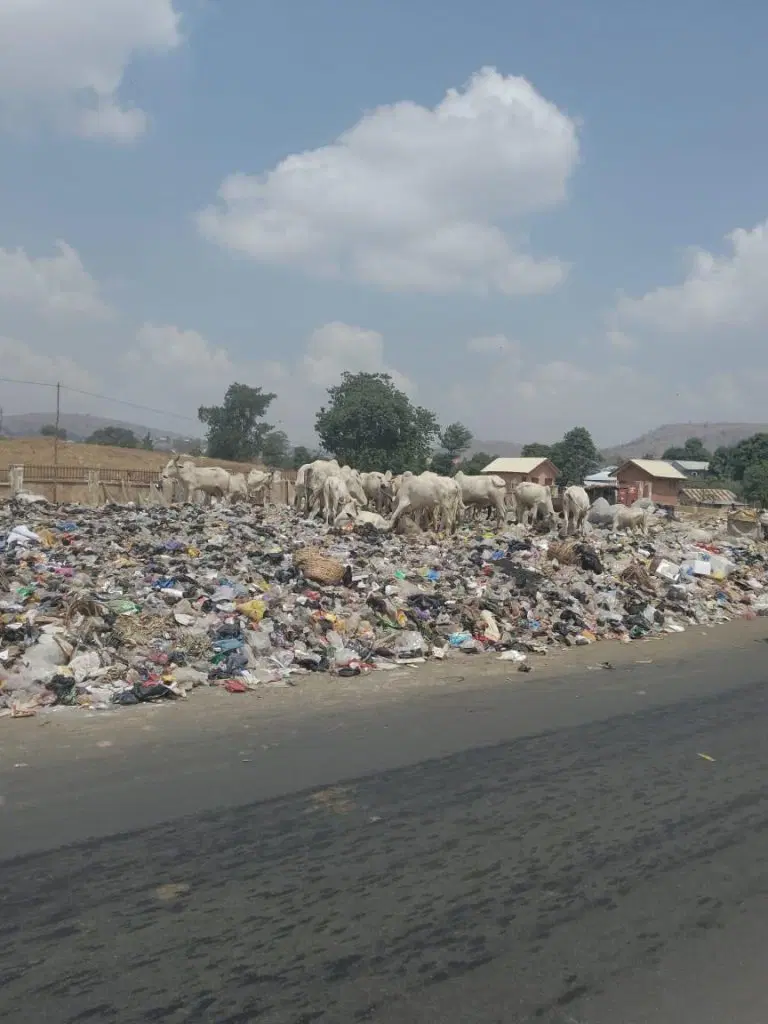
Residents of Karu and neighbouring satellite communities on the outskirts of Abuja say they are facing worsening environmental and health conditions due to unchecked refuse dumping and irregular waste evacuation, raising concerns about a looming sanitation crisis.
Across communities such as Nyanya, Kurudu, Mararaba and Kpegyi, heaps of decomposing waste now line major roads and residential streets. Residents say the persistent stench, overflowing dumpsites and the presence of flies and scavenging animals have become part of daily life in areas largely inhabited by low-income earners unable to afford housing in the city centre.
Many residents attribute the situation to weak enforcement against illegal dumping and irregular waste collection. Some allege that refuse contractors often offload waste in these communities at night, worsening an already fragile sanitation system.
For residents living close to roadside dumpsites, the impact is immediate. A trader in Nyanya, Mrs. Comfort Eze, said the odour from nearby refuse heaps makes breathing difficult and disrupts sleep at night. She added that her children frequently suffer from malaria, cough and skin infections, increasing the family’s medical expenses.
Business owners say the situation is also affecting their livelihoods. A mechanic in Karu, Mr. Sunday Audu, said customers often avoid his workshop because of the smell from a nearby dumpsite, while food vendors and fruit sellers in Nyanya and Kurudu reported losing customers due to flies and poor environmental conditions.
Children in affected communities are also exposed to risks, as many play near dumpsites due to the absence of safe recreational spaces. Parents say injuries from broken glass and frequent illnesses among children have become common occurrences.
Health professionals warn that prolonged exposure to unmanaged waste can lead to serious health complications. Public health physician Dr. Amina Sule described living near refuse dumps as a “silent emergency,” noting that gases released from decomposing waste could contribute to respiratory illnesses such as asthma and bronchitis. General practitioner Dr. Chinedu Okafor also warned that rodents, flies and mosquitoes around dumpsites increase the risk of malaria, typhoid, cholera and diarrhoeal diseases, particularly during the rainy season when runoff may contaminate water sources.
Officials of the Abuja Environmental Protection Board (AEPB) said responsibility for refuse evacuation in the affected satellite towns does not fall within their mandate. According to the agency’s spokesperson, Janet Peni, the board is responsible for waste management within the Federal Capital City, while a separate satellite town agency oversees surrounding communities.
Residents, however, argue that institutional gaps should not come at the expense of their health and safety. They are calling for improved waste collection services, stricter enforcement against illegal dumping and better coordination among relevant authorities to address what they describe as a growing environmental emergency.
Meanwhile, the Minister of the Federal Capital Territory, Nyesom Wike, has warned refuse contractors against poor evacuation practices and urged residents to report non-compliant operators through dedicated complaint channels recently introduced by the FCT Administration.