
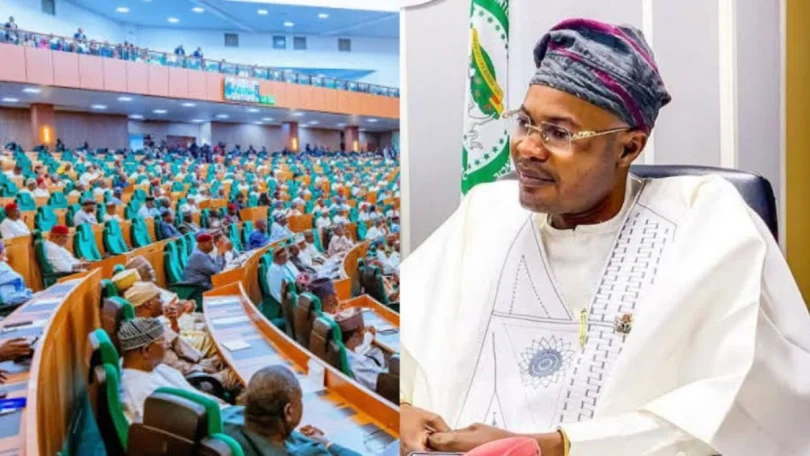
The House of Representatives Ad-hoc Committee investigating the controversial Presidential Foreign Investment Promotion Council (PFIPC) has fixed a new date for the appearance of National Security Adviser (NSA), Nuhu Ribadu, Minister of State for Foreign Affairs, Bianca Odumegwu-Ojukwu, and other key government officials.
The hearing, which was expected to hold on Thursday, failed to take place despite earlier arrangements.
Information made available to Politics Nigeria indicates that the committee has now scheduled a fresh session for Friday at the National Assembly complex in Abuja.
According to a notice issued by the committee and circulated to parliamentary correspondents late Thursday night, invited stakeholders are expected to appear before the lawmakers at Hearing Room 028 by 10:30 a.m.
“The House Ad-hoc Committee to Investigate the Unestablished Presidential Foreign Investment Promotion Council (PFIPC) in the Federal Budget Framework will meet with invited stakeholders.
Date: Friday, 24 July 2026.
Venue: 028. Time: 10:30,” the invitation stated.
The reason for the sudden postponement was not officially disclosed. However, developments at the National Assembly suggest it may have been linked to the prolonged plenary session held by the House of Representatives on Thursday.
The investigative hearing had initially been fixed for noon before it was later shifted to 2 p.m. Despite the adjustment, the meeting did not commence. Several hours after the scheduled time, there were no indications that the session would hold.
Officials expected to appear before the panel, including Ribadu and Odumegwu-Ojukwu, were not seen at the venue. It also remained unclear whether representatives had been sent on their behalf as no formal introductions were made.
Members of the committee, including its chairman, Hon. Yusuf Gagdi, were also absent from the hearing room, while only a few secretariat staff were observed around the venue.
The investigation centres on the controversial ‘fake’ PFIPC and how the council found its way into the Federal Government’s 2026 budget framework despite questions surrounding its legal existence and operational status.
The House committee had summoned the NSA and the Foreign Affairs Minister following revelations made earlier in the week by the Permanent Secretary of the Ministry of Foreign Affairs, Ambassador Dunoma Ahmed.
Appearing before the committee, Ahmed disclosed that the Ministry never conducted any official business with the PFIPC or its purported Director-General, Prince Adeniyi Adeyemi.
According to him, concerns over the authenticity of the council led the Ministry to seek clarification from the Office of the National Security Adviser in October 2025.
Ahmed told lawmakers that the Ministry rejected multiple requests allegedly submitted by the PFIPC after discovering inconsistencies in the documents presented.
“It is pertinent to state that, having discovered the discrepancies in the requests submitted by Prince Adeyemi, the Ministry, on 16 October 2025, wrote a letter to the Office of the National Security Adviser (ONSA), requesting clarification on the status of Prince Adeyemi Adeniyi Matthew as Director-General of the PFIPC,” he said.
He further revealed that the Office of the National Security Adviser later informed the Ministry that investigations conducted with the Office of the Secretary to the Government of the Federation and the Office of the Chief of Staff to the President showed that the individual was unknown to the Federal Government.
“In response, the ONSA reverted to the Ministry on 26 November 2025, indicating that the responses it received from the Office of the Secretary to the Government of the Federation (OSGF) and Chief of Staff (CoS) to Mr President revealed that Prince Adeniyi Adeyemi Mathew is unknown to any office of the Federal Government,” Ahmed stated.
The disclosure raised concern among members of the committee, who questioned what actions were taken after the discovery.
Committee Chairman, Yusuf Gagdi, said lawmakers were interested in understanding the response of the country security architecture after determining that both the council and its alleged Director-General were not recognised by the government.
“The NSA responded that it is an illegal agency. What has the Office of the National Security Adviser done as a security institution after that discovery? If they had discovered that the agency did not exist, appropriate action ought to have been taken. They should come before this Committee and explain the actions they have taken,” Gagdi said.
The committee also expressed displeasure over what it described as the poor response of some Ministries, Departments and Agencies (MDAs) to its invitations.
Lawmakers specifically criticised the absence of senior government officials who failed to appear personally before the panel despite being invited.
The committee warned that invitations issued by the House of Representatives are backed by constitutional powers and must be treated as a legal obligation.
“They are issued pursuant to the constitutional powers vested in the National Assembly under Sections 88 and 89 of the Constitution of the Federal Republic of Nigeria, 1999 (as amended). Compliance is therefore a legal obligation, not an act of courtesy,” the panel stated.
Furthermore, it warned that any agency or official who ignores future invitations without valid justification could face sanctions and other measures available under the law.