
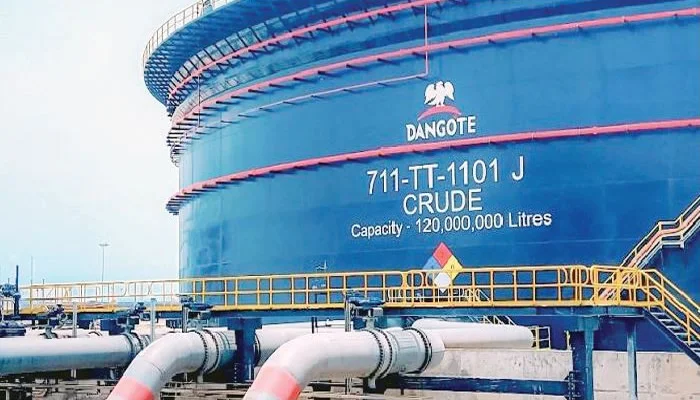
Petroleum importers and marketers in Nigeria are facing heavy financial losses following an aggressive price reduction by the Dangote Petroleum Refinery, which has triggered an intense price war in the downstream oil sector.
Industry sources estimate that oil marketers are collectively losing as much as ₦102.48 billion monthly as they struggle to compete with Dangote Refinery’s sharply reduced petrol prices. The refinery recently slashed its gantry price from ₦828 per litre to ₦699 per litre, a move that has significantly disrupted the market and forced other players to cut prices to remain competitive.
Based on Nigeria’s estimated daily petrol consumption of about 50 million litres, importers are said to supply roughly 26.48 million litres daily. With a price differential of ₦129 per litre between the old import cost and the new market price, importers are reportedly incurring daily losses of approximately ₦3.41 billion, translating to ₦102.48 billion over a 30-day period.
Private fuel depots in Lagos, Nigeria’s major fuel distribution hub, have also responded by reducing prices by about 14 per cent. In several cases, depot prices have fallen from around ₦828 per litre to between ₦700 and ₦710 per litre. While the reductions have benefited consumers, they have severely eroded marketers’ margins, weakened sales volumes and raised the risk of excess stock across the supply chain.
READ ALSO: Dangote refinery cuts petrol gantry price to N699 in fresh market shake-up
Importers with petrol cargoes already purchased and yet to be discharged are among the hardest hit. Many of these cargoes were procured at significantly higher prices and are now difficult to sell without incurring steep losses. An industry source described the situation as “grim”, noting that marketers with imported stock face uncertain prospects in the current market environment.
Retail marketers are equally affected, as many filling stations are compelled to sell petrol below cost. Much of their existing stock was bought at around ₦828 per litre, and selling at the new lower pump prices has resulted in substantial losses. Industry estimates suggest that retail marketers alone may have incurred losses exceeding ₦80 billion nationwide.
Marketers have described the sudden ₦129 per litre price reduction as a “big shock”, saying the abrupt nature of the change has made it difficult to adjust operations, pricing strategies and cash flow planning. Filling stations with large volumes of high-cost stock are particularly exposed.
In response to the mounting losses, some industry stakeholders have called on Dangote Refinery to consider compensatory measures, such as discounts on future purchases, to cushion the impact on marketers. They argue that without some form of relief, many operators may continue to “bleed financially” as they sell at reduced rates simply to stay competitive.
The unfolding price war underscores the growing influence of domestic refining on Nigeria’s fuel market, while also highlighting the short-term pain faced by import-dependent marketers adjusting to a rapidly changing pricing landscape.