
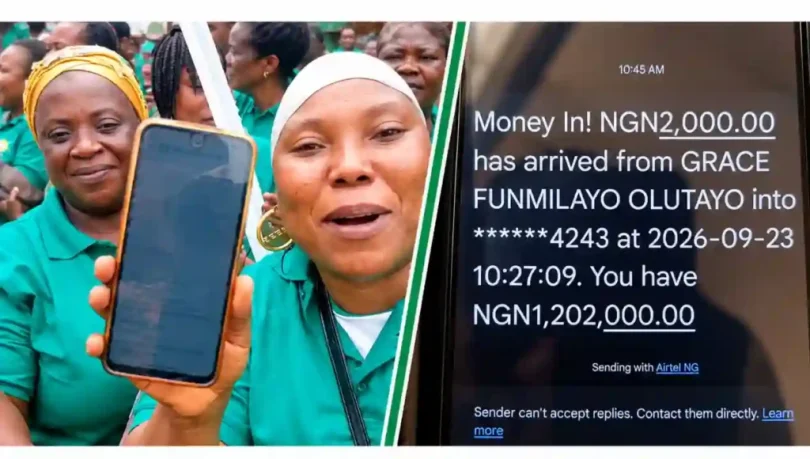
Women in Ogun State have begun benefiting from a ₦6bn Community Investment Fund aimed at helping them expand businesses, improve household livelihoods and take part more actively in economic activities.
The Ogun State Government, in partnership with the Federal Government and the World Bank, commenced the disbursement of the fund to 3,855 Women Affinity Groups across four local government areas under the Nigeria for Women Programme Scale-Up.
The fund was formally launched in Ijebu-Ode, where Governor Dapo Abiodun, represented by the immediate past Commissioner for Women Affairs and Social Development, Motunrayo Adeleye, said the intervention was designed to help women move from subsistence activities to sustainable enterprises.
Abiodun said the beneficiary groups had met key requirements, including regular participation, savings, internal lending, opening bank accounts and preparing Micro-Investment Plans.
He disclosed that the women had collectively saved ₦2.6bn in seven months, while loans accessed through the groups had exceeded ₦4bn.
According to him, the figures showed the financial discipline and commitment developed by the Women Affinity Groups, known as WAGs, under the programme.
The governor, however, clarified that the ₦6bn Community Investment Fund, or CIF, was not an outright grant. He said it was a sustainable revolving financing facility intended to provide capital for establishing and expanding businesses, creating employment and improving household welfare.
He explained that the intervention was an extension of the Nigeria for Women Project, which began in Ogun in December 2020 after the World Bank and Federal Government signed the project agreement in 2018.
The governor said the parent project established 3,792 WAGs across 1,003 communities in Odeda, Ikenne, Ijebu North-East and Yewa North local government areas. He added that 368 Ward Facilitators were trained and deployed, while 67,094 women received individual grants in April 2022.
The Scale-Up phase has since expanded to seven local government areas: Ifo, Ado-Odo/Ota, Ijebu-Ode, Sagamu, Abeokuta North, Ipokia and Remo North.
Abiodun said 5,394 WAGs had been formed under the Scale-Up phase, reaching 124,062 women as of September 21, 2026. The programme has also covered 3,489 communities and trained 664 Ward Facilitators.
He added that about 26 states had visited Ogun to study its model, while the World Bank had adopted the state as a training hub.
The governor said the WAG model was not limited to access to finance. It also included financial literacy, savings, responsible borrowing, collective accountability, business and entrepreneurial skills, gender awareness and life skills.
Beneficiaries were also being connected to opportunities involving health insurance, climate adaptation, strategic partnerships and National Identification Number enrolment.
The governor said the programme was therefore helping women build businesses while developing financial discipline and economic resilience. He reaffirmed his administration’s commitment to providing policy support and working with partners to strengthen the intervention.
The Minister of Women Affairs, Hajiya Imaan Sulaiman-Ibrahim, represented by her Special Assistant on Technical Management, Princess Jummaih Idonije, described the initiative as a strategic economic intervention. She said expanding women’s economic opportunities remained important to inclusive national development.
The minister commended Ogun State for its implementation of the programme and urged beneficiaries to sustain the momentum and serve as examples to other WAGs in participating local government areas.
The World Bank Task Team Manager, Michael Ilesanmi, said the programme was helping to bridge financial access gaps for women while strengthening their ability to withstand economic pressures.
The Commissioner for Finance and Chief Economic Adviser to the Governor and Chairman of the Multi-Sectoral Committee of the NFWP-SU, Dapo Okubadejo, said the intervention showed the importance of investing deliberately in women.
Okubadejo, represented by the Permanent Secretary, Ministry of Women Affairs and Social Development, Adebimpe Obienu, said women played important roles as traders, farmers, processors, artisans, entrepreneurs and community builders.