
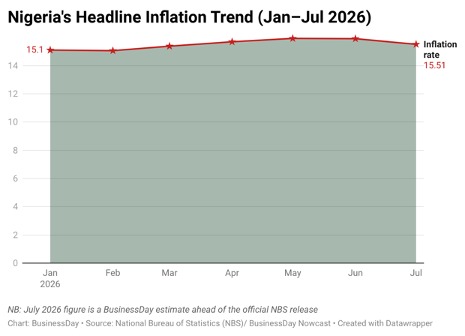
Nigeria’s inflation rate is expected to ease further in July, with BusinessDay’s latest inflation nowcast projecting headline inflation at 15.51 percent, down from 15.91 percent in June. If confirmed by the National Bureau of Statistics (NBS), the reading would extend the gradual disinflation that has followed the agency’s 2025 rebasing exercise, although households are unlikely to experience immediate relief as the overall price level remains significantly higher than in previous years.
BusinessDay’s July Inflation Nowcast estimates that headline inflation will decline by about 0.4 percentage points from June’s reading, suggesting that price pressures continue to moderate. The pace of disinflation, however, remains dependent on exchange-rate stability, food supply conditions and global commodity prices.
The nowcast was generated using an Autoregressive Integrated Moving Average with Exogenous Variables (ARIMAX) model. The model estimates monthly inflation by combining lagged inflation movements with changes in the official exchange rate, business activity measured by the Stanbic IBTC/S&P Global Purchasing Managers’ Index (PMI), the inflation rebasing dummy and an autoregressive component that captures inflation persistence. Business activity is included because stronger demand and improving business conditions often influence firms’ pricing decisions, making the PMI a useful leading indicator of inflation.
The model uses all available information up to June 2026 to estimate July inflation ahead of the NBS’s official release.
The projected moderation reflects improving macroeconomic stability and the fading effects of earlier shocks. Exchange-rate movements have become less disruptive than during the sharp depreciation that followed the foreign exchange reforms of 2023, reducing one of the biggest sources of inflationary pressure.
That assessment is broadly consistent with recent market developments. Ayo Teriba, chief executive officer of Economic Associates, said improved foreign exchange conditions and stronger market liquidity have created a more favourable environment for inflation moderation.
Analysts caution, however, that slower inflation should not be mistaken for low inflation. Nigeria continues to face structural challenges, including weak agricultural productivity, high logistics costs, energy constraints and persistent supply-chain inefficiencies that continue to keep prices elevated.
Muda Yusuf, chief executive officer of the Centre for the Promotion of Private Enterprise (CPPE), said external developments, particularly movements in global energy prices, remain an important risk to Nigeria’s inflation outlook.
“The recent geopolitical developments put some pressure on energy prices, which filtered into transportation and production costs,” he said, adding that inflation could still experience marginal movements depending on external conditions.
The July projection also comes at an important moment for monetary policy. The Central Bank of Nigeria has maintained one of the most aggressive tightening cycles in the country’s recent history, keeping the Monetary Policy Rate at elevated levels in an effort to stabilise inflation and support the naira.
A sustained decline in inflation would strengthen the case for a gradual shift towards monetary easing. Policymakers, however, are likely to remain cautious because inflation continues to be driven largely by supply-side constraints rather than excessive domestic demand.
For investors, moderating inflation improves the outlook for real returns on fixed-income assets. With domestic interest rates remaining well above inflation, Nigerian government securities continue to offer relatively attractive real yields compared with many emerging-market peers.
For households and businesses, however, the improvement is likely to be less noticeable. Inflation measures the rate at which prices increase, not the level of prices themselves. Food, transport, housing and energy costs therefore continue to rise even as inflation slows.
The July nowcast highlights an important transition in Nigeria’s inflation story. The economy appears to be moving beyond the most acute effects of exchange-rate adjustments and fuel subsidy reforms, but the next phase of disinflation will increasingly depend on structural improvements rather than cyclical factors.
Lower inflation over the long term will require higher agricultural productivity, improved electricity supply, stronger transport and logistics networks, and policies that reduce production costs across the economy.
The Central Bank’s tight monetary stance has likely contributed to moderating inflation by supporting exchange-rate stability and anchoring inflation expectations. Bringing inflation back to single digits, however, will depend less on interest rates than on the economy’s ability to produce, transport and distribute goods more efficiently. Those are reforms monetary policy alone cannot deliver.